
[Paper Review] Spin-orbit angle measurements for six southern transiting planets; New insights into the dynamical origins of hot Jupiters
This study measures spin-orbit angles for six southern transiting hot Jupiters using the Rossiter-McLaughlin effect via HARPS and CORALIE spectrographs, finding that 50% of hot Jupiters have spin-orbit angles >30°, strongly supporting dynamical origins like the Kozai mechanism over standard disc migration.
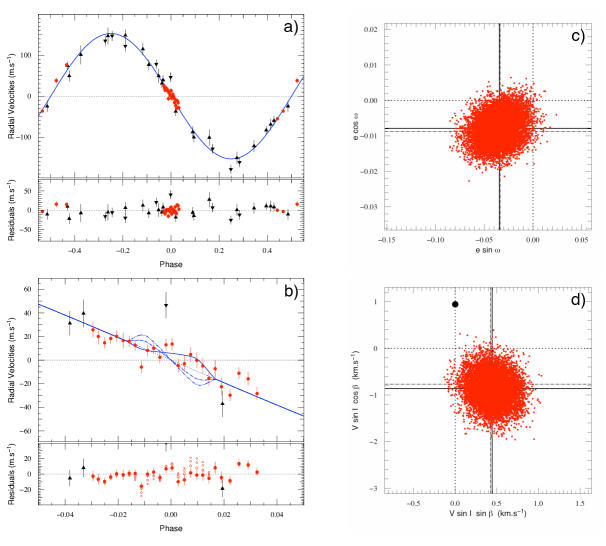
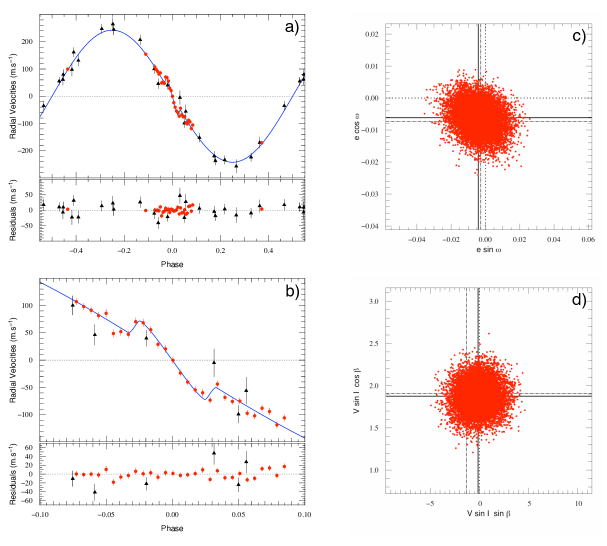
For transiting planets, the Rossiter-McLaughlin effect allows the measurement of the sky-projected angle beta between the stellar rotation axis and a planet's orbital axis. Using the HARPS spectrograph, we observed the Rossiter-McLaughlin effect for six transiting hot Jupiters found by the WASP consortium. We combine these with long term radial velocity measurements obtained with CORALIE. We found that three of our targets have a projected spin-orbit angle above 90 degrees: WASP-2b: beta = 153 (+11 -15), WASP-15b: beta = 139.6 (+5.2 -4.3) and WASP-17b: beta = 148.5 (+5.1 -4.2); the other three (WASP-4b, WASP-5b and WASP-18b) have angles compatible with 0 degrees. There is no dependence between the misaligned angle and planet mass nor with any other planetary parameter. All orbits are close to circular, with only one firm detection of eccentricity on WASP-18b with e = 0.00848 (+0.00085 -0.00095). No long term radial acceleration was detected for any of the targets. Combining all previous 20 measurements of beta and our six, we attempt to statistically determine the distribution of the real spin-orbit angle psi and find that between about 45 and 85 % of hot Jupiters have psi > 30 degrees. Observations and predictions using the Kozai mechanism match well. If these observational facts are confirmed in the future, we may then conclude that most hot Jupiters are formed from a dynamical and tidal origin without the necessity to use type I or II migration. At present, standard disc migration cannot explain the observations without invoking at least another additional process.
Motivation & Objective
- To measure the sky-projected spin-orbit angle β for six transiting hot Jupiters using high-resolution spectroscopy.
- To assess the correlation between spin-orbit misalignment and planetary parameters such as mass, eccentricity, and semi-major axis.
- To detect long-term radial velocity variations indicating additional companions in the systems.
- To statistically infer the true spin-orbit angle ψ from observed β values using a combined MCMC analysis of photometry and radial velocities.
- To evaluate the consistency of observed spin-orbit distributions with theoretical models like the Kozai mechanism and disc migration
Proposed method
- Utilized the Rossiter-McLaughlin effect observed with the HARPS spectrograph on the ESO 3.6 m telescope and CORALIE on the 1.2 m Euler Telescope at La Silla Observatory.
- Performed a joint fit of transit photometry and radial velocity data using a Markov Chain Monte Carlo (MCMC) method to derive β and uncertainties.
- Transformed observed β values into a distribution of true spin-orbit angles ψ using statistical modeling to account for projection effects.
- Combined the new six measurements with 20 prior measurements to construct a cumulative distribution of ψ for 26 hot Jupiters.
- Assessed the consistency of the observed ψ distribution with predictions from the Kozai mechanism and tidal circularization models.
- Searched for long-term radial velocity trends to detect additional massive bodies in the systems
Experimental results
Research questions
- RQ1What is the degree of alignment between the orbital axes of hot Jupiters and the spin axes of their host stars?
- RQ2Is there a correlation between spin-orbit misalignment and planetary mass, eccentricity, or semi-major axis?
- RQ3Do the observed spin-orbit angles support the Kozai mechanism or disc migration as the dominant formation pathway for hot Jupiters?
- RQ4Are there long-term radial velocity variations indicating the presence of additional companions in the systems?
- RQ5What fraction of hot Jupiters have true spin-orbit angles exceeding 30°, and how does this compare to theoretical expectations?
Key findings
- Three planets—WASP-2b, WASP-15b, and WASP-17b—exhibit significant spin-orbit misalignments with β = 153°⁺¹¹₋₁₅, 139.6°⁺⁵.²₋₄.₃, and 148.5°⁺⁵.¹₋₄.₂, respectively, indicating retrograde motion.
- The remaining three planets—WASP-4b, WASP-5b, and WASP-18b—have spin-orbit angles consistent with alignment (β ≈ 0°), with WASP-18b showing a small but firm eccentricity of e = 0.00848⁺⁰.⁰⁰⁰⁸⁵₋₀.⁰⁰⁰⁹⁵.
- No long-term radial velocity accelerations were detected, indicating no significant additional massive companions in the systems.
- When combined with 20 prior measurements, the cumulative distribution shows that between 45% and 85% of hot Jupiters have true spin-orbit angles ψ > 30°, indicating widespread misalignment.
- The observed spin-orbit distribution is consistent with theoretical models based on the Kozai mechanism followed by tidal circularization, suggesting a dynamical origin for most hot Jupiters.
- Standard disc migration models alone cannot explain the observed misalignments without invoking an additional dynamical process
Read this paper
Open the full text in the Nubint reader and ask about any passage as you read.
Read this paper on NubintThis review was generated by AI from the original paper. Please check the paper before citing it.