
[Paper Review] Strong coupling and single-photon nonlinearity in free-electron quantum optics
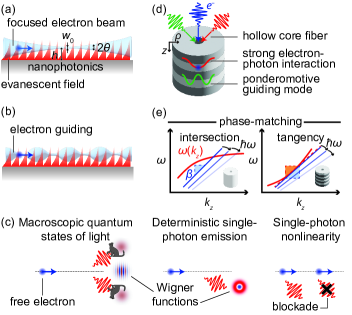
This paper proposes free-electron fibers—1D photonic systems that use ponderomotive guiding to suppress electron diffraction and enable long interaction lengths with guided photonic modes. The scheme achieves strong coupling ($|g_Q| \gtrsim 1$) and single-photon nonlinearities ($\delta_{\text{NL}} \sim 2\pi$), enabling deterministic single-photon emission and complex multimode dynamics.
The observation that free electrons can interact coherently with quantized electromagnetic fields and matter systems has led to a plethora of proposals leveraging the unique quantum properties of free electrons. At the heart of these proposals lies the assumption of a strong quantum interaction between a flying free electron and a photonic mode. However, existing schemes are intrinsically limited by electron diffraction, which puts an upper bound on the interaction length and therefore the quantum coupling strength. Here, we propose the use of "free-electron fibers'': effectively one-dimensional photonic systems where free electrons co-propagate with two guided modes. The first mode applies a ponderomotive trap to the free electron, effectively lifting the limitations due to electron diffraction. The second mode strongly couples to the guided free electron, with an enhanced coupling that is orders of magnitude larger than previous designs. Moreover, the extended interaction lengths enabled by our scheme allows for strong single-photon nonlinearities mediated by free electrons. We predict a few interesting observable quantum effects in our system, such as deterministic single-photon emission and complex, nonlinear multimode dynamics. Our proposal paves the way towards the realization of many anticipated effects in free-electron quantum optics, such as non-Gaussian light generation, deterministic single photon emission, and quantum gates controlled by free-electron--photon interactions.
Motivation & Objective
- To overcome the fundamental limit of electron diffraction that restricts interaction length and coupling strength in free-electron quantum optics.
- To enable strong quantum coupling between free electrons and photonic modes by extending interaction length through ponderomotive confinement.
- To achieve strong single-photon nonlinearities mediated by free electrons, essential for non-Gaussian light generation and deterministic quantum optics.
- To realize a platform for quantum information processing and sensing using free-electron–photon interactions with high coherence and tunability.
- To demonstrate feasibility of deterministic single-photon emission and complex nonlinear multimode dynamics in a dielectric waveguide structure.
Proposed method
- Designs a one-dimensional photonic system where free electrons co-propagate with two guided photonic modes: one for ponderomotive trapping and one for strong coupling.
- Uses a ponderomotive potential to counteract electron diffraction, effectively increasing the electron's mean free path and enabling long interaction lengths.
- Employs a tailored photonic mode structure to achieve enhanced coupling strength $|g_Q| \gtrsim 1$, entering the strong coupling regime.
- Models the electron-photon interaction using a Jaynes-Cummings-type Hamiltonian with a nonlinear recoil term to describe single-photon nonlinearity.
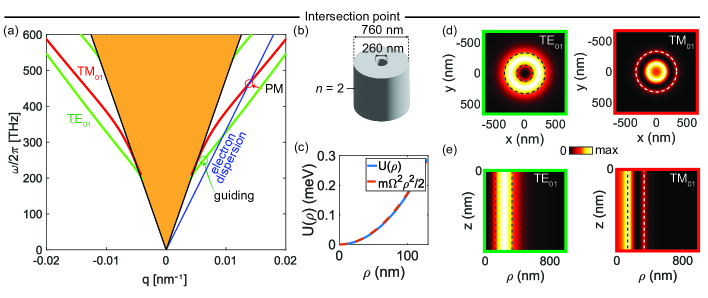
- Analyzes phase-matching conditions for both continuum modes (intersection and tangency points) and discrete cavity modes using Hermite-Gaussian mode expansions.
- Derives analytical expressions for photon emission amplitudes $\bar{s}_n(t)$ under different dispersion relations (linear and quadratic), optimizing the electron wavefunction width $\sigma$ for maximum coupling.
Experimental results
Research questions
- RQ1Can ponderomotive guiding in a photonic fiber structure overcome electron diffraction and enable long interaction lengths with photonic modes?
- RQ2What is the maximum achievable coupling strength $|g_Q|$ in a free-electron–photon system when diffraction is suppressed?
- RQ3Can strong single-photon nonlinearities ($\delta_{\text{NL}} \sim 2\pi$) be realized in a free-electron-based platform via quantum recoil effects?
- RQ4How does phase-matching to continuum or discrete cavity modes affect the dynamics of photon emission and nonlinear interaction?
- RQ5What observable quantum effects—such as deterministic single-photon emission or multimode entanglement—can emerge in this system?
Key findings
- The proposed free-electron fiber enables interaction lengths significantly longer than the diffraction limit, allowing for strong coupling with $|g_Q| \gtrsim 1$.
- For intersection phase-matching, the optimal scaling parameter is $\sigma' \approx 1.4$, maximizing photon emission into a single mode.
- For tangency phase-matching, the optimal scaling is $\sigma' \approx 0.93$, with only even-mode emission due to symmetry, and the emission profile exhibits a characteristic $\arctan$-like phase evolution.
- In the discrete cavity mode case, when $1 - v_g/v_e = 2m$ for integer $m$, the supermode basis aligns with the cavity mode basis, simplifying the dynamics to $s_n(t) = \frac{|g_Q|}{T} \exp(in \cdot 2\pi m t / T)$.
- When the nonlinear detuning $2\kappa$ is an integer multiple of the cavity FSR $\Delta$, cascaded phase-matching to neighboring modes occurs, enabling nonlinear multimode dynamics.
- In the limit of slow electrons ($v_e \ll v_g$) and large $\delta_{\text{NL}}$, the system reduces to a single-mode Jaynes-Cummings interaction, confirming the validity of the model.
Read this paper
Open the full text in the Nubint reader and ask about any passage as you read.
Read this paper on NubintThis review was generated by AI from the original paper. Please check the paper before citing it.