
[Paper Review] Strong lensing selection effects
This paper quantifies strong lensing selection effects by modeling how lensing surveys bias galaxy and source populations, showing that lens galaxies are systematically more massive, compact, and dark matter-rich than the general population. For a Euclid-like survey complete to 0.5" Einstein radius, the bias in stellar mass-to-light ratio is only ~10%, enabling direct use of lensing data to calibrate stellar masses without correction.
Context. Strong lenses are a biased subset of the general population of galaxies. Aims. The goal of this work is to quantify how lens galaxies and lensed sources differ from their parent distribution, namely the strong lensing bias. Methods. We first studied how the strong lensing cross-section varies as a function of lens and source properties. Then, we simulated strong lensing surveys with data similar to that expected for Euclid and measured the strong lensing bias in different scenarios. We focused particularly on two quantities: the stellar population synthesis mismatch parameter, $α_{sps}$, defined as the ratio between the true stellar mass of a galaxy and the stellar mass obtained from photometry, and the central dark matter mass at fixed stellar mass and size. Results. Strong lens galaxies are biased towards larger stellar masses, smaller half-mass radii and larger dark matter masses. The amplitude of the bias depends on the intrinsic scatter in the mass-related parameters of the galaxy population and on the completeness in Einstein radius of the lens sample. For values of the scatter that are consistent with observed scaling relations and a minimum detectable Einstein radius of $0.5''$, the strong lensing bias in $α_{sps}$ is $10\%$, while that in the central dark matter mass is $5\%$. The bias has little dependence on the properties of the source population: samples of galaxy-galaxy lenses and galaxy-quasar lenses that probe the same Einstein radius distribution are biased in a very similar way. Conclusions. Given current uncertainties, strong lensing observations can be used directly to improve our current knowledge of the inner structure of galaxies, without the need to correct for selection effects. Time-delay measurements of $H_0$ from lensed quasars can take advantage of prior information obtained from galaxy-galaxy lenses with similar Einstein radii.
Motivation & Objective
- To quantify how strong lensing surveys select biased subsets of galaxies and background sources.
- To model the impact of survey selection functions on lens galaxy properties like stellar mass, size, and dark matter content.
- To assess whether current uncertainties in stellar population synthesis parameters can be constrained using strong lensing data.
- To evaluate the transferability of priors from galaxy-galaxy lenses to galaxy-quasar lenses in time-delay H₀ measurements.
- To determine the dependence of selection bias on intrinsic scatter and survey completeness in Einstein radius.
Proposed method
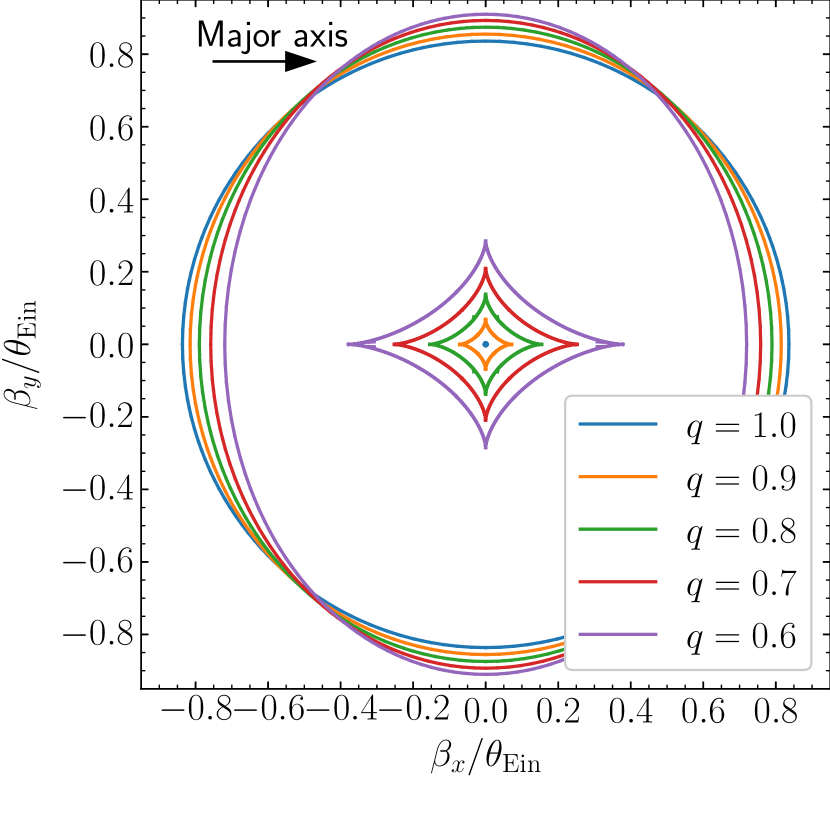
- The authors compute the strong lensing cross-section as a function of lens and source properties using analytical and semi-analytical models.
- They simulate Euclid-like lensing surveys with realistic survey characteristics, including detection limits and image separation thresholds.
- The selection function is modeled as P_SL(ψ_g, ψ_s|S) ∝ P_g(ψ_g) P_s(ψ_s) P_sel(ψ_g, ψ_s|S), incorporating lensing geometry and detection completeness.
- The stellar population synthesis mismatch parameter α_sps is defined as the ratio of true to photometric stellar mass, used to quantify mass measurement bias.
- The central dark matter mass is measured at fixed stellar mass and size to isolate structural biases.
- Simulations compare galaxy-galaxy lenses with galaxy-quasar lenses to assess source population dependence of selection effects.

Experimental results
Research questions
- RQ1How does the strong lensing selection function bias the observed distribution of lens galaxy properties such as stellar mass, size, and dark matter content?
- RQ2To what extent does the intrinsic scatter in stellar population synthesis parameters affect the magnitude of selection bias?
- RQ3How does the completeness in detecting lenses with small Einstein radii influence the amplitude of selection bias?
- RQ4Can information from galaxy-galaxy lenses be reliably used as a prior for galaxy-quasar lens systems in H₀ measurements?
- RQ5Does the selection function introduce a bias in the size distribution of background sources, or only in their magnitude distribution?
Key findings
- For a Euclid-like survey complete to 0.5" Einstein radius, the strong lensing bias in the stellar population synthesis mismatch parameter α_sps is 10%, or 0.04 dex.
- The bias in central dark matter mass at fixed stellar mass and size is 5%, or 0.02 dex, under the same assumptions.
- The bias on the average halo mass at fixed stellar mass is 0.07 dex, indicating a moderate but measurable selection effect.
- The strong lensing bias is nearly independent of the source population: galaxy-galaxy and galaxy-quasar lenses show similar bias amplitudes when matched in Einstein radius.
- The selection function broadens the magnitude distribution of background sources but does not significantly bias their size distribution at fixed magnitude.
- The bias in H₀ inference from time-delay lensing is estimated at ~1% when using galaxy-galaxy lens priors for quasar lenses, supporting the transferability of constraints.
Read this paper
Open the full text in the Nubint reader and ask about any passage as you read.
Read this paper on NubintThis review was generated by AI from the original paper. Please check the paper before citing it.