
[Paper Review] Study of ttbb and ttW background modelling for ttH analyses
This paper compares Monte Carlo simulations of $t\bar{t}b\bar{b}$ and $t\bar{t}W$ backgrounds for $t\bar{t}H$ analyses using ATLAS and CMS data, evaluating differences in generator setups, scale uncertainties, and parton shower matching. A key outcome is the agreement on a common reference $t\bar{t}W$ cross section of $722^{+70}_{-78}$ fb to enable direct experimental comparisons.
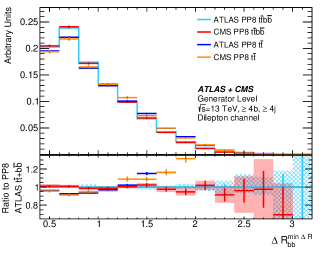
This note presents Monte Carlo generator comparisons of the ttbb and ttW processes at particle level. The aim is to compare the modelling of important backgrounds to ttH measurements in multi-lepton final states and in the ttH(H->bb) decay channel and the treatment of the associated theory uncertainties for a combination of the full Run-2 ttH results from ATLAS and CMS. As a first step, modelling and theory uncertainties as used in ATLAS an CMS are compared in the relevant analysis regions. Significant differences in the treatment of systematic uncertainties between the experiments have been observed in ttbb and ttW. As a first step, ATLAS and CMS agreed on a common reference value of the inclusive ttW cross section to allow direct comparisons between experiments.
Motivation & Objective
- To compare $t\bar{t}b\bar{b}$ and $t\bar{t}W$ background modeling between ATLAS and CMS for $t\bar{t}H$ measurements in Run-2 data.
- To identify and quantify discrepancies in theoretical uncertainty treatments, especially for scale and parton shower effects.
- To establish a common reference $t\bar{t}W$ cross section to enable direct comparison and future combination of ATLAS and CMS results.
- To assess the impact of different MC generators, merging schemes (e.g., FxFx), and EW corrections on differential distributions.
- To inform a unified strategy for theory uncertainty estimation in combined $t\bar{t}H$ measurements across experiments.
Proposed method
- Used Rivet analysis toolkit to compare stable particle-level distributions in phase spaces relevant to $t\bar{t}H$ analyses.
- Evaluated multiple MC generators: MG5_aMC@NLO + Pythia8 (with FxFx and no FxFx), Sherpa 2.2.10, and Powheg-Box-Res for $t\bar{t}b\bar{b}$ and $t\bar{t}W$.
- Compared inclusive cross sections and normalized differential distributions across fiducial regions, focusing on $H_{\text{T}}$, jet multiplicity, and lepton/jet kinematics.
- Assessed scale uncertainties by varying renormalization and factorization scales within ±50% of the central value.
- Evaluated effects of including tree-level electroweak corrections and differences in parton shower tunes and merging scales.
- Used the $t\bar{t}W$ cross section from Ref. [50] as a reference value to normalize and compare predictions across experiments.

Experimental results
Research questions
- RQ1How do ATLAS and CMS model $t\bar{t}b\bar{b}$ and $t\bar{t}W$ backgrounds differently in terms of generator choice and uncertainty treatment?
- RQ2What are the key sources of shape and normalization differences between $t\bar{t}W$ predictions from MG5_aMC@NLO+Pythia8, Sherpa, and Powheg-Box-Res?
- RQ3To what extent do FxFx merging, parton shower tunes, and merging scale choices affect jet multiplicity and $H_{\text{T}}$ distributions?
- RQ4How significant are the effects of tree-level electroweak corrections on $t\bar{t}W$ differential distributions?
- RQ5Can a common reference $t\bar{t}W$ cross section be established to enable consistent comparison and combination of ATLAS and CMS $t\bar{t}H$ results?
Key findings
- Significant differences in $t\bar{t}W$ cross section predictions were found between MG5_aMC@NLO+Pythia8 (FxFx) and Sherpa 2.2.10, especially in jet multiplicity and $H_{\text{T}}$ distributions.
- The inclusive $t\bar{t}W$ cross section was agreed upon as $722^{+70}_{-78}$ fb (scale) ±7 fb (PDF) to serve as a common reference for inter-experimental comparisons.
- Scale uncertainties on normalized distributions were below 10% in most regions, but became significant when acceptance effects were included.
- Tree-level electroweak corrections caused up to 20% differences in cross section at high jet multiplicity, though shape effects were generally small.
- The FxFx merging scheme in MG5_aMC@NLO+Pythia8 led to large effects at low $H_{\text{T}}$, with notable discrepancies between ATLAS and CMS predictions.
- Despite similar perturbative accuracy, differences in merging scale or Pythia8 tune may explain discrepancies in jet activity, suggesting a need for further investigation.
Better researchstarts right now
From reading papers to final review, dramatically reduce your research time.
No credit card · Free plan available
This review was created by AI and reviewed by human editors.