
[Paper Review] Superconducting Diode Effect Sign Change in Epitaxial Al-InAs Josepshon Junctions
This study demonstrates a sign change in the superconducting diode effect (SDE) in epitaxial Al-InAs Josephson junctions with strong Rashba spin-orbit coupling (SOC) under in-plane magnetic fields. The SDE sign reversal arises from SOC-induced critical current asymmetry at low fields in narrow superconducting widths ($W_S = 0.15\,\mu\text{m}$), while in wider junctions ($W_S = 0.6\,\mu\text{m}$), it correlates with $0-\pi$-like transitions, not necessarily indicating topological superconductivity.
There has recently been a surge of interest in studying the superconducting diode effect (SDE) partly due to the possibility of uncovering the intrinsic properties of a material system. A change of sign of the SDE at finite magnetic field has previously been attributed to different mechanisms. Here, we observe the SDE in epitaxial Al-InAs Josephson junctions with strong Rashba spin-orbit coupling (SOC). We show that this effect strongly depends on the orientation of the in-plane magnetic field. In the presence of a strong magnetic field, we observe a change of sign in the SDE. Simulation and measurement of supercurrent suggest that depending on the superconducting widths, $W_ ext{S}$, this sign change may not necessarily be related to 0--$π$ or topological transitions. We find that the strongest sign change in junctions with narrow $W_ ext{S}$ is consistent with SOC-induced asymmetry of the critical current under magnetic-field inversion, while in wider $W_ ext{S}$, the sign reversal could be related to 0--$π$ transitions and topological superconductivity.
Motivation & Objective
- To investigate the dependence of the superconducting diode effect (SDE) on in-plane magnetic field orientation in epitaxial Al-InAs Josephson junctions with strong Rashba spin-orbit coupling (SOC).
- To determine whether SDE sign reversals in these junctions are linked to $0-\pi$ transitions or topological superconductivity.
- To distinguish between SOC-induced critical current asymmetry and $0-\pi$-like ground-state phase jumps as the origin of SDE sign changes.
- To develop a method for estimating the Rashba SOC strength from the magnetic field shift $B_*$ of the critical current maximum.
Proposed method
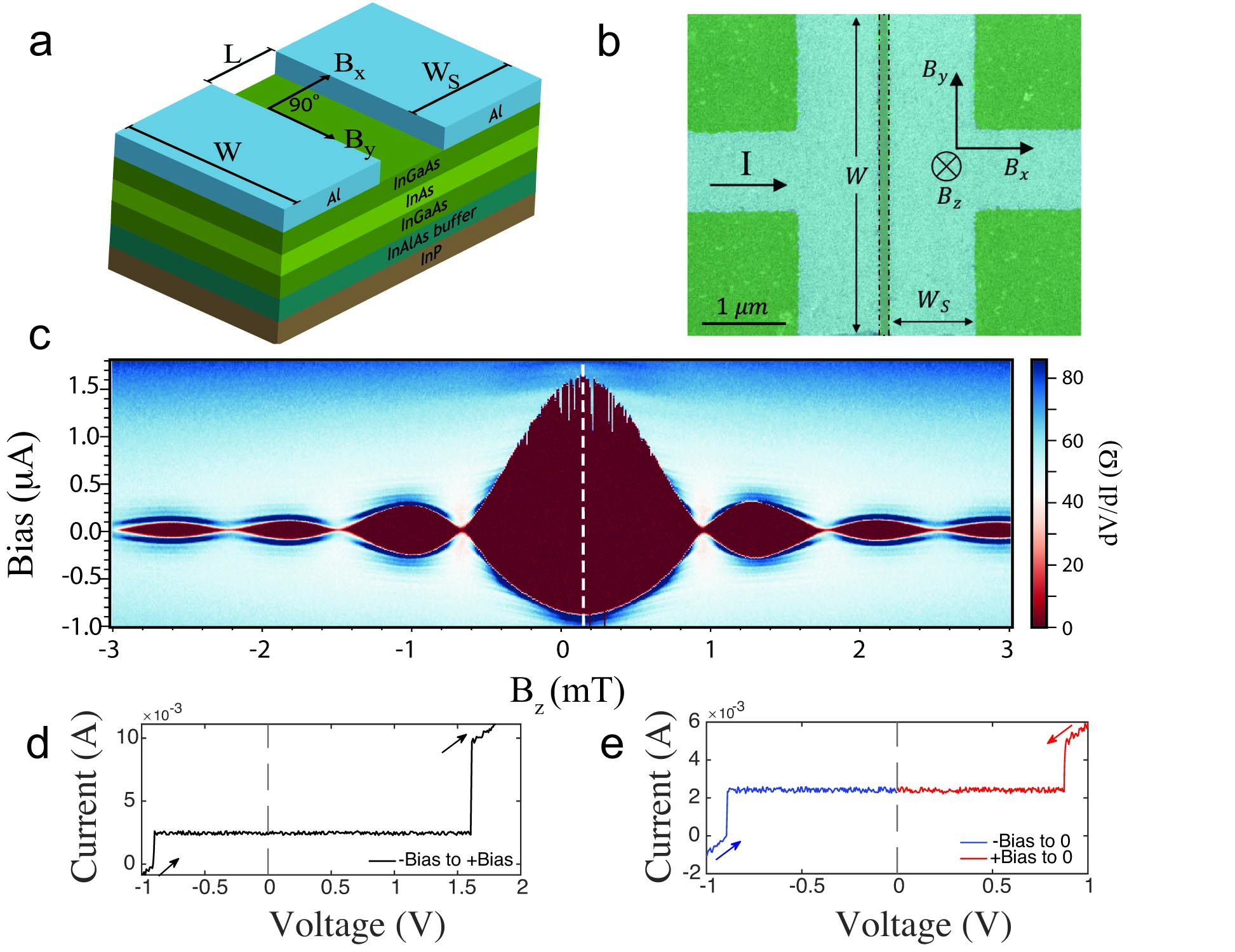
- Fabrication of planar Josephson junctions on molecular beam epitaxial Al-InAs heterostructures with variable superconducting width $W_S$ from 0.15 to 1.0 $\mu$m.
- Measurement of nonreciprocal critical currents $I_c^+$ and $I_c^-$ under in-plane magnetic fields applied perpendicular to the current direction.
- Use of tight-binding simulations to model the supercurrent and ground-state phase difference, incorporating Rashba SOC and Zeeman interaction.
- Analytical modeling of the critical current behavior at low fields, deriving an expression for the magnetic field shift $B_*$ related to SOC strength.
- Comparison of experimental SDE sign reversals with simulated $0-\pi$ transitions and ground-state phase jumps at $qL = (2m+1)\pi/2$, where $q$ is the momentum of finite-momentum Cooper pairs.
- Rescaling of the Zeeman field using $r_l = L/(2W_S + L)$ to account for field distribution beyond the semiconductor region.
Experimental results
Research questions
- RQ1What causes the sign reversal of the superconducting diode effect in Al-InAs Josephson junctions under in-plane magnetic fields?
- RQ2Is the observed SDE sign reversal in narrow junctions ($W_S = 0.15\,\mu\text{m}$) related to $0-\pi$ transitions or topological superconductivity?
- RQ3How does the superconducting width $W_S$ influence the mechanism behind SDE sign changes?
- RQ4Can the Rashba spin-orbit coupling strength be extracted from the magnetic field shift $B_*$ of the critical current maximum?
- RQ5What role does the ground-state phase difference $\phi_{GS}$ play in determining SDE behavior and its sign reversal?
Key findings
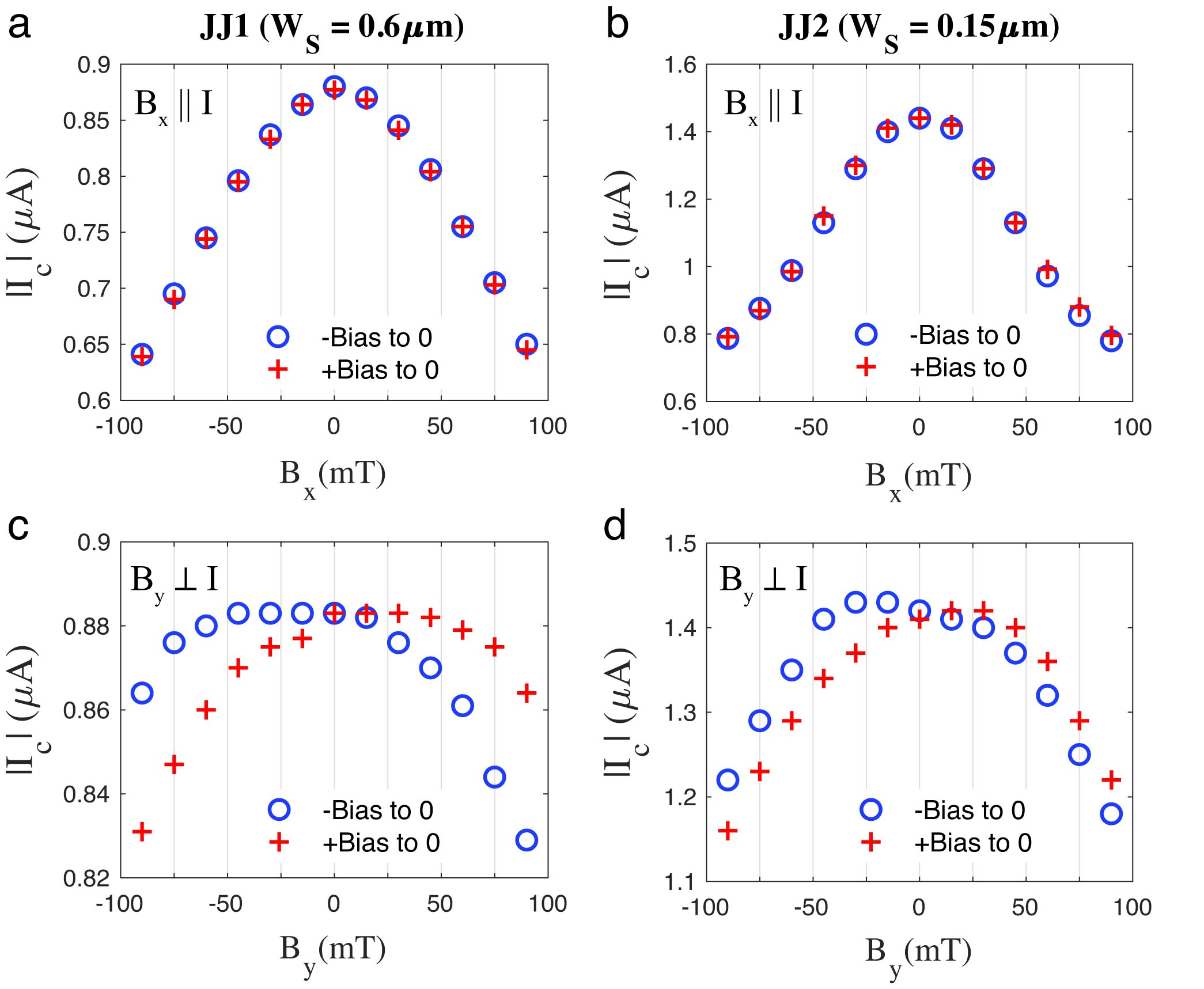
- A sign reversal of the SDE is observed at $B_y \approx \pm 0.35$ T in the narrow junction (JJ2, $W_S = 0.15\,\mu\text{m}$), with no clear correspondence to $0-\pi$ transitions or topological phase transitions.
- The SDE sign reversal in narrow junctions is attributed to SOC-induced asymmetry in the critical current under magnetic field inversion, centered at a field shift $B_*$.
- In wider junctions (JJ1, $W_S = 0.6\,\mu\text{m}$), the SDE sign reversal at higher fields is consistent with $0-\pi$-like ground-state phase jumps, predicted at $B_y \approx \pm 0.6$ T.
- Numerical simulations confirm that the $0-\pi$ transition at $B_y \approx 1$ T corresponds to $qL = (2m+1)\pi/2$, indicating a ground-state phase jump.
- The measured $B_*$ shift in the critical current maximum is used to estimate the Rashba SOC strength, with results consistent with previously reported values for the system.
- The SDE vanishes at zero magnetic field due to restored time-reversal symmetry and also at specific finite fields where $\Delta I_c = 0$, indicating symmetry restoration.
Read this paper
Open the full text in the Nubint reader and ask about any passage as you read.
Read this paper on NubintThis review was generated by AI from the original paper. Please check the paper before citing it.