
[Paper Review] Taming the Long Tail of Deep Probabilistic Forecasting
This paper proposes Pareto Loss and Kurtosis Loss—two moment-based loss functions that improve deep probabilistic forecasting by explicitly targeting the long-tail distribution of prediction errors. By emphasizing rare, high-error scenarios through generalized Pareto distribution fitting and fourth-moment regularization, the methods significantly reduce tail errors in trajectory and time series forecasting without degrading average performance.
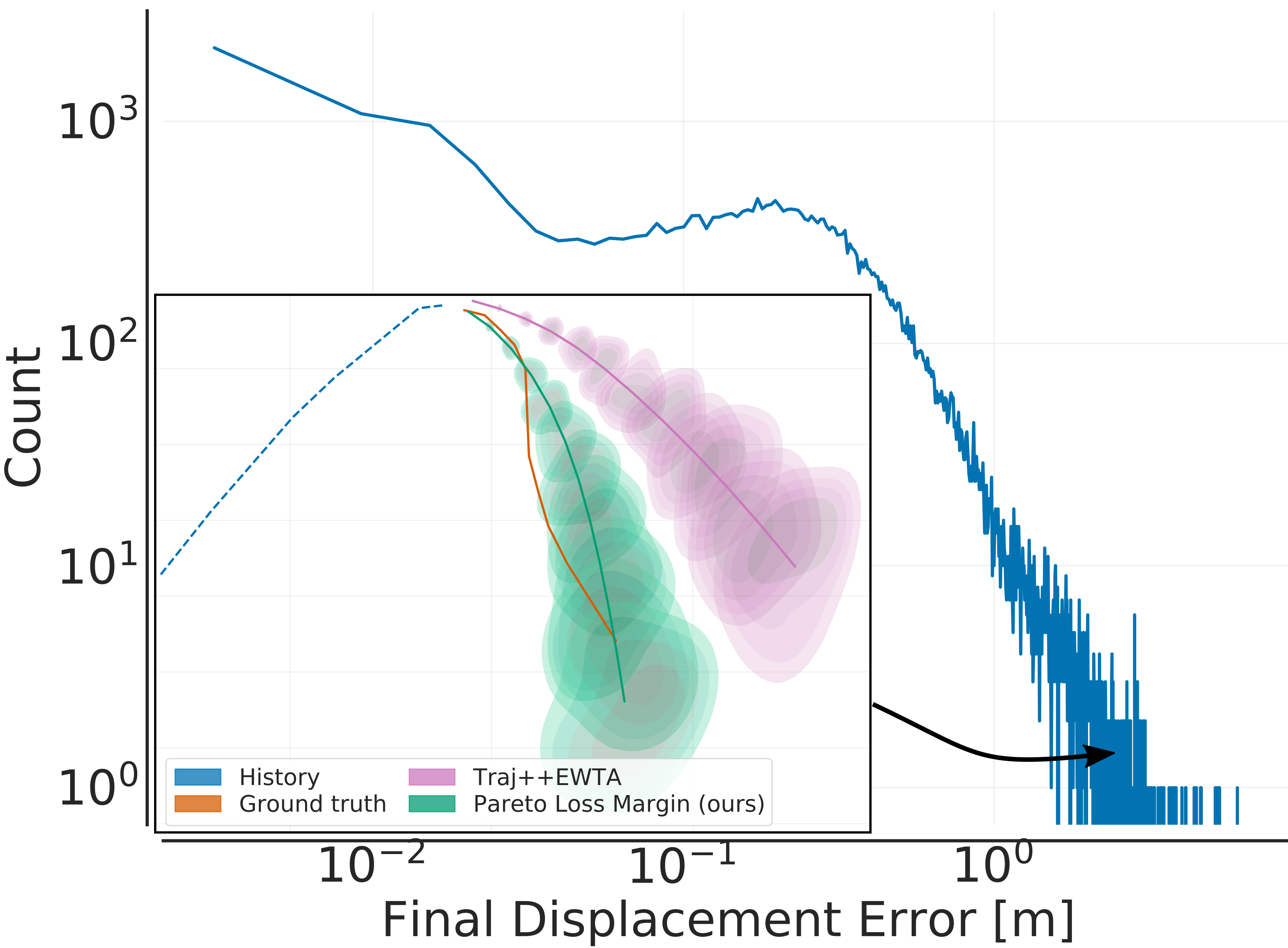
Deep probabilistic forecasting is gaining attention in numerous applications ranging from weather prognosis, through electricity consumption estimation, to autonomous vehicle trajectory prediction. However, existing approaches focus on improvements on the most common scenarios without addressing the performance on rare and difficult cases. In this work, we identify a long tail behavior in the performance of state-of-the-art deep learning methods on probabilistic forecasting. We present two moment-based tailedness measurement concepts to improve performance on the difficult tail examples: Pareto Loss and Kurtosis Loss. Kurtosis loss is a symmetric measurement as the fourth moment about the mean of the loss distribution. Pareto loss is asymmetric measuring right tailedness, modeling the loss using a generalized Pareto distribution (GPD). We demonstrate the performance of our approach on several real-world datasets including time series and spatiotemporal trajectories, achieving significant improvements on the tail examples.
Motivation & Objective
- To identify and address the long-tail behavior in deep probabilistic forecasting, where models fail on rare but critical prediction cases.
- To improve model performance on difficult, tail-case examples without compromising average performance.
- To develop moment-based loss functions that are principled, interpretable, and effective for long-tailed error distributions in forecasting.
- To demonstrate the effectiveness of these losses across diverse real-world datasets, including time series and spatiotemporal trajectories.
- To advocate for evaluating tail metrics (e.g., VaR95, VaR99) alongside average metrics to detect long-tail issues in forecasting systems.
Proposed method
- Pareto Loss uses a generalized Pareto distribution (GPD) to model the tail of the loss distribution, enabling asymmetric weighting of high-error samples.
- The method formulates loss as a weighted sum of shifted moments, with margins that saturate beyond a threshold to stabilize training on extreme cases.
- Kurtosis Loss leverages the fourth central moment of the loss distribution to measure and penalize heavy-tailed behavior symmetrically.
- Both losses are differentiable and can be integrated into existing deep probabilistic forecasting frameworks as regularization or loss weighting.
- The approach treats tail examples as high-priority during training by increasing their effective contribution to the loss function.
- Hyperparameters are tuned to balance tail emphasis and generalization, with ablation showing sensitivity in kurtosis but robustness in Pareto Loss.
Experimental results
Research questions
- RQ1How does long-tail error behavior manifest in state-of-the-art deep probabilistic forecasting models across different real-world datasets?
- RQ2Can moment-based loss functions like kurtosis and Pareto loss effectively improve performance on rare, high-error forecasting cases?
- RQ3How do Pareto Loss and Kurtosis Loss compare in their ability to reduce extreme errors (e.g., VaR99) versus moderate tail errors (e.g., VaR95)?
- RQ4To what extent do these losses improve long-term forecasting performance, especially as prediction horizons increase?
- RQ5Can these methods enhance model reliability in safety-critical applications like autonomous vehicle trajectory prediction without degrading average performance?
Key findings
- Pareto Loss (PLM) achieves the most consistent improvement across all metrics, outperforming baselines on both tail and average performance in all four datasets tested.
- Kurtosis Loss significantly reduces the worst-case errors, achieving the best performance on VaR99 and Max metrics, indicating strong impact on extreme tail events.
- On the ETH-UCY Zara1 dataset, both methods reduce FDE (Final Displacement Error) for the top 5% most erroneous predictions, with improvements most pronounced at longer horizons.
- The error distribution for long-horizon predictions shows a worsening tail, confirming that tail errors compound over time and must be addressed for reliable long-term forecasting.
- Pareto Loss provides more stable and scalable improvements across the tail distribution, while Kurtosis Loss is more sensitive to extreme outliers, making it better suited for worst-case robustness.
- The results demonstrate that integrating tail-aware losses leads to measurable gains in reliability for safety-critical forecasting tasks such as autonomous driving and power grid anomaly detection.
Read this paper
Open the full text in the Nubint reader and ask about any passage as you read.
Read this paper on NubintThis review was generated by AI from the original paper. Please check the paper before citing it.