
[Paper Review] Tensor Network Quantum Simulator With Step-Dependent Parallelization
This paper presents a tensor network quantum simulator with step-dependent parallelization that enables the largest-scale QAOA circuit simulation to date—210 qubits with 1,785 gates—on 1,024 nodes of the Theta supercomputer. The method uses a novel slicing algorithm based on step-dependent variable selection to reduce contraction width and memory footprint, achieving up to 512x speedup over non-parallelized approaches while maintaining high efficiency across multiple simulations.
In this work, we present a new large-scale quantum circuit simulator. It is based on the tensor network contraction technique to represent quantum circuits. We propose a novel parallelization algorithm based on \stepslice . In this paper, we push the requirement on the size of a quantum computer that will be needed to demonstrate the advantage of quantum computation with Quantum Approximate Optimization Algorithm (QAOA). We computed 210 qubit QAOA circuits with 1,785 gates on 1,024 nodes of the the Cray XC 40 supercomputer Theta. To the best of our knowledge, this constitutes the largest QAOA quantum circuit simulations reported to this date.
Motivation & Objective
- To push the limits of classical simulation for large-scale quantum circuits, particularly QAOA, to define the threshold for quantum advantage.
- To address the high memory and computational cost of simulating deep quantum circuits using tensor network contraction.
- To develop a scalable, high-performance parallelization strategy that reduces contraction width and memory usage in tensor network simulations.
- To enable efficient reuse of contraction orders across multiple QAOA parameter variations for optimization and analysis.
Proposed method
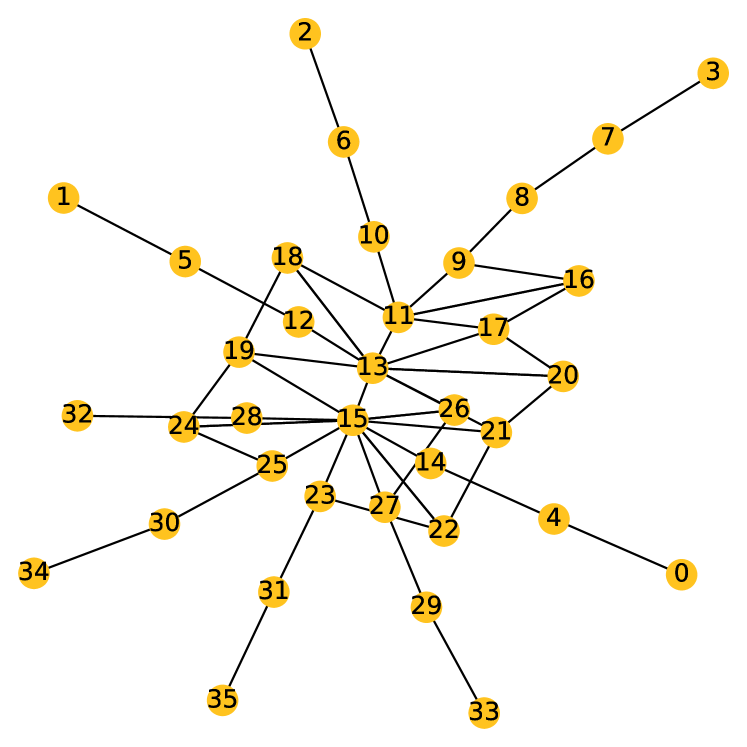
- The simulator represents quantum circuits as tensor networks and uses the bucket elimination algorithm for contraction order generation.
- A novel step-dependent slicing algorithm dynamically selects slicing variables based on the current contraction step, reducing the maximum contraction width.
- The method splits the tensor expression into smaller parts by pre-contracting segments, minimizing the need for repeated elimination order computation.
- The algorithm is implemented on a distributed system (Theta supercomputer), using up to 1,024 nodes and 213 TB of memory.
- The approach supports efficient simulation of multiple amplitudes with minimal overhead by reusing the same contraction order.
- The slicing strategy is optimized to minimize the maximum contraction width across steps, with performance evaluated across varying numbers of parallel indices.
Experimental results
Research questions
- RQ1Can step-dependent slicing significantly reduce the contraction width and memory footprint in large-scale tensor network simulations?
- RQ2What is the maximum qubit count achievable for QAOA circuits using tensor network contraction with advanced parallelization?
- RQ3How does step-dependent slicing compare in performance to standard parallelization methods in terms of speedup and memory efficiency?
- RQ4To what extent can a single contraction order be reused across different QAOA parameter sets to accelerate simulation?
- RQ5What is the impact of increasing the number of parallel indices on the minimal contraction width and overall simulation time?
Key findings
- The simulator successfully simulated a 210-qubit QAOA ansatz state with 1,785 gates, setting a new record for the largest QAOA circuit simulation to date.
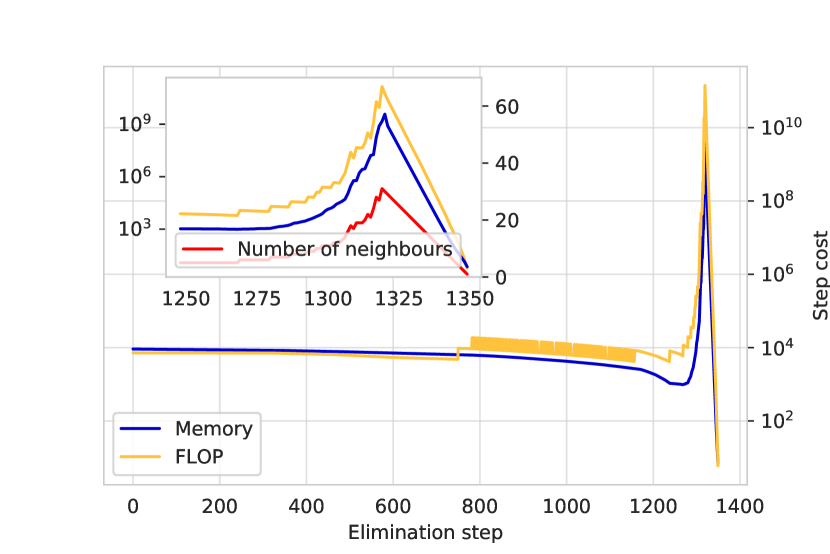
- Using 1,024 nodes of the Theta supercomputer, the simulation achieved a 3x reduction in time compared to 64-node execution, with a contraction width reduced to 29.
- The step-dependent slicing algorithm achieved a maximum speedup of 512x compared to non-parallelized contraction steps, exceeding the theoretical 64x limit for straightforward parallelization.
- The method reduced cumulative memory usage to 60% of the 13 TB available on 64 nodes, representing over 35x less memory than a serial approach.
- The minimal contraction width decreased by one for each increment in the number of sliced indices, demonstrating predictable and scalable performance improvement.
- The algorithm enables efficient reuse of contraction orders across different QAOA parameter sets, supporting large-scale parameter optimization and angle transferability studies.
Read this paper
Open the full text in the Nubint reader and ask about any passage as you read.
Read this paper on NubintThis review was generated by AI from the original paper. Please check the paper before citing it.