
[Paper Review] The Age of Generative AI and AI-Generated Everything
This paper introduces AI-Generated Everything (AIGX), a paradigm that extends generative AI beyond content creation to dynamically optimize and adapt systems in real time. By establishing a virtuous interactive cycle between generative AI and networks—where networks provide real-time data and feedback to improve AIGX models, and AIGX enhances network management—the system achieves a 15.1% gain in data rate through adaptive power allocation, outperforming traditional methods like SAC.
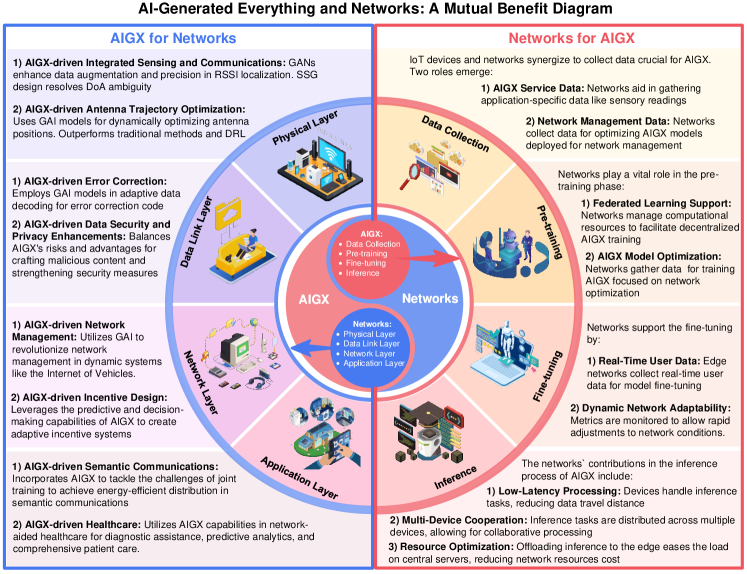
Generative AI (GAI) has emerged as a significant advancement in artificial intelligence, renowned for its language and image generation capabilities. This paper presents ``AI-Generated Everything'' (AIGX), a concept that extends GAI beyond mere content creation to real-time adaptation and control across diverse technological domains. In networking, AIGX collaborates closely with physical, data link, network, and application layers to enhance real-time network management that responds to various system and service settings as well as application and user requirements. Networks, in return, serve as crucial components in further AIGX capability optimization through the AIGX lifecycle, i.e., data collection, distributed pre-training, and rapid decision-making, thereby establishing a mutually enhancing interplay. Moreover, we offer an in-depth case study focused on power allocation to illustrate the interdependence between AIGX and networking systems. Through this exploration, the article analyzes the significant role of GAI for networking, clarifies the ways networks augment AIGX functionalities, and underscores the virtuous interactive cycle they form. This article paves the way for subsequent future research aimed at fully unlocking the potential of GAI and networks.
Motivation & Objective
- To propose AI-Generated Everything (AIGX) as a paradigm that extends generative AI beyond content creation to system-level adaptation and optimization.
- To establish a bidirectional, mutually enhancing interaction between generative AI and networking systems across the AIGX lifecycle.
- To demonstrate through a case study that real-time network feedback significantly improves AIGX model performance in dynamic environments.
- To identify future research directions for integrating AIGX into emerging network architectures such as SAGIN, near-field MIMO, and multimodal communications.
- To explore how networks can support AIGX through swarm intelligence, transfer learning, and energy-efficient routing for sustainable deployment.
Proposed method
- AIGX integrates generative AI across physical, data link, network, and application layers to enable real-time adaptation and control in dynamic environments.
- The framework employs a closed-loop lifecycle: data collection from networks, distributed pre-training of generative models, and rapid inference-driven decision-making.
- A generative diffusion model is used to synthesize realistic channel states and expert solutions for power allocation under varying network conditions.
- The system leverages real-time network feedback—such as updated channel gains and performance metrics—to retrain and refine the AIGX model continuously.
- A case study on power allocation in a rain-impacted fading channel demonstrates the impact of network feedback on model retraining and performance improvement.
- The approach enables dynamic, context-aware optimization by combining generative modeling with network telemetry, forming a self-improving system.
Experimental results
Research questions
- RQ1How can generative AI be extended beyond content generation to enable real-time system optimization in networking environments?
- RQ2What is the nature and impact of the bidirectional interaction between AIGX and network systems across the AIGX lifecycle?
- RQ3To what extent does real-time network feedback improve the performance of AIGX models in dynamic, non-stationary environments?
- RQ4How does the AIGX-network interaction cycle compare to conventional AI-based network optimization methods in terms of adaptability and performance?
- RQ5What are the key network-enabling mechanisms that support scalable, efficient, and sustainable deployment of AIGX in future communication systems?
Key findings
- The AIGX-network virtuous cycle achieved a 15.1% improvement in data rate through retraining the power allocation model using real-time network feedback.
- A deep reinforcement learning method (SAC) achieved only 8.9% virtuous gain under the same conditions, demonstrating AIGX’s superior adaptability and performance.
- Networks actively contribute to AIGX by providing critical data and feedback, making them essential for model retraining and performance enhancement.
- The integration of AIGX into near-field MIMO, space-air-ground integrated networks (SAGIN), and multimodal communications enables adaptive, high-performance resource management.
- Swarm intelligence and transfer learning across network hubs significantly improve the efficiency of AIGX service distribution and model training.
- Energy-aware networking and renewable energy integration can reduce the carbon footprint of energy-intensive AIGX workloads, enabling sustainable deployment.
Better researchstarts right now
From reading papers to final review, dramatically reduce your research time.
No credit card · Free plan available
This review was created by AI and reviewed by human editors.