
[Paper Review] The Commensal Real-time ASKAP Fast Transient incoherent-sum survey
The paper reports 43 FRBs detected by the CRAFT/ICS survey using incoherent summation of ASKAP antenna intensities, with sub-arcsecond localisations and host identifications for many events, and outlines the instrumentation, methods, and scientific implications.
With wide-field phased array feed technology,the Australian Square Kilometre Array Pathfinder (ASKAP) is ideally suited to search for seemingly rare radio transient sources that are difficult to discover previous-generation narrow-field telescopes. The Commensal Real-time ASKAP Fast Transient (CRAFT) Survey Science Project has developed instrumentation to continuously search for fast radio transients (duration < 1 second) with ASKAP, with a particular focus on finding and localising Fast Radio Bursts (FRBs). Since 2018, the CRAFT survey has been searching for FRBs and other fast transients by incoherently adding the intensities received by individual ASKAP antennas, and then correcting for the impact of frequency dispersion on these short-duration signals in the resultant incoherent sum (ICS) in real-time. This low-latency detection enables the triggering of voltage buffers, which facilitates the localisation of the transient source and the study of spectro-polarimetric properties at high time resolution. Here we report the sample of 43 FRBs discovered in this CRAFT/ICS survey to date. This includes 22 FRBs that had not previously been reported: 16 FRBs localised by ASKAP to < 1 arcsec and 6 FRBs localised to ~ 10 arcmin. Of the new arcsecond-localised FRBs, we have identified and characterised host galaxies (and measured redshifts) for 11. The median of all 30 measured host redshifts from the survey to date is z=0.23. We summarise results from the searches, in particular those contributing to our understanding of the burst progenitors and emission mechanisms, and on the use of bursts as probes of intervening media. We conclude by foreshadowing future FRB surveys with ASKAP using a coherent detection system that is currently being commissioned. This will increase the burst detection rate by a factor of approximately ten and also the distance to which ASKAP can localise FRBs.
Motivation & Objective
- Explain the design and capabilities of the CRAFT/ICS FRB search system on ASKAP.
- Demonstrate real-time, low-latency FRB detection using incoherent summation of antenna intensities.
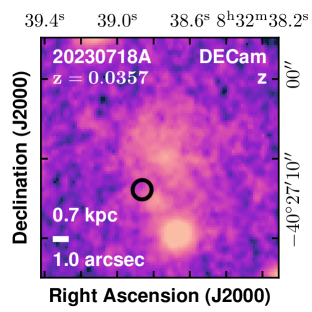
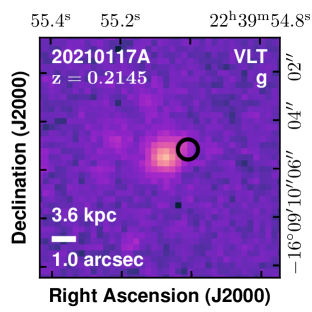
- Localise FRBs to arcsecond scales and identify host galaxies and redshifts.
- Assess survey performance and implications for FRB progenitors and intervening media.
- Outline future transitions to coherent detection for higher rate and localisation accuracy.
Proposed method
- Incoherently sum intensities from all ASKAP beams and antennas after dispersion-correcting short-duration signals in real time.
- Use the FREDDA GPU-based dispersion measure transform to detect FRB candidates across beams.
- Apply density-based clustering to group real-time candidates and distinguish FRBs from RFI.
- Trigger and download 3.1 s voltage buffers for high-resolution post-detection analysis and localisation.
- Employ the CELEBI pipeline to process voltage data for high time resolution spectro-polarimetric products.
- Utilise PATH formalism to associate FRBs with host galaxies using localisation regions and candidate galaxy magnitudes.
Experimental results
Research questions
- RQ1How effective is the ICS incoherent-sum approach for real-time FRB detection and localisation with ASKAP?
- RQ2What are the localization accuracies achievable for ASKAP-detected FRBs using ICS and voltage-buffer triggering?
- RQ3What host galaxies and redshift distribution are associated with the detected FRBs, and what does this imply about FRB progenitors and environments?
- RQ4How does the survey performance (detection rate, DM range, fluence) compare with previous FRB surveys and what are implications for future coherent detections?
- RQ5What are the limitations and future improvements when moving from incoherent to coherent FRB detection systems?
Key findings
- The CRAFT/ICS survey has detected 43 unique FRBs to date, including 22 new ones not previously reported.
- Among the new arcsecond-localised FRBs, 11 host galaxies have been identified and characterised with measured redshifts.
- The median redshift of all measured hosts in the sample is z = 0.23.
- Bursts show a range of dispersion measures from 206 to 1780 pc cm-3 and fluences from 10 to 120 Jy ms.
- Approximately 30 FRB host galaxies have been identified with positions measured to sub-arcsecond precision for many events.
- The survey demonstrates the feasibility and scientific value of real-time, commensal FRB searches and sets the stage for future coherent detection upgrades.
Read this paper
Open the full text in the Nubint reader and ask about any passage as you read.
Read this paper on NubintThis review was generated by AI from the original paper. Please check the paper before citing it.