
[Paper Review] The Evolution of U.S. Retail Concentration
This paper uses novel Census CRT data (1992–2012) to show local and national retail concentration rose in parallel, driven mainly by multi-market retailers expanding across markets, with significant implications for margins.
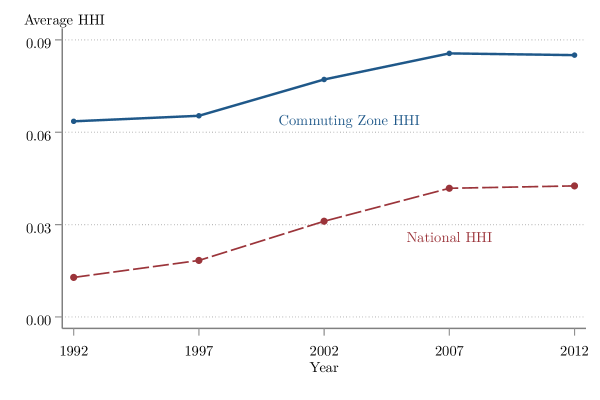
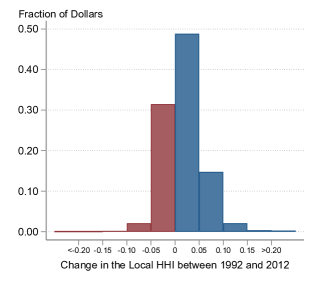
Increases in national concentration have been a salient feature of industry dynamics in the U.S. and have contributed to concerns about increasing market power. Yet, local trends may be more informative about market power, particularly in the retail sector where consumers have traditionally shopped at nearby stores. We find that local concentration has increased almost in parallel with national concentration using novel Census data on product-level revenue for all U.S. retail stores between 1992 and 2012. The increases in concentration are broad based, affecting most markets, products, and retail industries. We show that the expansion of multi-market firms into new markets explains most of the increase in national retail concentration, with consolidation via increases in local market shares increasing in importance between 1997 and 2007, and single-market firms playing a negligible role. Finally, we find that increases in local concentration can explain one-quarter to one-third of the observed rise in retail gross margins.
Motivation & Objective
- Investigate trends in national and local retail concentration in the United States.
- Differentiate product-level and industry-level measures of concentration and their implications.
- Assess the role of multi-market retailers versus single-market firms in driving concentration.
- Examine the potential impact of online/non-store retailers on local concentration and margins.
Proposed method
- Construct store-level product-category revenue for all U.S. stores using Census of Retail Trade data (1992–2012).
- Compute local (commuting zone) and national HHI measures for product markets and for industry-level markets.
- Assign store sales to product markets to handle cross-industry competition and multi-product stores.
- Decompose national concentration into local and cross-market components to assess drivers.
- Incorporate bounds for non-store retailers to gauge their effect on concentration.
- Compare product-based and industry-based concentration results over time.
Experimental results
Research questions
- RQ1What are the trends in local (commuting zone) and national retail concentration from 1992 to 2012?
- RQ2To what extent do multi-market retailers explain the rise in national concentration versus single-market firms?
- RQ3How do product-based concentration trends compare to industry-based concentration trends within retail?
- RQ4What is the role of online and other non-store retailers in shaping local concentration and margins?
Key findings
- National retail concentration rose from 0.013 to 0.043 between 1992 and 2012, while local commuting-zone concentration rose from 6.4 to 8.6.
- Concentration increases are broad-based across most markets, products, and retail industries.
- Expansion and consolidation of multi-market retailers account for 89 percent of the increase in national concentration (1992–2012).
- Single-market firms have a negligible effect on national concentration due to dispersion across many markets.
- Increases in local concentration can explain about one-quarter to one-third of the rise in retail gross margins observed in 1993–2012.
Read this paper
Open the full text in the Nubint reader and ask about any passage as you read.
Read this paper on NubintThis review was generated by AI from the original paper. Please check the paper before citing it.