
[Paper Review] The Platonic Representation Hypothesis
The paper argues that representations in AI models converge toward a shared, platonic representation of reality, observable across architectures, modalities, and tasks, and that scaling fuel this convergence.
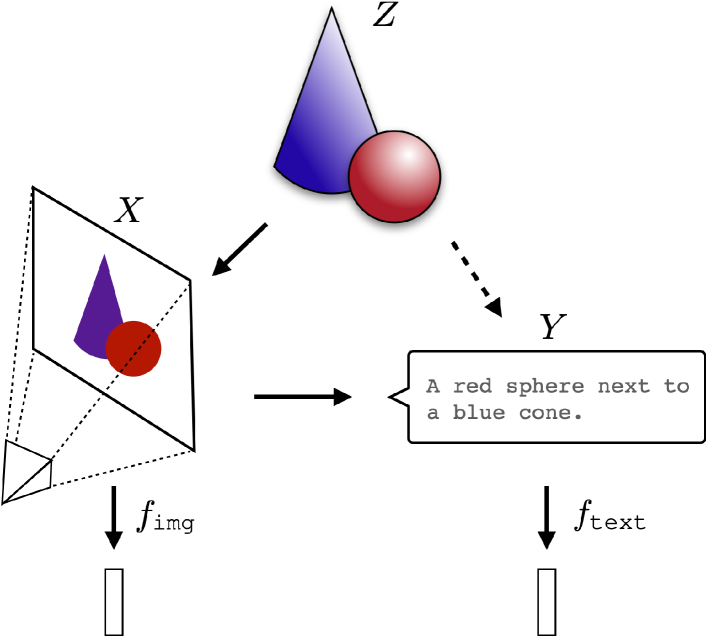
We argue that representations in AI models, particularly deep networks, are converging. First, we survey many examples of convergence in the literature: over time and across multiple domains, the ways by which different neural networks represent data are becoming more aligned. Next, we demonstrate convergence across data modalities: as vision models and language models get larger, they measure distance between datapoints in a more and more alike way. We hypothesize that this convergence is driving toward a shared statistical model of reality, akin to Plato's concept of an ideal reality. We term such a representation the platonic representation and discuss several possible selective pressures toward it. Finally, we discuss the implications of these trends, their limitations, and counterexamples to our analysis.
Motivation & Objective
- Motivate and formalize the idea that neural representations converge to a shared statistical model of reality (a platonic representation).
- Define representation alignment and measure it with kernel-based similarity metrics across models and modalities.
- Investigate convergence across architectures, objectives, data modalities, and brain-like representations.
- Examine how scale and performance relate to representation alignment and downstream task transfer.
- Discuss limitations, counterexamples, and implications for future foundation models.
Proposed method
- Representations are treated as vector embeddings with associated kernels to capture similarity structure.
- Representational alignment is quantified using kernel-alignment metrics such as CKD/CKA and mutual nearest-neighbor measures.
- Experiments compare alignment across 78 vision models with varying architectures and training objectives.
- Cross-modal alignment is measured by pairing vision and language models on shared datasets (e.g., Wikipedia captions) and comparing induced kernels.
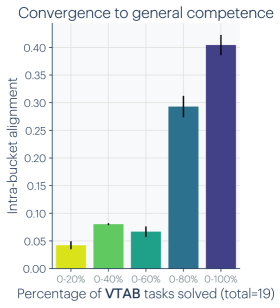
- Evidence of alignment is linked to model competence, scale, and downstream task transfer performance.
Experimental results
Research questions
- RQ1Do neural representations from different architectures and objectives align with one another as models scale and diversify?
- RQ2Does cross-modal representation (vision and language) converge toward a shared representation?
- RQ3Is there a measurable relationship between representation alignment and downstream task performance?
- RQ4To what extent do representations align with brain representations, and what does this imply about universal structure in data?
- RQ5What are the limitations and boundary conditions of representational convergence (e.g., sensor differences)?
Key findings
- Representations from different models with diverse objectives show increasing alignment as competence grows.
- Vision and language models exhibit cross-modal alignment that strengthens with model quality, and explicit language supervision (e.g., CLIP) affects this alignment.
- Alignment across models increases with scale and performance, with competent models forming tighter representation clusters.
- There is empirical evidence that better-aligned models tend to perform better on downstream tasks (e.g., commonsense reasoning, math problems).
- Neural networks show alignment with brain representations, suggesting a shared underlying structure in processing perceptual data.
Read this paper
Open the full text in the Nubint reader and ask about any passage as you read.
Read this paper on NubintThis review was generated by AI from the original paper. Please check the paper before citing it.