
[Paper Review] The sample-dependent and sample-independent thermal transport properties of $α$-RuCl$_3$
This study investigates how stacking disorder in α-RuCl₃ crystals affects thermal transport properties, particularly the field-induced oscillations in longitudinal thermal conductivity and the planar thermal Hall effect. Using two crystals with differing disorder levels, the authors find that oscillatory features correlate with the zig-zag magnetic order at ~7.6 K, not higher-T transitions at 10 K or 13 K, and that the half-quantized thermal Hall plateau is strongly suppressed by disorder, indicating that intrinsic quantum phenomena are highly sensitive to crystal quality.
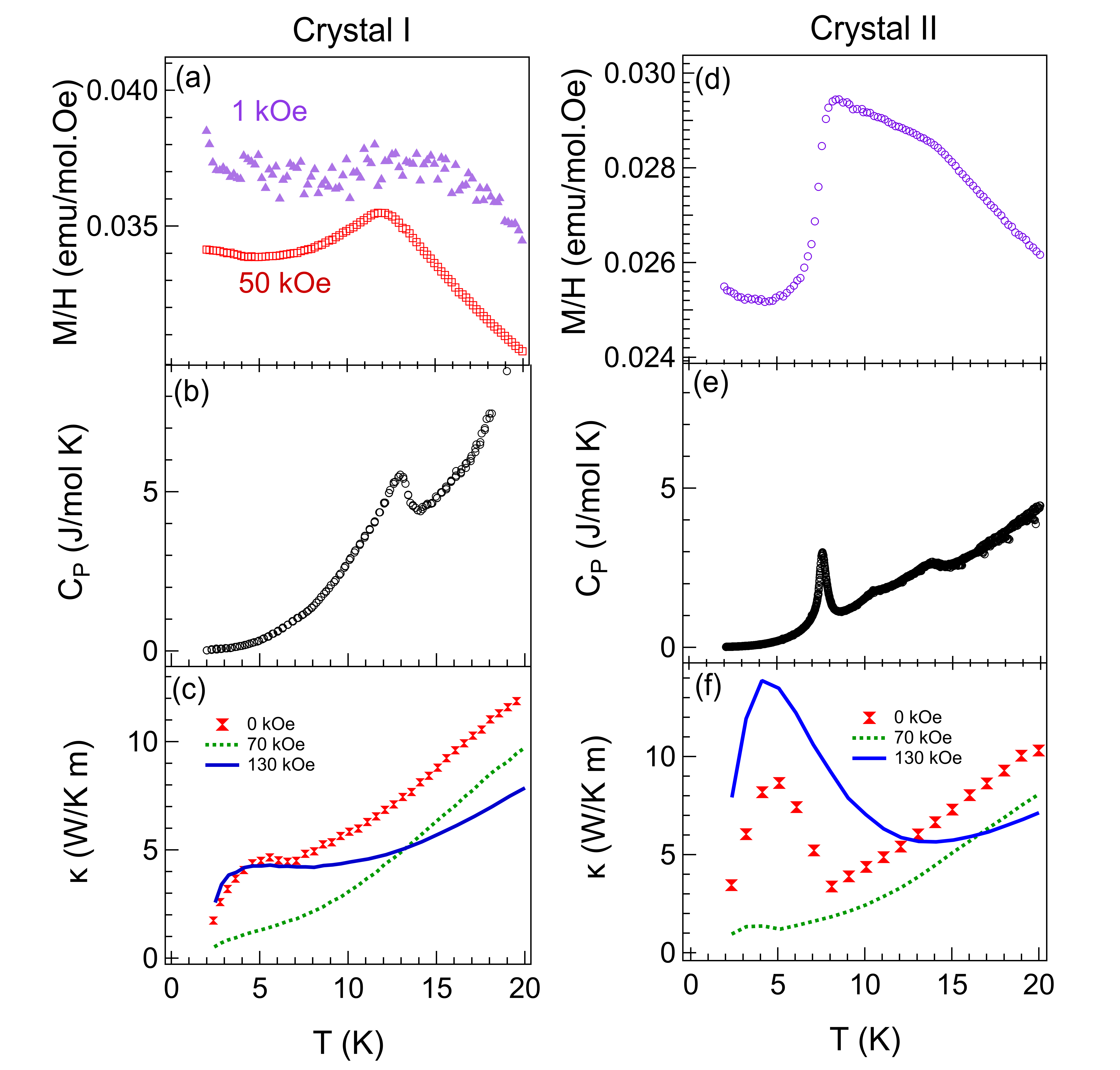
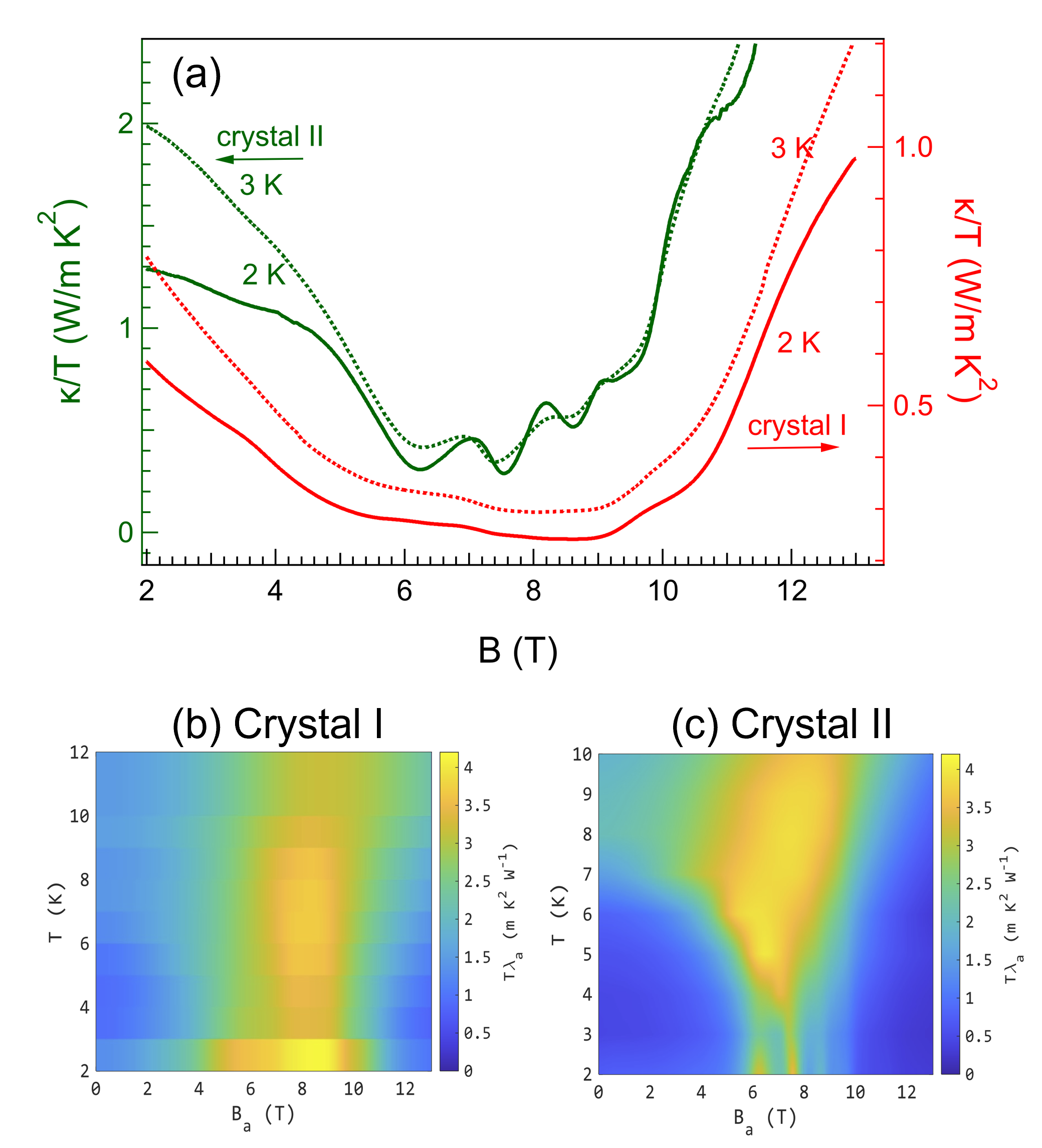
We investigated the thermal transport properties of two $α$-RuCl$_3$ crystals with different degrees of stacking disorder to understand the origin of the previously reported oscillatory feature in the field dependence of thermal conductivity. Crystal I shows only one magnetic order around 13\,K, which is near the highest T$_N$ for $α$-RuCl$_3$ with stacking faults. Crystal II has less stacking disorder, with a dominant heat capacity at 7.6\,K along with weak anomalies at 10\,K and 13\,K. In the temperature and field dependence of thermal conductivity, no obvious anomaly was observed to be associated with the magnetic order around 13\,K for either crystal or around 10\,K for crystal II. Crystal II, with less disorder, showed clear oscillations in the field dependence of thermal conductivity, while crystal I, with more disorder, did not. For crystal I, an L-shaped region in the temperature-field space was observed where thermal Hall conductivity $κ_{xy}$/T is within $\pm$20\% of the half quantized thermal Hall conductivity $κ_{HQ}$/T. While for crystal II, $κ_{xy}$/T reaches $κ_{HQ}$/T only in the high field and high temperature regime with no indication of a plateau at $κ_{HQ}$/T. Our thermal conductivity data suggest the oscillatory features are inherent to the zig-zag ordered phase with T$_N$ near 7\,K. Our planar thermal Hall effect measurements highlight the sensitivity of this phenomena to stacking disorder. Overall, our results highlight the importance of understanding and controlling crystallographic disorder for obtaining and interpreting intrinsic thermal transport properties in $α$-RuCl$_3$.
Motivation & Objective
- To understand the origin of oscillatory features in the in-plane thermal conductivity of α-RuCl₃ under magnetic fields.
- To investigate how stacking disorder—introduced via mechanical deformation—affects thermal transport properties in α-RuCl₃.
- To determine whether the observed oscillations arise from field-induced magnetic phase transitions or intrinsic electronic/magnetic order.
- To examine the relationship between stacking disorder and the emergence of the half-quantized thermal Hall effect.
- To clarify the role of intrinsic vs. extrinsic effects in thermal transport measurements of quantum spin liquid candidates.
Proposed method
- Two α-RuCl₃ crystals were prepared with different levels of stacking disorder via mechanical deformation.
- Specific heat measurements were used to identify magnetic transitions at 7.6 K, 10 K, and 13 K in the two samples.
- Longitudinal thermal conductivity and planar thermal Hall conductivity (κxy) were measured as functions of temperature and in-plane magnetic field.
- The thermal Hall conductivity normalized by temperature (κxy/T) was compared to the half-quantized value (κHQ/T) to assess quantization.
- Color plots of thermal resistivity (Tλ) and κxy/T were used to visualize field and temperature dependencies across the phase space.
- The L-shaped region in temperature-field space where κxy/T is within ±20% of κHQ/T was analyzed to identify potential quantized plateaus.
Experimental results
Research questions
- RQ1Do the oscillatory features in the field-dependent thermal conductivity of α-RuCl₃ originate from magnetic phase transitions at 10 K and 13 K?
- RQ2Is the half-quantized thermal Hall effect in α-RuCl₃ a robust intrinsic property or sensitive to stacking disorder?
- RQ3How does stacking disorder influence the emergence of quantum oscillations in thermal conductivity?
- RQ4Can the observed thermal transport anomalies be attributed to the zig-zag magnetic order at ~7.6 K rather than higher-T transitions?
- RQ5What is the role of crystal quality in observing intrinsic quantum spin liquid phenomena in α-RuCl₃?
Key findings
- Crystal I, with high stacking disorder and a dominant magnetic transition at 13 K, showed no clear anomaly in thermal conductivity at 13 K or 10 K, but exhibited an L-shaped region in temperature-field space where κxy/T was within ±20% of the half-quantized value (κHQ/T).
- Crystal II, with reduced stacking disorder and a dominant transition at 7.6 K, showed oscillatory features in thermal conductivity only when the zig-zag order at ~7.6 K was present, indicating these oscillations are tied to this phase.
- The oscillatory features in thermal conductivity were absent in crystal I above 4 K, suggesting thermal activation suppresses the oscillations, consistent with a quantum origin linked to the 7.6 K phase.
- For crystal II, κxy/T reached κHQ/T only in the high-field and high-temperature regime, with no plateau observed, indicating the half-quantized behavior is not robust in disordered samples.
- The planar thermal Hall effect was highly sensitive to stacking disorder: crystal I showed a broad, stable L-shaped region near 80 kOe and 6–12 K, while crystal II showed only a narrow feature near 72 kOe, which shifted with temperature.
- The absence of clear anomalies in thermal conductivity at 10 K and 13 K in both crystals suggests these transitions do not drive the observed oscillations, challenging the hypothesis that they result from field-induced magnetic phase transitions.
Read this paper
Open the full text in the Nubint reader and ask about any passage as you read.
Read this paper on NubintThis review was generated by AI from the original paper. Please check the paper before citing it.