
[Paper Review] The Spatial Complexity of Optical Computing and How to Reduce It
This paper introduces a space-efficient neuromorphic optics paradigm that reduces the spatial complexity of optical computing systems by leveraging physics-inspired structural sparsity—local sparsity in free-space optics and block-diagonal sparsity in photonic chips—achieving up to 90% size reduction with minimal performance loss, demonstrating optimal scaling laws and a balanced space-accuracy trade-off.
Similar to algorithms, which consume time and memory to run, hardware requires resources to function. For devices processing physical waves, implementing operations needs sufficient "space," as dictated by wave physics. How much space is needed to perform a certain function is a fundamental question in optics, with recent research addressing it for given mathematical operations, but not for more general computing tasks, e.g., classification. Inspired by computational complexity theory, we study the "spatial complexity" of optical computing systems in terms of scaling laws - specifically, how their physical dimensions must scale as the dimension of the mathematical operation increases - and propose a new paradigm for designing optical computing systems: space-efficient neuromorphic optics, based on structural sparsity constraints and neural pruning methods motivated by wave physics (notably, the concept of "overlapping nonlocality"). On two mainstream platforms, free-space optics and on-chip integrated photonics, our methods demonstrate substantial size reductions (to 1%-10% the size of conventional designs) with minimal compromise on performance. Our theoretical and computational results reveal a trend of diminishing returns on accuracy as structure dimensions increase, providing a new perspective for interpreting and approaching the ultimate limits of optical computing - a balanced trade-off between device size and accuracy.
Motivation & Objective
- To address the fundamental question of how small an optical computing system can be for a given computational task, particularly for general-purpose functions like classification.
- To identify the spatial scaling laws governing wave-based computing systems as task complexity increases.
- To develop a new design paradigm that reduces physical size without sacrificing performance, inspired by computational complexity theory and wave physics.
- To explore the trade-off between device size and accuracy in optical computing, identifying diminishing returns beyond a certain complexity threshold.
- To enable hardware-software synergy by aligning optical hardware design with the sparsity patterns of neural networks through physics-motivated pruning.
Proposed method
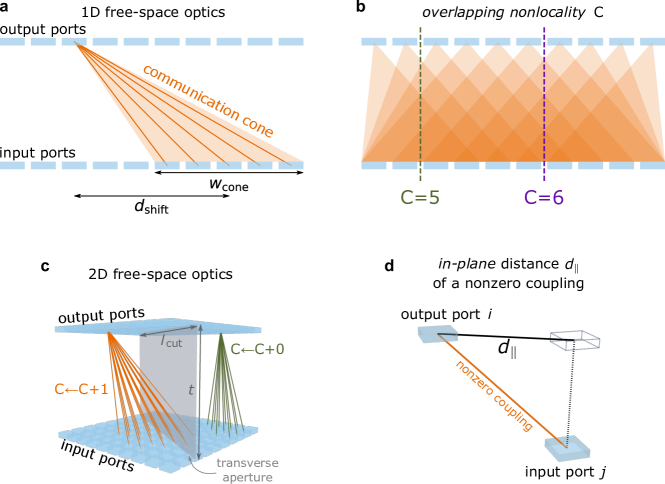
- Proposes a space-efficient neuromorphic optics framework based on structural sparsity constraints derived from wave physics, particularly 'overlapping nonlocality'.
- Applies neural pruning techniques to optical systems, adapting them to physical wave constraints rather than purely algorithmic ones.
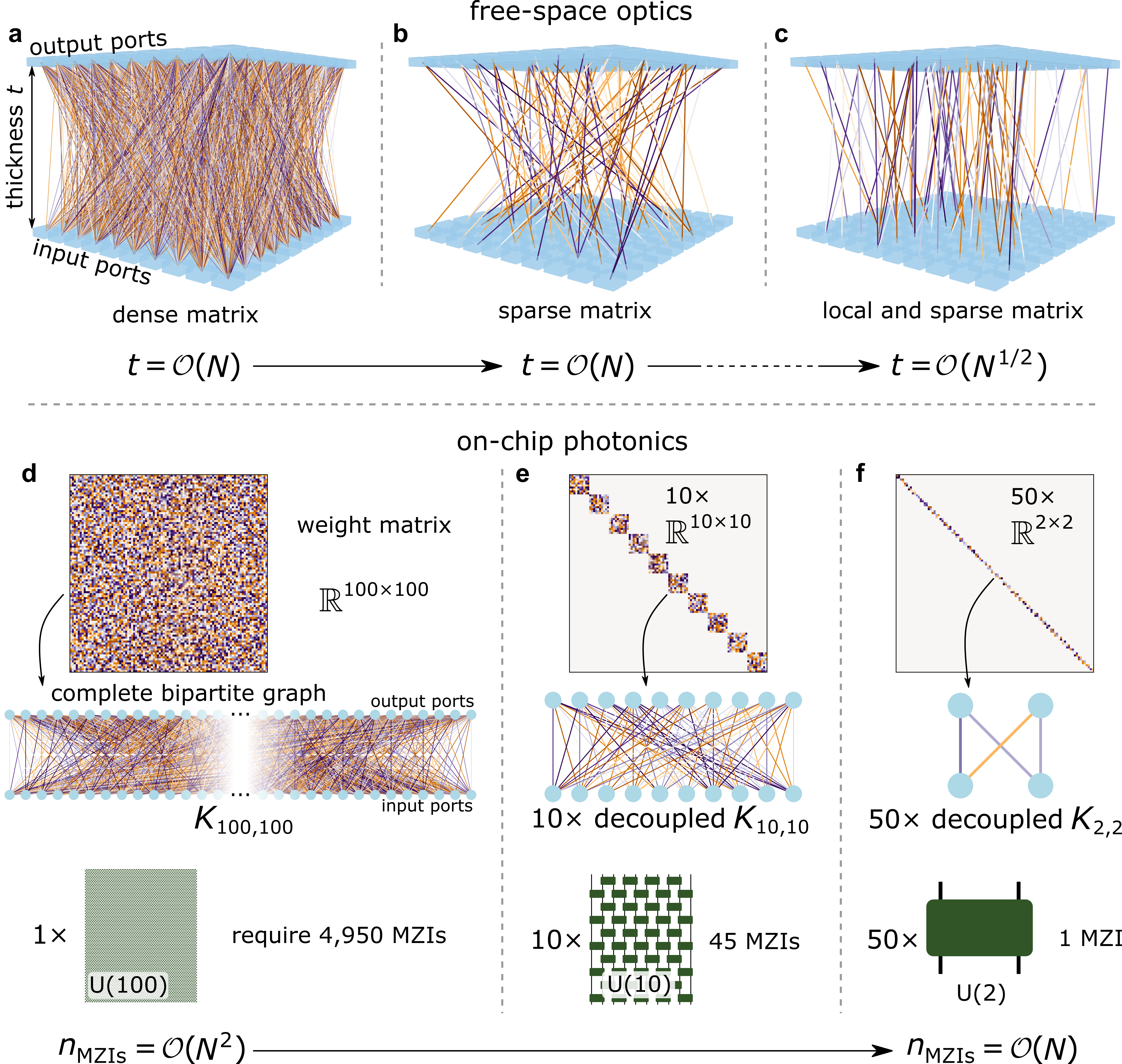
- For free-space optics, enforces a 'local sparse' kernel matrix structure where coupling coefficients are confined near the diagonal, reducing thickness scaling from O(N) to O(N^{1/2}).
- For on-chip photonic chips, implements block-diagonalization of the kernel matrix into small, decoupled complete bipartite graphs (K_{N',N'}), reducing MZI count from O(N^2) to quasi-linear O(N).
- Uses graph-theoretic interpretation to model photonic chip connectivity, enabling efficient decomposition into independent subnetworks.
- Employs computational modeling and simulations to validate the scaling laws and performance of sparse optical systems across both free-space and integrated photonic platforms.
Experimental results
Research questions
- RQ1What are the fundamental spatial scaling laws that govern the size of optical computing systems as the dimension of the computational task increases?
- RQ2How can optical computing systems be designed to achieve optimal scaling with minimal physical footprint while maintaining high accuracy?
- RQ3To what extent can structural sparsity—such as local sparsity or block-diagonalization—reduce spatial complexity without degrading performance?
- RQ4What is the nature of the space-accuracy trade-off in optical computing, and does it exhibit diminishing returns beyond a certain size?
- RQ5Can wave physics-inspired pruning methods enable a more synergistic alignment between neural network sparsity and optical hardware design?
Key findings
- The proposed space-efficient design reduces the physical size of optical computing systems to 1%-10% of conventional designs on both free-space optics and on-chip photonic platforms.
- The thickness scaling law for free-space optics is reduced from O(N) to O(N^{1/2}) when using a local sparse kernel matrix structure.
- Block-diagonalization of the kernel matrix in photonic chips reduces the number of required Mach-Zehnder interferometers from O(N^2) to quasi-linear O(N), enabling scalable integration.
- A trend of diminishing returns on accuracy is observed as spatial resources increase, indicating a balanced trade-off between size and performance.
- Optimal, pruned optical neural networks achieve comparable accuracy to unpruned networks while consuming only 1%-10% of the spatial resources.
- The study reveals that adjusting the global connectivity topology of optical systems is as critical as tuning traditional optical parameters like refractive index contrast for performance optimization.
Read this paper
Open the full text in the Nubint reader and ask about any passage as you read.
Read this paper on NubintThis review was generated by AI from the original paper. Please check the paper before citing it.