
[Paper Review] Towards quantum-enabled cell-centric therapeutics
The paper envisions using quantum computing, including quantum machine learning and optimization, to advance cell-centric therapeutics in healthcare and life sciences, and outlines potential areas, tools, and open problems for quantum-enabled research in HCLS.
In recent years, there has been tremendous progress in the development of quantum computing hardware, algorithms and services leading to the expectation that in the near future quantum computers will be capable of performing simulations for natural science applications, operations research, and machine learning at scales mostly inaccessible to classical computers. Whereas the impact of quantum computing has already started to be recognized in fields such as cryptanalysis, natural science simulations, and optimization among others, very little is known about the full potential of quantum computing simulations and machine learning in the realm of healthcare and life science (HCLS). Herein, we discuss the transformational changes we expect from the use of quantum computation for HCLS research, more specifically in the field of cell-centric therapeutics. Moreover, we identify and elaborate open problems in cell engineering, tissue modeling, perturbation modeling, and bio-topology while discussing candidate quantum algorithms for research on these topics and their potential advantages over classical computational approaches.
Motivation & Objective
- Motivate the potential of quantum computing in healthcare and life sciences (HCLS) beyond cryptography and chemistry.
- Identify areas in cell-centric therapeutics where quantum methods could offer advantages over classical approaches.
- Survey current quantum hardware, software tools, and algorithms relevant to HCLS applications.
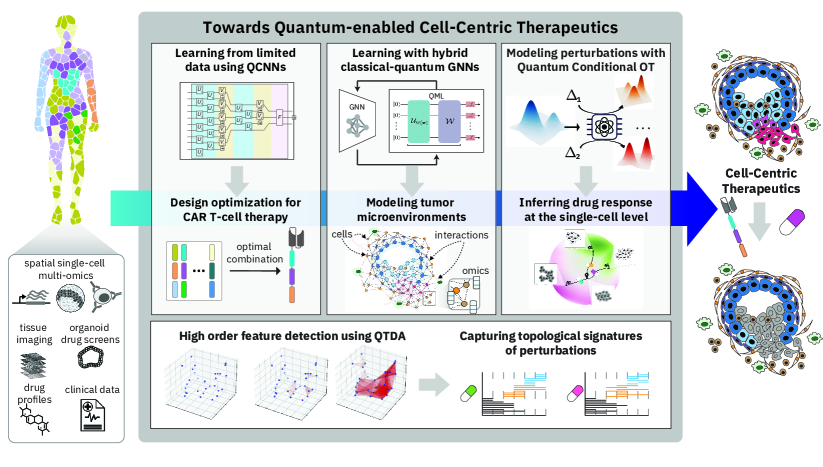
- Propose a vision for integrating single-cell and spatial-omics data with quantum-enabled workflows to design therapies.
- Highlight open problems in cell engineering, tissue modeling, perturbation modeling, and bio-topology for quantum applications.
Proposed method
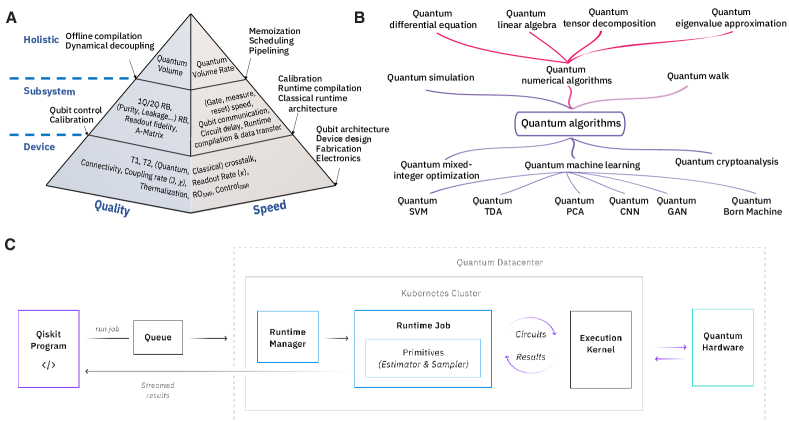
- Discuss recent advances in quantum hardware (qubits, error mitigation, circuit cutting) and their implications for HCLS workflows.
- Outline quantum toolkit and services (e.g., Qiskit Runtime) and how they enable cloud-based quantum computation for HCLS tasks.
- Review quantum algorithms relevant to HCLS, including quantum simulation (VQE, QSE, qEOM), quantum optimization (QAOA, quantum Monte Carlo), and quantum machine learning (QSVM, QNNs).
- Describe quantum data science techniques such as quantum topological data analysis, cumulant calculations, and quantum network medicine as components of a cell-centric therapeutic paradigm.
- Propose a conceptual framework for Quantum Enabled Cell-Centric Therapeutics that leverages single-cell and spatial technologies to map cellular metabolism and dynamics for therapeutic design.
- Discuss near-term vs. fault-tolerant quantum computing considerations and the need for domain-expert collaboration to identify tractable problems at scale.
Experimental results
Research questions
- RQ1What are the most promising quantum-enabled approaches to cell-centric therapeutic design?
- RQ2How can quantum machine learning and optimization improve analyses of single-cell and spatial-omics data for therapeutic discovery?
- RQ3What open problems in cell engineering, tissue modeling, perturbation modeling, and bio-topology can be addressed with quantum algorithms?
- RQ4What hardware/software developments are needed to realize practical quantum advantages for HCLS applications?
- RQ5How can quantum network medicine concepts be integrated into cell-centric therapeutic workflows?
Key findings
- Quantum hardware and software advances are expanding the feasibility of running meaningful quantum computations for HCLS tasks.
- Near-term quantum devices with error mitigation and circuit cutting can address larger problems than earlier devices, enabling early quantum-enabled experiments in healthcare contexts.
- A suite of quantum algorithms (simulation, optimization, ML) and toolkits (e.g., Qiskit Runtime) are being positioned to complement classical approaches in drug design, biomarker discovery, and tissue modeling.
- Quantum data science concepts such as quantum TDA, cumulants, redescriptions, and network medicine offer new ways to extract patterns from complex, multi-omics data.
- The paper presents a vision and roadmap for Quantum Enabled Cell-Centric Therapeutics, calling for collaboration between quantum and HCLS researchers to co-create biology-inspired quantum algorithms.
Read this paper
Open the full text in the Nubint reader and ask about any passage as you read.
Read this paper on NubintThis review was generated by AI from the original paper. Please check the paper before citing it.