
[Paper Review] TR-ARPES Signal in Pumped Semiconductors within Dynamical Projective Operatorial Approach (DPOA)
This paper introduces the Dynamical Projective Operatorial Approach (DPOA), a novel many-body theoretical framework that efficiently simulates time-resolved angle-resolved photoemission spectroscopy (TR-ARPES) in out-of-equilibrium semiconductors. By combining second-quantization formalism, Wannier-based tight-binding models, and a custom Peierls expansion in the dipole gauge, DPOA enables accurate, fast computation of multi-particle, multi-time correlation functions and captures complex pump-induced effects such as band dressing, sidebands, and resonant excitations—offering a computationally efficient alternative to TD-DFT with deeper physical insight into transient electronic structure dynamics.
In this manuscript, after discussing in detail the internals of our recently developed method, the dynamical projective operatorial approach (DPOA), we provide the framework to apply this method to pumped semiconductor lattice systems and, in particular, to study and analyze their electronic excitations and TR-ARPES signal. The expressions for relevant out-of-equilibrium Green's functions and TR-ARPES signal are given within the DPOA framework and, defining a retarded TR-ARPES signal, it is shown that it is possible to obtain an out-of-equilibrium version of the fluctuation-dissipation theorem. We clarify how single- and multi-photon resonances, rigid shifts, band dressings, and different types of sidebands emerge in the TR-ARPES signal. We also propose protocols for evaluating the strength of single- and multi-photon resonances and for assigning the residual excited electronic population at each crystal momentum and band to a specific excitation process. Hamiltonians, where intra- and inter-band transitions are selectively inhibited, are defined and used to analyze the effects on the TR-ARPES signal and the residual electronic excited population. Three relevant cases of light-matter coupling are examined within the dipole gauge: only a local dipole, only the Peierls substitution in the hopping term, and both terms at once. The transient and residual pump effects are studied in detail, including the consequences of the lattice symmetries at different crystal momenta on the TR-ARPES signal. A detailed study of the dependence of the TR-ARPES signal on the probe-pulse characteristics is also reported. To provide a guideline for understanding the complex effects and interplays and the variety of possible physical phenomena without being limited by the characteristics of a single particular real material, we have chosen to study a prototypical pumped two-band semiconductor lattice system.
Motivation & Objective
- To address the computational inefficiency and limited physical insight of existing methods like TD-DFT and single-particle approaches in simulating out-of-equilibrium TR-ARPES signals.
- To develop a framework capable of handling both weakly and strongly correlated systems while preserving the complexity of real materials through Wannierization of DFT band structures.
- To enable accurate, numerically efficient simulation of pump-probe spectroscopies by incorporating dipole gauge and Peierls substitution within a second-quantized formalism.
- To clarify the emergence of single- and multi-photon resonances, rigid shifts, and sidebands through a newly devised Peierls expansion.
- To provide a theoretical basis for assigning residual excited populations to specific excitation processes and derive an out-of-equilibrium fluctuation-dissipation theorem for TR-ARPES.
Proposed method
- DPOA employs many-body second-quantization formalism with composite operators to describe electron correlation effects in both weakly and strongly correlated systems.
- It uses Wannierization of DFT band structures to map complex real materials onto a tight-binding model with minimal degrees of freedom.
- The method incorporates the dipole gauge and Peierls substitution in the Hamiltonian to model light-matter coupling under time-dependent fields.
- A novel Peierls expansion is introduced to efficiently compute time-evolving Green's functions and clarify the origin of resonant phenomena like sidebands and band shifts.
- The approach computes multi-particle, multi-time correlation functions, enabling access to non-equilibrium spectral functions beyond single-particle approximations.
- It derives retarded and lesser Green's functions in frequency space via Fourier transformation, allowing the definition of out-of-equilibrium spectral functions and a TR-ARPES signal.
Experimental results
Research questions
- RQ1How do single- and multi-photon resonances emerge in pump-probe TR-ARPES experiments, and what is their microscopic origin in time-dependent light-matter coupling?
- RQ2To what extent can the residual electronic population after a pump pulse be assigned to specific excitation channels, and how can this be quantified?
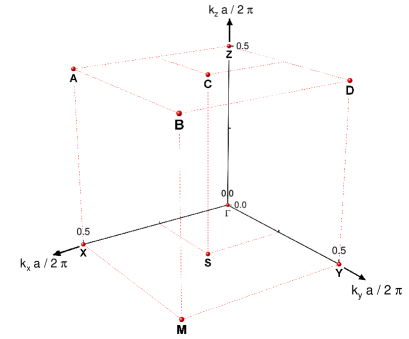
- RQ3How do lattice symmetries and crystal momentum affect the transient and residual TR-ARPES signal in a pumped two-band system?
- RQ4What is the role of the probe pulse duration and delay in shaping the observed TR-ARPES signal, and how does this affect spectral resolution?
- RQ5Can a fluctuation-dissipation-like relation be derived for out-of-equilibrium systems, and how does it relate to the TR-ARPES signal?
Key findings
- The DPOA framework successfully reproduces the emergence of sidebands and band dressing in TR-ARPES spectra, which arise from non-adiabatic transitions induced by the pump pulse.
- The method reveals that rigid band shifts and multi-photon resonances originate from the time-dependent phase accumulation in the Peierls substitution, clarified through the novel Peierls expansion.
- Residual excited populations persist at specific k-points after the pump, with their distribution reflecting the symmetry and band structure of the system, as shown in the occupied spectral function at t > 0.
- The retarded spectral function becomes negative during the pump pulse, indicating loss of physical interpretation during strong driving, but recovers equilibrium-like features post-pulse.
- The out-of-equilibrium fluctuation-dissipation theorem is derived, linking the TR-ARPES signal to the imaginary part of the retarded Green's function in the time-dependent regime.
- Comparisons with the Houston method and single-particle density matrix approach confirm that DPOA captures multi-particle effects beyond mean-field approximations.
Read this paper
Open the full text in the Nubint reader and ask about any passage as you read.
Read this paper on NubintThis review was generated by AI from the original paper. Please check the paper before citing it.