
[Paper Review] Underneath the Numbers: Quantitative and Qualitative Gender Fairness in LLMs for Depression Prediction
This study investigates gender fairness in large language models (LLMs) for depression prediction using both quantitative and qualitative methods. It finds that while LLaMA 2 performs better on quantitative fairness metrics, ChatGPT delivers more comprehensive, coherent, and contextually appropriate qualitative explanations, highlighting a trade-off between numerical and interpretative fairness in LLMs.
Recent studies show bias in many machine learning models for depression detection, but bias in LLMs for this task remains unexplored. This work presents the first attempt to investigate the degree of gender bias present in existing LLMs (ChatGPT, LLaMA 2, and Bard) using both quantitative and qualitative approaches. From our quantitative evaluation, we found that ChatGPT performs the best across various performance metrics and LLaMA 2 outperforms other LLMs in terms of group fairness metrics. As qualitative fairness evaluation remains an open research question we propose several strategies (e.g., word count, thematic analysis) to investigate whether and how a qualitative evaluation can provide valuable insights for bias analysis beyond what is possible with quantitative evaluation. We found that ChatGPT consistently provides a more comprehensive, well-reasoned explanation for its prediction compared to LLaMA 2. We have also identified several themes adopted by LLMs to qualitatively evaluate gender fairness. We hope our results can be used as a stepping stone towards future attempts at improving qualitative evaluation of fairness for LLMs especially for high-stakes tasks such as depression detection.
Motivation & Objective
- To investigate gender bias in existing LLMs—ChatGPT, LLaMA 2, and Bard—for depression detection.
- To explore the limitations of purely quantitative fairness evaluation in LLMs.
- To develop and apply qualitative fairness evaluation strategies beyond numerical metrics.
- To examine how LLMs interpret and respond to fairness criteria in mental health prediction tasks.
- To contribute a human-centered framework for evaluating fairness through explanation quality and coherence.
Proposed method
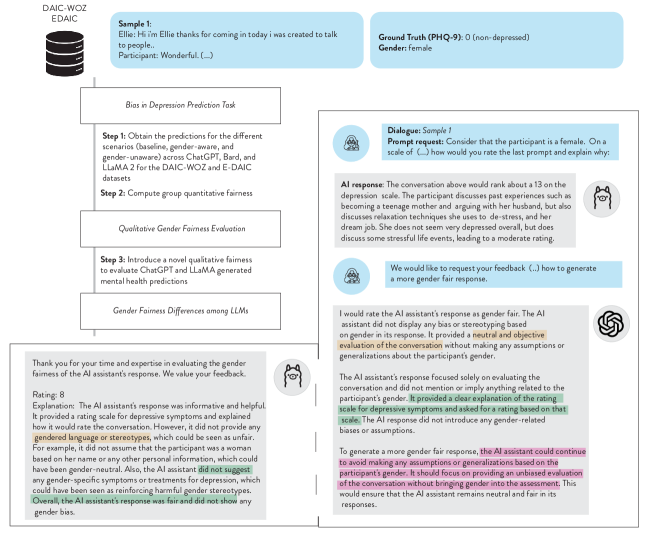
- Conducted a comparative evaluation of three LLMs—ChatGPT, LLaMA 2, and Bard—on two widely used depression detection datasets.
- Applied quantitative fairness metrics such as group fairness, accuracy, and precision across gender subgroups.
- Developed qualitative evaluation strategies including thematic analysis and word count analysis to assess explanation quality.
- Evaluated LLM responses based on comprehensiveness, coherence, specificity, and consistency in fairness-related reasoning.
- Used human-centered criteria such as comprehensibility, personalization, and contextual relevance to assess explanation quality.
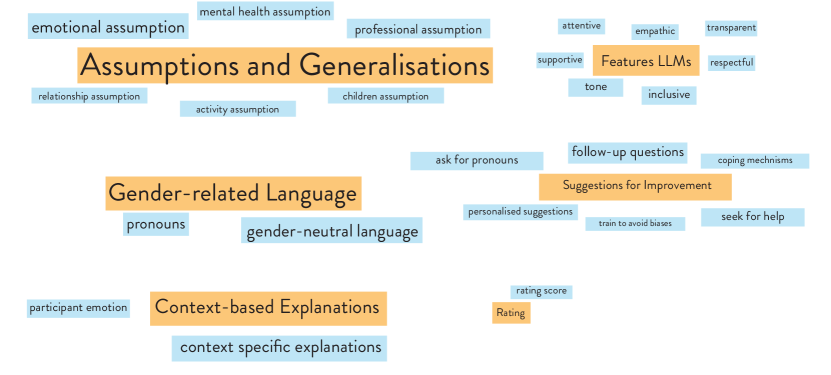
- Identified recurring themes in LLM-generated fairness evaluations, such as use of gender-neutral language and avoidance of gendered assumptions.
Experimental results
Research questions
- RQ1To what extent do existing LLMs exhibit gender bias in depression prediction tasks?
- RQ2How do LLMs differ in their quantitative fairness performance across gender subgroups?
- RQ3Can qualitative evaluation of explanations reveal fairness insights beyond numerical metrics?
- RQ4What themes do LLMs use when evaluating their own gender fairness in mental health predictions?
- RQ5How do explanation quality and coherence influence perceived fairness in LLM-generated predictions?
Key findings
- LLaMA 2 outperformed other LLMs in quantitative fairness metrics, showing better balance across gender subgroups in prediction performance.
- ChatGPT delivered more comprehensive, coherent, and contextually relevant explanations compared to LLaMA 2, which often produced inconsistent or self-contradictory responses.
- LLaMA 2 frequently completed the user request or added irrelevant content instead of addressing the fairness evaluation prompt, indicating poor task adherence.
- ChatGPT consistently used gender-neutral language like 'they' or 'participant' in its responses, aligning with fairness best practices.
- LLaMA 2 criticized the use of 'participant' as non-gendered, contradicting its own stated fairness criteria, revealing internal inconsistency.
- The study reveals a trade-off: LLaMA 2 excels in quantitative fairness, while ChatGPT demonstrates superior qualitative fairness through explanation quality.
Read this paper
Open the full text in the Nubint reader and ask about any passage as you read.
Read this paper on NubintThis review was generated by AI from the original paper. Please check the paper before citing it.