
[Paper Review] Variational preparation of entangled states on quantum computers
This paper proposes a variational quantum algorithm that uses trainable unitaries with hypergraph-based ansatzes to efficiently prepare entangled quantum states—such as GHZ, W, and absolutely maximally entangled states—on NISQ devices. By minimizing the Fubini-Study distance via gradient-based optimizers like Adam and quantum natural gradient, the method achieves polynomial circuit depth scaling (O(L)) independent of qubit count, enabling scalable, low-depth state preparation resilient to noise and barren plateaus.
We propose a variational approach for preparing entangled quantum states on quantum computers. The methodology involves training a unitary operation to match with a target unitary using the Fubini-Study distance as a cost function. We employ various gradient-based optimization techniques to enhance performance, including Adam and quantum natural gradient. Our investigation showcases the versatility of different ansatzes featuring a hypergraph structure, enabling the preparation of diverse entanglement target states such as GHZ, W, and absolutely maximally entangled states. Remarkably, the circuit depth scales efficiently with the number of layers and does not depend on the number of qubits. Moreover, we explore the impacts of barren plateaus, readout noise, and error mitigation techniques on the proposed approach. Through our analysis, we demonstrate the effectiveness of the variational algorithm in maximizing the efficiency of quantum state preparation, leveraging low-depth quantum circuits.
Motivation & Objective
- To develop a scalable, variational approach for preparing complex entangled quantum states on near-term quantum computers.
- To address the challenge of exponential circuit depth in conventional quantum state preparation methods, especially for multi-qubit entangled states.
- To enhance robustness against noise and barren plateaus in NISQ devices through optimized ansatz design and error mitigation.
- To demonstrate the effectiveness of quantum natural gradient and Adam optimization in training unitaries for state preparation.
- To enable universal state preparation for any target state using a single, adaptable framework based on quantum compilation.
Proposed method
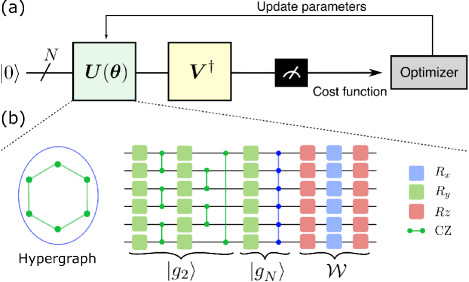
- The method employs a variational quantum circuit where a trainable unitary operation is optimized to transform a computational basis state |0⟩^⊗N into a target entangled state via unitary compilation.
- The cost function is the Fubini-Study distance between the evolved state and the target state, minimized using gradient-based optimization techniques.
- Hypergraph-based ansatzes are introduced to structure entangling gates, enabling flexible and hardware-compatible circuit designs that scale efficiently with qubit number.
- The approach uses quantum natural gradient (QNG) and Adam optimizers to improve convergence and avoid barren plateaus during training.
- Error mitigation is applied via quasi-probability decomposition using a measurement matrix M constructed from 2^N computational basis circuits.
- Circuit depth is maintained at O(L), where L is the number of layers, independent of the number of qubits N, enabling scalability.
Experimental results
Research questions
- RQ1Can a variational quantum algorithm prepare diverse entanglement classes (GHZ, W, AME) with low-depth circuits on NISQ devices?
- RQ2How does the choice of ansatz structure (e.g., hypergraph, ring, star) affect the convergence and fidelity of state preparation?
- RQ3To what extent can gradient-based optimizers like Adam and quantum natural gradient mitigate the barren plateau problem in variational state preparation?
- RQ4How effective is error mitigation in restoring fidelity under readout noise and circuit noise in the absence of full error correction?
- RQ5Can the circuit depth be decoupled from the number of qubits while maintaining high state fidelity across different entanglement classes?
Key findings
- The variational approach achieves circuit depth scaling of O(L), independent of the number of qubits N, enabling scalable preparation of entangled states.
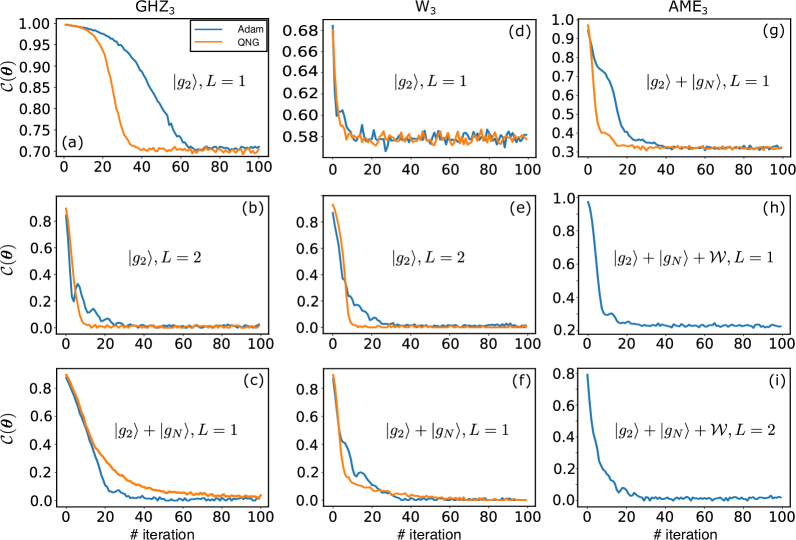
- For N=5, the W-state preparation using the |g₂⟩+|g_N⟩+𝒲 ansatz with L=2 layers achieved a Fubini-Study distance of 0.0001, indicating near-perfect state fidelity.
- Error mitigation reduced the Fubini-Study distance to near-original (noise-free) levels, with mitigation results in Fig. 4 showing effective noise suppression.
- The quantum natural gradient (QNG) optimizer outperformed standard Adam in convergence speed and robustness, particularly in high-dimensional parameter spaces.
- The method successfully prepared AME states for N=3 with a circuit depth of 22, significantly lower than the target unitary’s depth of 24, demonstrating efficiency gains.
- Barren plateau effects were observed but mitigated through careful ansatz design and optimizer choice, with average results over 10 runs showing stable convergence.
Read this paper
Open the full text in the Nubint reader and ask about any passage as you read.
Read this paper on NubintThis review was generated by AI from the original paper. Please check the paper before citing it.