
[Paper Review] Variational Quantum Fidelity Estimation
This paper introduces Variational Quantum Fidelity Estimation (VQFE), a hybrid quantum-classical algorithm that computes tunable, monotonically tightening upper and lower bounds on quantum state fidelity $F(\rho,\sigma)$ when $\rho$ is low-rank. By variational diagonalization of $\rho$, estimating $\sigma$'s matrix elements in $\rho$'s eigenbasis, and leveraging truncated fidelity, VQFE achieves $\widetilde{O}(m^6/\zeta^2)$ runtime with additive error $\gamma$ that decreases with $m$, outperforming prior bounds like SSFB in tightness and qubit requirements.
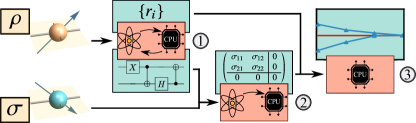
Computing quantum state fidelity will be important to verify and characterize states prepared on a quantum computer. In this work, we propose novel lower and upper bounds for the fidelity $F(ρ,σ)$ based on the "truncated fidelity" $F(ρ_m, σ)$, which is evaluated for a state $ρ_m$ obtained by projecting $ρ$ onto its $m$-largest eigenvalues. Our bounds can be refined, i.e., they tighten monotonically with $m$. To compute our bounds, we introduce a hybrid quantum-classical algorithm, called Variational Quantum Fidelity Estimation, that involves three steps: (1) variationally diagonalize $ρ$, (2) compute matrix elements of $σ$ in the eigenbasis of $ρ$, and (3) combine these matrix elements to compute our bounds. Our algorithm is aimed at the case where $σ$ is arbitrary and $ρ$ is low rank, which we call low-rank fidelity estimation, and we prove that a classical algorithm cannot efficiently solve this problem. Finally, we demonstrate that our bounds can detect quantum phase transitions and are often tighter than previously known computable bounds for realistic situations.
Motivation & Objective
- To develop an efficient, hybrid quantum-classical algorithm for estimating fidelity between a low-rank quantum state $\rho$ and an arbitrary state $\sigma$, crucial for verifying near-term quantum computations.
- To address the computational intractability of classically estimating fidelity when $\rho$ is low-rank, proven under standard complexity assumptions.
- To provide bounds on $F(\rho,\sigma)$ that tighten monotonically with $m$, the number of largest eigenvalues retained in a truncated version of $\rho$.
- To reduce resource overhead by requiring only $2n+1$ qubits, compared to $4n+1$ for prior methods like SSFB.
Proposed method
- Variational diagonalization of $\rho$ to prepare its eigenbasis, using parameterized quantum circuits to estimate the largest eigenvalues and eigenvectors.
- Estimation of matrix elements $\sigma_{ij} = \langle \psi_i | \sigma | \psi_j \rangle$ in the eigenbasis of $\rho$, using the Swap Test on $2n+1$ qubits.
- Computation of truncated fidelity $F(\rho_m, \sigma)$, where $\rho_m$ is $\rho$ projected onto its $m$ largest eigenvalues, to generate bounds.
- Construction of upper and lower bounds on $F(\rho,\sigma)$ using novel inequalities derived from the fidelity spectrum and perturbation theory.
- Use of concentration bounds and error propagation to bound the total additive error $\gamma$, which depends on $\epsilon = \|\rho - \rho_m\|_1$, $C$ (diagonalization error), and $\zeta$ (estimation precision).
- Integration of the fidelity spectrum — the set of all truncated fidelities $F(\rho_m, \sigma)$ — as a richer characterization of state similarity than $F(\rho,\sigma)$ alone.
Experimental results
Research questions
- RQ1Can we efficiently estimate quantum state fidelity when one state is low-rank, a regime where classical algorithms fail under standard assumptions?
- RQ2Can we design a hybrid quantum-classical algorithm that provides bounds on fidelity that tighten monotonically with increasing $m$, the number of retained eigenmodes?
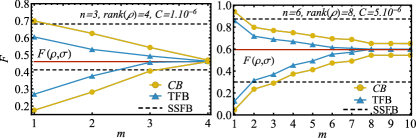
- RQ3How does the performance of our bounds compare to the state-of-the-art sub- and super-fidelity bounds (SSFB) in terms of tightness and resource cost?
- RQ4Can the fidelity spectrum provide more informative insight into the similarity between quantum states than the single fidelity value?
- RQ5What is the quantum circuit complexity and error scaling of the proposed algorithm for achieving a desired fidelity approximation precision?
Key findings
- VQFE achieves a runtime of $\widetilde{O}(m^6/\zeta^2)$, with additive error $\gamma = \sqrt{2\epsilon + (2+\sqrt{2})\sqrt{mC}} + \sqrt{\epsilon + \sqrt{mC}} + \zeta\|T\|$, where $\epsilon = \|\rho - \rho_m\|_1$, $C$ is diagonalization error, and $\zeta$ controls estimation precision.
- The algorithm outputs a $\pm\gamma$-approximation of $F(\rho,\sigma)$ with probability at least $1-\delta$, and the error $\gamma$ decreases monotonically as $m$ increases.
- VQFE requires only $2n+1$ qubits, significantly fewer than the $4n+1$ qubits required by the SSFB method, improving resource efficiency.
- In numerical demonstrations, VQFE bounds are tighter than SSFB bounds, especially in realistic low-rank scenarios, and can detect quantum phase transitions by tracking the fidelity spectrum.
- The fidelity spectrum, defined as the set of all truncated fidelities $F(\rho_m, \sigma)$, provides richer information about state similarity than the single fidelity value.
- Theoretical analysis proves that no classical algorithm can efficiently solve low-rank fidelity estimation under standard complexity assumptions, justifying the need for quantum algorithms like VQFE.
Read this paper
Open the full text in the Nubint reader and ask about any passage as you read.
Read this paper on NubintThis review was generated by AI from the original paper. Please check the paper before citing it.