
[Paper Review] Visual Chain of Thought: Bridging Logical Gaps with Multimodal Infillings
Visual Chain-of-Thought (VCoT) extends chain-of-thought prompting to the vision-language domain by generating and selecting multimodal infillings to bridge logical gaps in sequential data, improving downstream reasoning tasks like visual storytelling and WikiHow summarization through data augmentation.
Recent advances in large language models elicit reasoning in a chain-of-thought that allows models to decompose problems in a human-like fashion. Though this paradigm improves multi-step reasoning ability in language models, it is limited by being unimodal and applied mainly to question-answering tasks. We claim that incorporating visual augmentation into reasoning is essential, especially for complex, imaginative tasks. Consequently, we introduce VCoT, a novel method that leverages chain-of-thought prompting with vision-language grounding to recursively bridge the logical gaps within sequential data. Our method uses visual guidance to generate synthetic multimodal infillings that add consistent and novel information to reduce the logical gaps for downstream tasks that can benefit from temporal reasoning, as well as provide interpretability into models' multi-step reasoning. We apply VCoT to the Visual Storytelling and WikiHow summarization datasets and demonstrate through human evaluation that VCoT offers novel and consistent synthetic data augmentation beating chain-of-thought baselines, which can be used to enhance downstream performance.
Motivation & Objective
- Motivate extending chain-of-thought reasoning from text to multimodal sequences to address logical gaps.
- Propose a training-free, iterative generation-and-selection framework that creates synthetic text-visual infillings.
- Enable data augmentation for downstream sequential tasks while providing interpretable insights into multi-step reasoning.
Proposed method
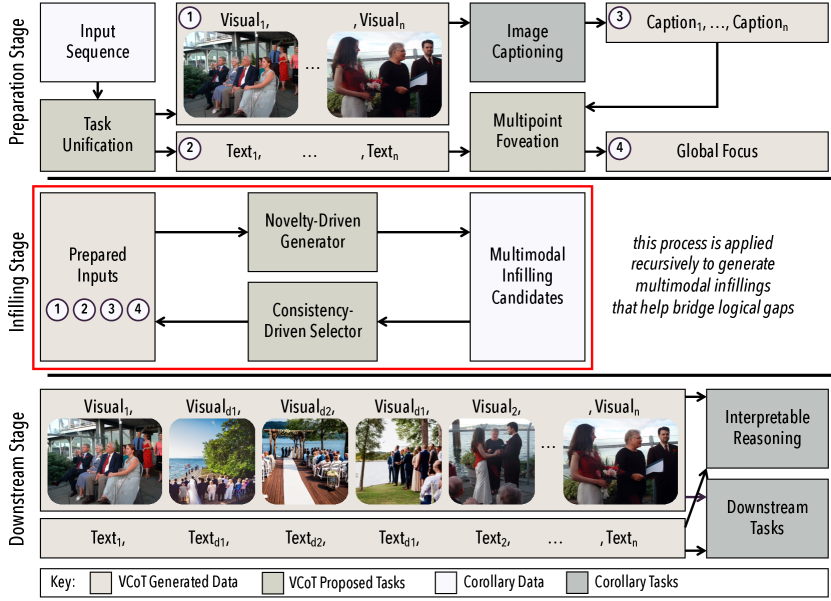
- Unify sequences into text-visual pairs by generating candidate visuals for text-only data using Stable Diffusion and selecting the most similar to the given text with CLIP.
- Extract a global focus from the input sequence via multipoint foveation to guide consistent infilling generation.
- Recursively generate multimodal infillings using a novelty- and consistency-driven approach guided by GPT-3.5 and visual grounding.
- Use Clip-based similarity to select the most consistent text and visual infillings and a fixed recursion depth (depth-limit = 2).
- Evaluate infillings with human judgments emphasizing novelty, consistency, coherence, and descriptiveness.

Experimental results
Research questions
- RQ1Can multimodal infillings generated from visual and textual context bridge logical gaps in sequential data for downstream tasks?
- RQ2Do VCoT infillings improve consistency and novelty relative to unimodal chain-of-thought baselines across vision-language tasks?
- RQ3How do synthetic multimodal augmentations affect downstream performance on visual storytelling and WikiHow-style summarization?
- RQ4What is the role of grounding and foveation in maintaining coherence across generated infillings?
Key findings
- VCoT infillings are rated higher in novelty and consistency by human evaluators than Chain-of-Thought (CoT) and Chain-of-Images (CoI) baselines.
- VCoT improves downstream performance on WikiHow summarization and visual storytelling relative to baselines, with stronger novelty gains on WikiHow and better consistency on Vist.
- Consistency is aided by multipoint foveation and CLIP-guided selection, while novelty is achieved through GPT-3.5-driven generation of text infillings and Stable Diffusion-generated visuals.
- VCoT provides multimodal interpretability of the reasoning process and acts as data augmentation that reduces logical leaps in sequential reasoning.
Read this paper
Open the full text in the Nubint reader and ask about any passage as you read.
Read this paper on NubintThis review was generated by AI from the original paper. Please check the paper before citing it.