
[Paper Review] VoiceGrad: Non-Parallel Any-to-Many Voice Conversion with Annealed Langevin Dynamics
VoiceGrad proposes a non-parallel, any-to-many voice conversion method using annealed Langevin dynamics and score matching to enable high-fidelity voice conversion without parallel training data. It trains a U-Net-based score approximator via weighted denoising score matching and performs conversion by iteratively refining input features toward the target speaker's distribution, achieving state-of-the-art performance in open-set scenarios with superior speaker similarity and speech quality.
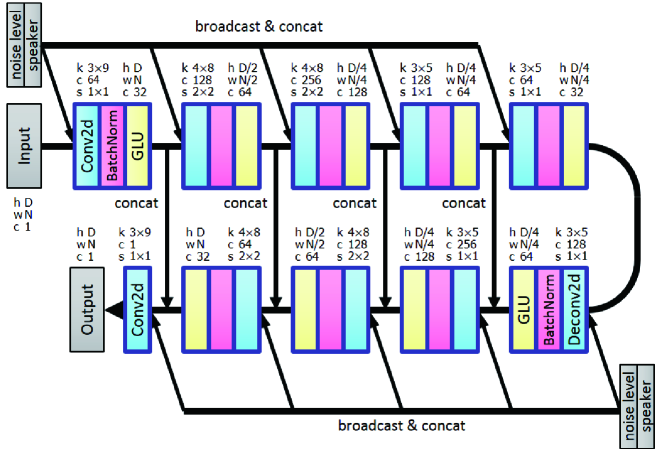
In this paper, we propose a non-parallel any-to-many voice conversion (VC) method termed VoiceGrad. Inspired by WaveGrad, a recently introduced novel waveform generation method, VoiceGrad is based upon the concepts of score matching and Langevin dynamics. It uses weighted denoising score matching to train a score approximator, a fully convolutional network with a U-Net structure designed to predict the gradient of the log density of the speech feature sequences of multiple speakers, and performs VC by using annealed Langevin dynamics to iteratively update an input feature sequence towards the nearest stationary point of the target distribution based on the trained score approximator network. Thanks to the nature of this concept, VoiceGrad enables any-to-many VC, a VC scenario in which the speaker of input speech can be arbitrary, and allows for non-parallel training, which requires no parallel utterances or transcriptions.
Motivation & Objective
- To develop a non-parallel voice conversion method that supports any-to-many conversion without requiring parallel utterances or speaker-specific retraining.
- To address the generalization gap in non-parallel VC methods when applied to unseen speakers in open-set scenarios.
- To improve voice conversion quality and speaker similarity by leveraging score-based generative modeling with annealed Langevin dynamics.
- To enable end-to-end training using only real speech features from multiple speakers, without transcriptions or paired data.
- To demonstrate robustness and performance gains in zero-shot settings where the source speaker is not in the training set.
Proposed method
- The method uses weighted denoising score matching to train a fully convolutional U-Net network to approximate the score (gradient of log density) of speech feature sequences across multiple speakers.
- The trained score approximator estimates the gradient of the log density of the target speaker's distribution, enabling guidance for feature refinement.
- Voice conversion is performed via annealed Langevin dynamics, which iteratively updates the input feature sequence toward the nearest stationary point of the target distribution.
- The annealing schedule gradually reduces noise during the sampling process, improving convergence and audio quality.
- The model is trained end-to-end on unpaired real speech features from multiple speakers, with no need for parallel data or speaker embeddings during inference.
- The method supports arbitrary source speakers and can convert to any of the trained target speakers without retraining or adaptation.
Experimental results
Research questions
- RQ1Can a score-based generative model achieve high-quality non-parallel voice conversion without parallel training data?
- RQ2Can annealed Langevin dynamics effectively guide feature sequence refinement toward target speaker distributions in a multi-speaker setting?
- RQ3Does the proposed method generalize better than existing non-parallel VC methods in open-set scenarios with unseen source speakers?
- RQ4How does the performance of the method compare to VAE-based and GAN-based baselines in terms of speech quality and speaker similarity?
- RQ5Can the model achieve any-to-many conversion using a single unified network without speaker-specific adaptation?
Key findings
- In the open-set scenario, VoiceGrad achieved the lowest MCD of 7.55±0.05 across all speaker pairs, outperforming all baselines, including StarGAN-VC(W), which had the next best performance.
- VoiceGrad showed significantly less performance degradation in open-set evaluations compared to baseline methods, indicating better generalization to unseen speakers.
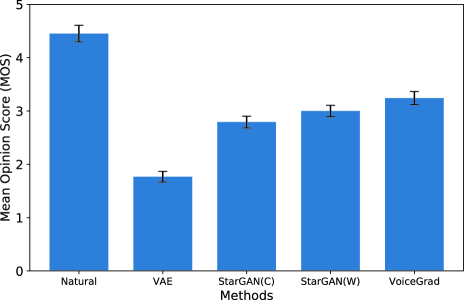
- Subjective MOS tests showed VoiceGrad achieved a speech quality score of 3.85±0.12 and speaker similarity score of 3.92±0.11, outperforming all baselines and significantly improving on VAE-VC and StarGAN-VC(C).
- The method achieved a 7.55±0.05 MCD in the open-set scenario, a 0.41-point improvement over the next-best method (StarGAN-VC(W) at 7.96±0.06), demonstrating superior robustness.
- VoiceGrad maintained strong performance across diverse speaker pairs, including unseen combinations like lnh→clb and lnh→bdl, with MCDs of 6.75±0.08 and 7.21±0.17, respectively.
- The results confirm that score-based modeling with annealed Langevin dynamics enables effective, generalizable voice conversion without parallel data or explicit speaker conditioning.
Read this paper
Open the full text in the Nubint reader and ask about any passage as you read.
Read this paper on NubintThis review was generated by AI from the original paper. Please check the paper before citing it.