
[Paper Review] Vorticity Suppression by Particle Lag Effects in Shock-Driven Multiphase Instability
This study investigates how particle lag effects suppress vorticity and mixing in shock-driven multiphase instability (SDMI) using solid, nondeforming particles to isolate momentum transfer dynamics. By varying particle size while holding effective density ratio constant, experiments show that increasing particle relaxation time reduces circulation and mixing, leading to a new theoretical model predicting circulation deposition based on shock strength, effective density ratio, and particle response time.
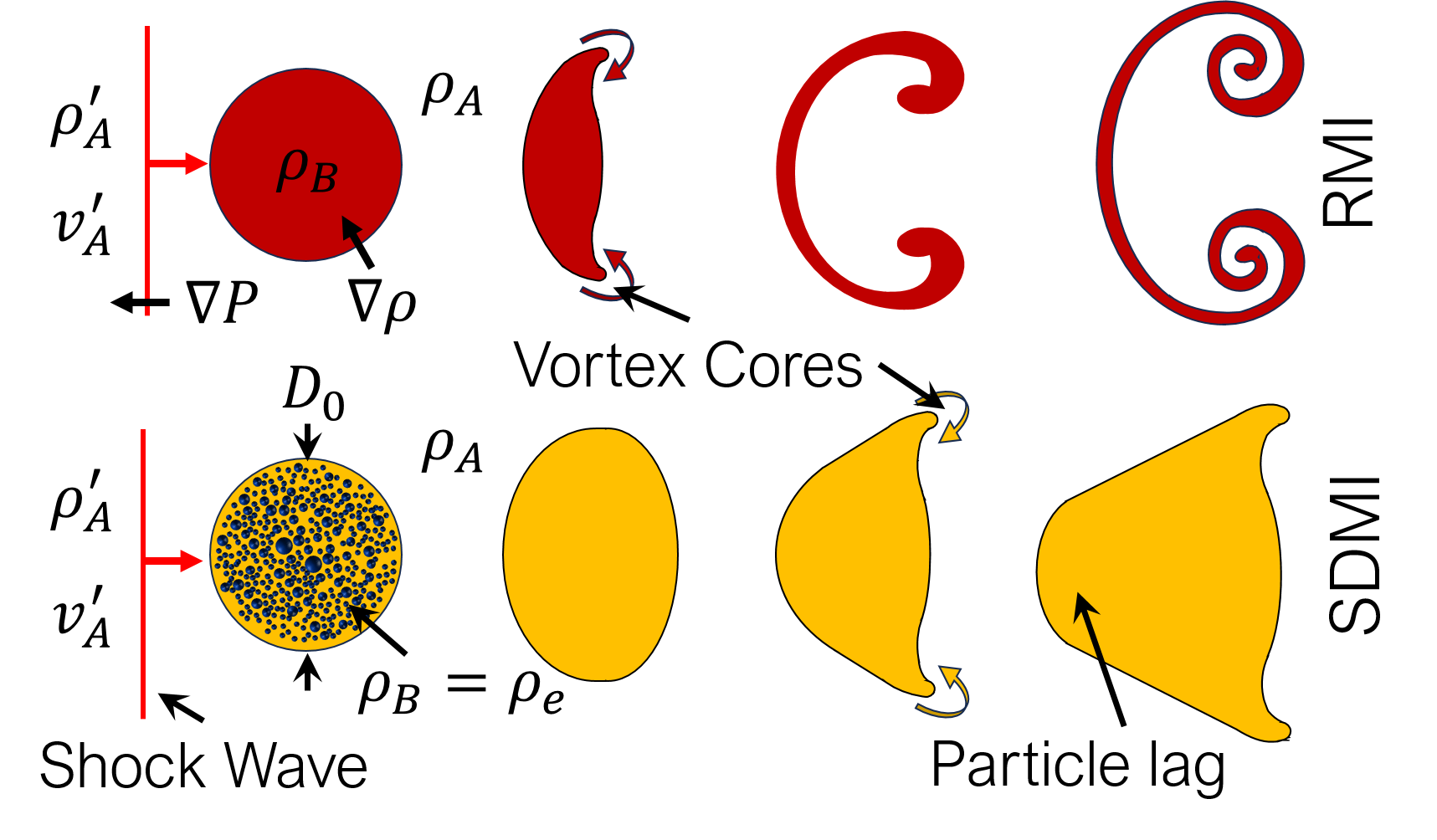
Shock-driven multiphase mixing occurs in many physical systems such as explosive dispersal of chemical or biological agents, in the evolution of supernova remnants, and in supersonic and detonative combustion engines. This mixing process is driven by the Shock Driven Multiphase Instability (SDMI), a derivative of the canonical Richtmyer-Meshkov Instability (RMI). The SDMI deviates from the RMI as particle lag effects become significant, where a higher momentum deficit leads to longer equilibration times and a reduction in hydrodynamic mixing. In this work, the effect of particle lag (rate of momentum transfer) on the SDMI evolution was isolated and investigated utilizing solid nondeforming and nonevaporating particles of differing sizes while holding the effective density ratio (mass of particles in the interface) constant. Three particle sizes were selected with increasing velocity relaxation times. Experiments were conducted by accelerating a cylindrical interface comprised of air and seeded particles surrounded by clean (particle-free) air with a Mach 1.35 shock wave. The development of the multiphase interface was measured using particle imaging velocimetry (PIV). Circulation measurements showed a decrease in mixing with increasing particle size. Finally, a new model, derived from theory, is proposed to predict circulation deposition, mixing energy, in the SDMI based on shock strength, effective density ratio, and particle response times.
Motivation & Objective
- To isolate and quantify the effect of particle lag (momentum transfer rate) on vorticity and mixing in shock-driven multiphase instability (SDMI), independent of droplet breakup, evaporation, or deformation.
- To investigate how increasing particle size—leading to longer velocity relaxation times—affects the development of hydrodynamic mixing and circulation in a shocked cylindrical interface.
- To develop and validate a theoretical model for circulation deposition in SDMI that accounts for finite particle response times, extending classical Richtmyer-Meshkov Instability (RMI) theory.
- To provide a framework for predicting mixing suppression in applications such as supersonic combustion and inertial confinement fusion where particle-laden flows are critical.
Proposed method
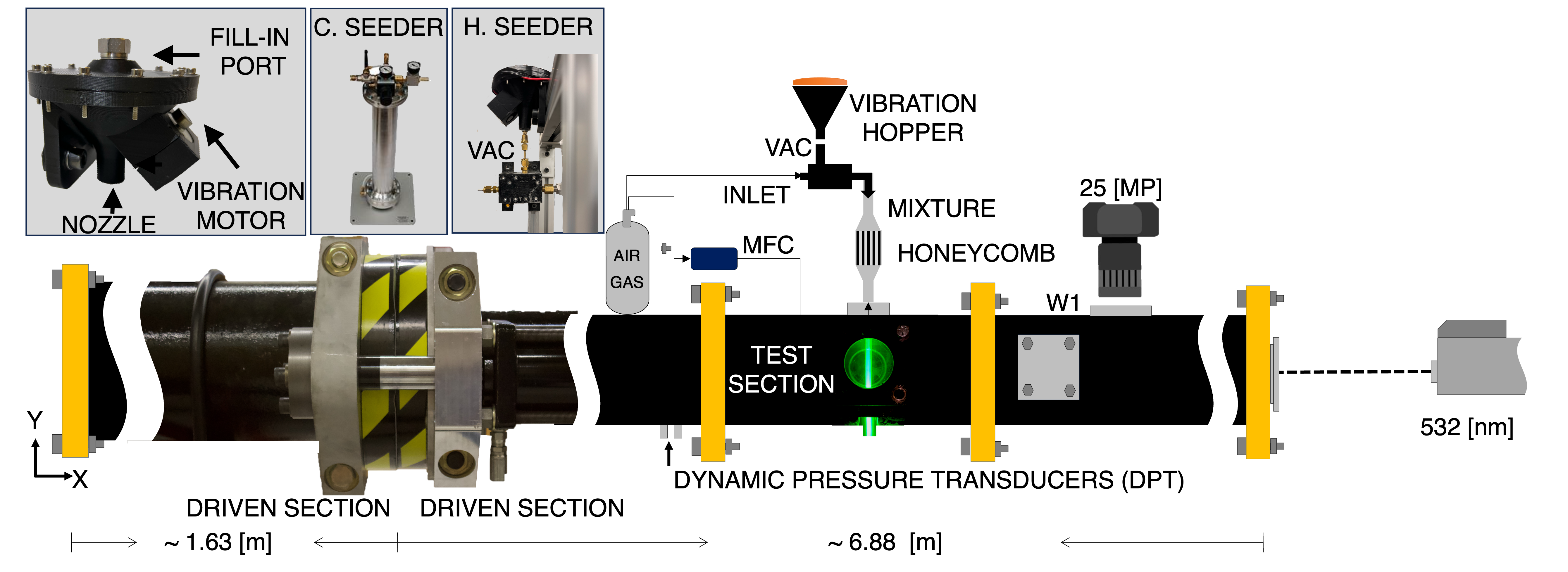
- Experiments used a Mach ∼1.35 shock wave to impulsively accelerate a cylindrical interface composed of air and solid, nondeforming, non-evaporating particles of three distinct sizes (1–10 μm), with effective density ratio held constant.
- Particle imaging velocimetry (PIV) was applied to Mie-scattering images of the particle field to measure velocity fields and compute vorticity and circulation via line integrals around vortex cores.
- Circulation was quantified as the line integral of velocity around closed contours enclosing vortex structures, with results averaged over ten trials for statistical reliability.
- A theoretical model was derived from the multiphase vorticity equation, incorporating baroclinic vorticity generation and particle drag force as a body force, with separate formulations for local and total circulation.
- The model was validated against experimental data, simulations from prior studies, and experimental data from other sources, with adjustments for resolution and breakup effects.
- Particle size was characterized ex-situ via scanning electron microscopy and in-situ via phase Doppler particle anemometry to ensure accurate relaxation time estimation.
Experimental results
Research questions
- RQ1How does increasing particle size—specifically particle relaxation time—affect vorticity generation and circulation in shock-driven multiphase instability?
- RQ2To what extent does particle lag suppress hydrodynamic mixing and vortex core development in a shocked particle-laden interface?
- RQ3Can a theoretical model based on the vorticity equation and momentum transfer dynamics accurately predict circulation reduction due to particle lag?
- RQ4How do the predictions of the proposed model compare with experimental data and prior simulations, especially when breakup and evaporation effects are absent?
- RQ5What role does the alignment of vorticity and the body force source term play in the persistence of circulation over time in multiphase flows?
Key findings
- Circulation decreased significantly with increasing particle size, indicating stronger suppression of vorticity and mixing due to longer particle relaxation times.
- The small-particle case (1 μm) exhibited behavior consistent with classical Richtmyer-Meshkov Instability (RMI), showing strong vortex formation and high circulation.
- The large-particle case (10 μm) showed minimal vortex core development and a long trailing tail of particles, indicating severe suppression of hydrodynamic mixing.
- The proposed local circulation model showed strong agreement with experimental data and prior simulations, particularly when accounting for vorticity diffusion and dissipation of advected vorticity.
- Discrepancies in circulation for larger particles were attributed to breakup and evaporation effects in prior simulations and experiments, which reduce effective particle lag time.
- The study demonstrates that only vorticity generated locally near the interface persists over time, supporting the use of local circulation models for predicting mixing suppression in particle-laden flows.
Read this paper
Open the full text in the Nubint reader and ask about any passage as you read.
Read this paper on NubintThis review was generated by AI from the original paper. Please check the paper before citing it.