
[Paper Review] Weak-Mamba-UNet: Visual Mamba Makes CNN and ViT Work Better for Scribble-based Medical Image Segmentation
Weak-Mamba-UNet combines CNN, Vision Transformer, and Visual Mamba networks under a scribble-based weak supervision framework to improve medical image segmentation through cross-supervised learning and pseudo-labeling.
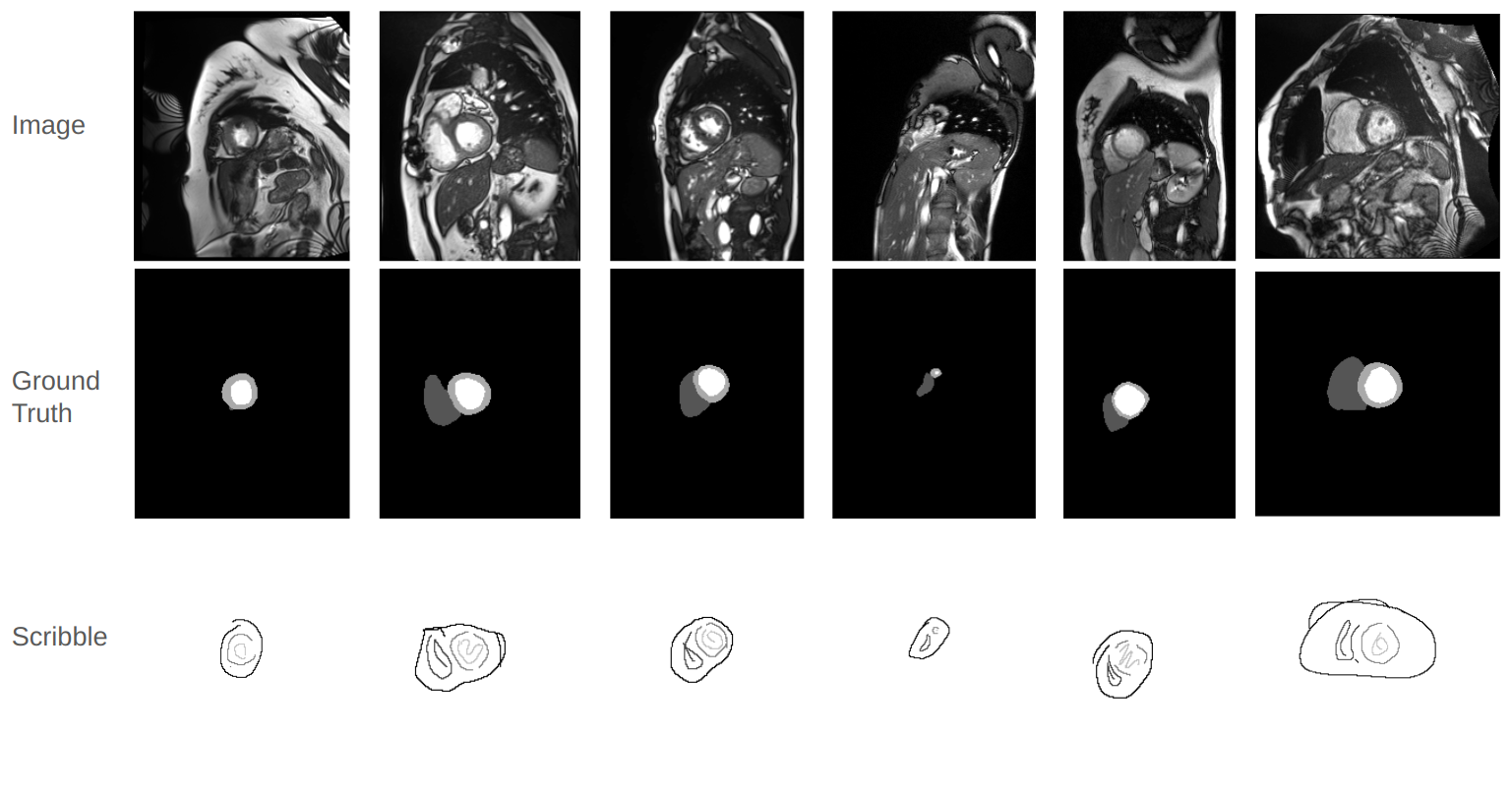
Medical image segmentation is increasingly reliant on deep learning techniques, yet the promising performance often come with high annotation costs. This paper introduces Weak-Mamba-UNet, an innovative weakly-supervised learning (WSL) framework that leverages the capabilities of Convolutional Neural Network (CNN), Vision Transformer (ViT), and the cutting-edge Visual Mamba (VMamba) architecture for medical image segmentation, especially when dealing with scribble-based annotations. The proposed WSL strategy incorporates three distinct architecture but same symmetrical encoder-decoder networks: a CNN-based UNet for detailed local feature extraction, a Swin Transformer-based SwinUNet for comprehensive global context understanding, and a VMamba-based Mamba-UNet for efficient long-range dependency modeling. The key concept of this framework is a collaborative and cross-supervisory mechanism that employs pseudo labels to facilitate iterative learning and refinement across the networks. The effectiveness of Weak-Mamba-UNet is validated on a publicly available MRI cardiac segmentation dataset with processed scribble annotations, where it surpasses the performance of a similar WSL framework utilizing only UNet or SwinUNet. This highlights its potential in scenarios with sparse or imprecise annotations. The source code is made publicly accessible.
Motivation & Objective
- Motivate the use of scribble-based annotations to reduce labeling costs in medical image segmentation.
- Propose a multi-view, cross-supervised framework that jointly trains CNN, ViT, and VMamba architectures under weak supervision.
- Introduce pseudo-labeling to convert sparse scribble supervision into dense signal guidance for all networks.
- Demonstrate that integrating CNN, ViT, and VMamba yields superior segmentation performance on MRI cardiac data compared to single-backbone weakly supervised methods.
Proposed method
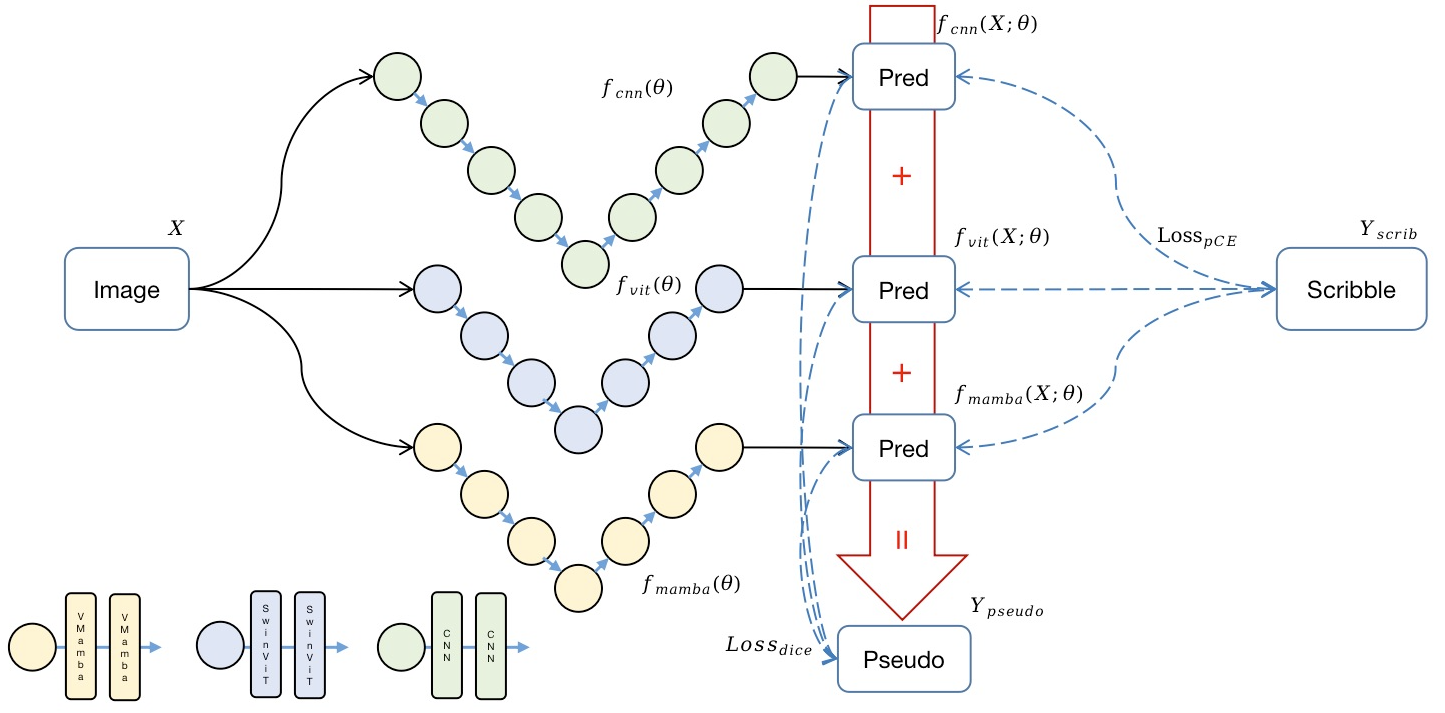
- Three encoder–decoder backbones are used: UNet (CNN), SwinUNet (ViT), and MambaUNet (Visual Mamba).
- A partial cross-entropy loss is applied to scribble-labeled pixels (ignoring unlabeled regions).
- A dense pseudo label is created by a weighted combination of the three networks’ predictions (Ypseudo = α fcnn + β ftjn + γ fmamba, with random α, β, γ per iteration and α+β+γ=1).
- Dice-coefficient loss is used with the argmax of predictions and Ypseudo to provide dense supervision for all networks.
- Loss combines per-network scribble loss and dice loss: Ltotal = sum_i (Lpce^i + Ldice^i) for i ∈ {CNN, ViT, Mamba}.
- Networks are initialized separately (UNet, SwinUNet, MambaUNet) to promote diverse views, enabling cross-supervision.”],
- research_questionsuziational_parts
- research_questions (RQ) : ["Does incorporating CNN, ViT, and VMamba under a cross-supervised, scribble-based scheme improve segmentation performance compared to single-backbone WSL methods?","Can pseudo-labels generated from multi-view predictions enhance dense supervision without dense annotations?","How does the VMamba architecture contribute to long-range dependency modeling and overall segmentation accuracy in a WSL setting?"]
- key_findings
- - Weak-Mamba-UNet achieves the best Dice, accuracy, precision, sensitivity, and specificity among tested weakly supervised frameworks on the MRI cardiac dataset.
- - It also attains the lowest Hausdorff Distance (HD) and Average Surface Distance (ASD) compared with baselines.
- - Ablation shows that combining UNet, SwinUNet, and MambaUNet yields superior results versus any single backbone, with the UNet+SwinUNet+MambaUNet (Ours) configuration achieving strong metrics.
- - The framework outperforms pCE/USTM/Mumford/Gated CRF baselines across multiple metrics, demonstrating the benefit of cross-view collaboration under scribble supervision.
- - SwinUNet-based WSL methods generally outperform UNet-based ones, but the multi-view combination surpasses both, highlighting feature diversity from heterogeneous architectures.
- - The approach reduces annotation costs while preserving high segmentation accuracy, leveraging the Visual Mamba's long-range modeling capabilities.
- table_headers":["Network","Dice ↑","Acc ↑","Pre ↑","Sen ↑","Spe ↑","HD ↓","ASD ↓"],"table_rows":[["pCE + UNet", "0.7620", "0.9807", "0.6799", "0.9174", "0.9823", "151.0593", "54.6531"],["USTM + UNet", "0.8592", "0.9917", "0.8128", "0.9257", "0.9888", "99.8293", "26.0185"],["Mumford + UNet", "0.8993", "0.9950", "0.8844", "0.9200", "0.9874", "28.0604", "7.3907"],["Gated CRF + UNet", "0.9046", "0.9955", "0.8890", "0.9304", "0.9922", "7.4340", "2.0753"],["pCE + SwinUNet", "0.8935", "0.9950", "0.8808", "0.9129", "0.9884", "24.4750", "6.9108"],["USTM + SwinUNet", "0.9044", "0.9957", "0.8952", "0.9187", "0.9898", "6.5172", "2.2319"],["Mumford + SwinUNet", "0.9051", "0.9958", "0.8996", "0.9157", "0.9889", "6.0653", "1.6482"],["Gated CRF + SwinUNet", "0.8995", "0.9955", "0.8920", "0.9175", "0.9904", "6.6559", "1.6222"],["Weak-Mamba-UNet", "0.9171", "0.9963", "0.9095", "0.9309", "0.9920", "3.9597", "0.8810"]],"empty":false}
- table_headers_2":["Network","Dice ↑","Acc ↑","Pre ↑","Sen ↑","Spe ↑","HD ↓","ASD ↓"],"table_rows_2":[["3 × UNet", "0.9141", "0.9959", "0.8958", "0.9383", "0.9927", "8.0566", "2.8806"],["3 × SwinUNet", "0.7446", "0.9791", "0.6555", "0.9142", "0.9815", "121.4224", "51.4317"],["3 × MambaUNet", "0.9128", "0.9958", "0.8931", "0.9395", "0.9932", "8.3386", "2.7928"],["UNet+SwinUNet+MambaUNet(Ours)", "0.9171", "0.9963", "0.9095", "0.9309", "0.9920", "3.9597", "0.8810"]]} }
Experimental results
Research questions
- RQ1How does a cross-supervised, multi-view framework with CNN, ViT, and VMamba perform under scribble-based supervision compared to single-backbone WSL methods?
- RQ2Can pseudo-labels derived from diverse backbones improve dense segmentation with limited annotations?
- RQ3What is the contribution of the Visual Mamba architecture to long-range dependency modeling in this context?
Key findings
- Weak-Mamba-UNet achieves the best Dice, accuracy, precision, sensitivity, and specificity among tested WSL methods on the MRI cardiac dataset.
- It also attains the lowest 95% Hausdorff Distance (HD) and Average Surface Distance (ASD) compared with baselines.
- Ablation shows that the UNet+SwinUNet+MambaUNet configuration outperforms any single backbone or two-backbone combinations.
- SwinUNet-based WSL methods generally outperform UNet-based ones, but the multi-view integration yields further gains.
- The approach demonstrates that cross-view collaboration under scribble supervision can yield high segmentation performance with reduced annotation costs.
Read this paper
Open the full text in the Nubint reader and ask about any passage as you read.
Read this paper on NubintThis review was generated by AI from the original paper. Please check the paper before citing it.