
[Paper Review] What Twitter Data Tell Us about the Future?
This study analyzes over 1 million tweets from Twitter futurists using LDA and BERTopic to model anticipated futures, revealing 15 topics via LDA and 100 distinct topics via BERTopic. It identifies 'future present' futures—dynamic, evolving conceptualizations of potential futures—that influence social media users to anticipate and act proactively, demonstrating that language cues from influential voices shape collective anticipatory behavior through scalable NLP pipelines and open-sourced data and code.
Anticipation is a fundamental human cognitive ability that involves thinking about and living towards the future. While language markers reflect anticipatory thinking, research on anticipation from the perspective of natural language processing is limited. This study aims to investigate the futures projected by futurists on Twitter and explore the impact of language cues on anticipatory thinking among social media users. We address the research questions of what futures Twitter's futurists anticipate and share, and how these anticipated futures can be modeled from social data. To investigate this, we review related works on anticipation, discuss the influence of language markers and prestigious individuals on anticipatory thinking, and present a taxonomy system categorizing futures into "present futures" and "future present". This research presents a compiled dataset of over 1 million publicly shared tweets by future influencers and develops a scalable NLP pipeline using SOTA models. The study identifies 15 topics from the LDA approach and 100 distinct topics from the BERTopic approach within the futurists' tweets. These findings contribute to the research on topic modelling and provide insights into the futures anticipated by Twitter's futurists. The research demonstrates the futurists' language cues signals futures-in-the-making that enhance social media users to anticipate their own scenarios and respond to them in present. The fully open-sourced dataset, interactive analysis, and reproducible source code are available for further exploration.
Motivation & Objective
- To investigate the types of futures projected by Twitter-based futurists and how they influence public anticipatory thinking.
- To examine the role of language markers and prestigious individuals in shaping social media users' anticipation of future scenarios.
- To develop a scalable NLP pipeline for modeling anticipated futures from social media data.
- To create a publicly available, reproducible dataset and analysis framework for future research on anticipatory rhetoric and social forecasting.
Proposed method
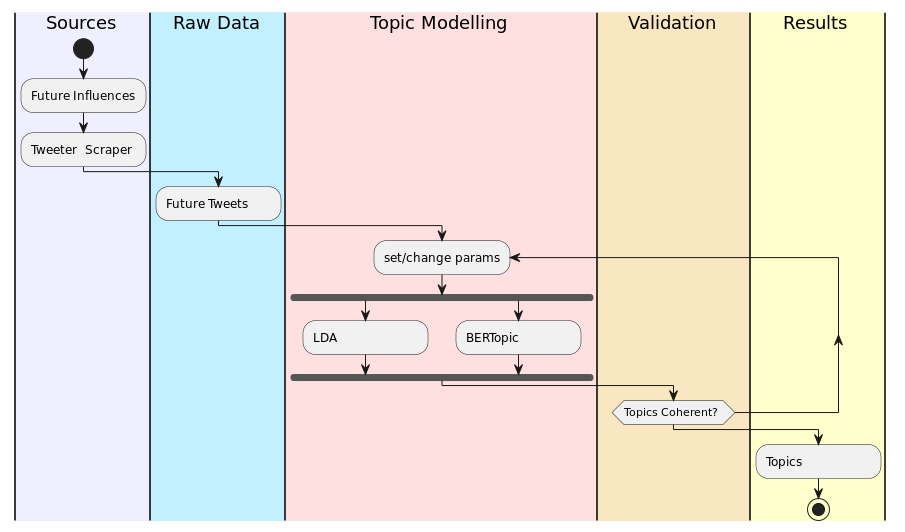
- Collected over 1 million publicly shared tweets from verified Twitter futurists using web scraping under the constraints of the Twitter Academic API and data availability considerations.
- Pre-processed the text data through standard NLP techniques, including cleaning, tokenization, and removal of noise, to prepare for topic modeling.
- Applied Latent Dirichlet Allocation (LDA) for topic modeling to identify 15 broad thematic clusters in the futurist tweets.
- Employed BERTopic, a transformer-based topic modeling approach, to extract 100 more granular and semantically coherent topics from the same dataset.
- Developed a scalable, SOTA-compliant NLP pipeline tailored for short-form social media text, leveraging contextual embeddings and clustering.
- Released the full dataset, interactive visualizations, and source code via the Open Science Framework for reproducibility and community reuse.
Experimental results
Research questions
- RQ1RQ.1: What futures do Twitter’s futurists anticipate and share?
- RQ2RQ.2: How can anticipated futures be modeled from social data using NLP techniques?
- RQ3RQ.3: How do language cues from influential futurists affect social media users’ anticipatory behavior?
- RQ4RQ.4: What is the structure and evolution of 'future present' conceptualizations in online discourse?
Key findings
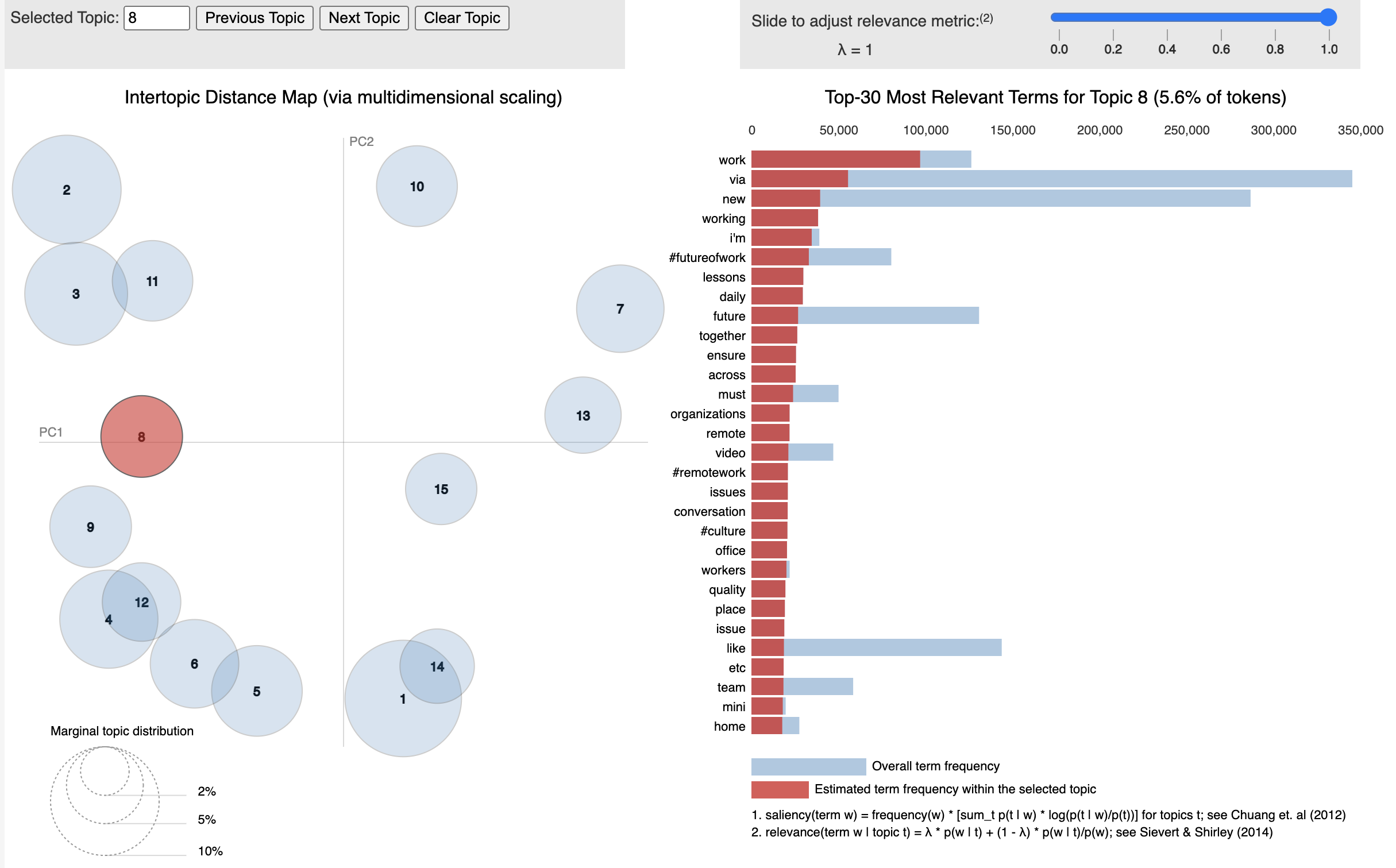
- The LDA model identified 15 broad thematic topics in the tweets of Twitter futurists, representing high-level anticipatory narratives.
- The BERTopic model uncovered 100 distinct, semantically rich topics, demonstrating superior granularity and interpretability compared to LDA.
- The majority of projected futures were categorized as 'future present'—dynamic, evolving, and non-predetermined conceptualizations of potential futures.
- These 'future present' futures are not fixed but represent living, malleable visions that compel users to anticipate and respond proactively.
- Language cues from influential futurists act as signals that enhance social media users’ ability to anticipate and prepare for multiple possible futures.
- The study demonstrates that social media data, particularly from thought leaders, can be effectively modeled to extract and analyze anticipatory narratives at scale.
Read this paper
Open the full text in the Nubint reader and ask about any passage as you read.
Read this paper on NubintThis review was generated by AI from the original paper. Please check the paper before citing it.