
[Paper Review] XFL: A High Performace, Lightweighted Federated Learning Framework
XFL is a high-performance, lightweight, and production-ready federated learning framework that supports both horizontal and vertical federated learning with strong privacy guarantees through homomorphic encryption, differential privacy, and secure multi-party computation. It achieves superior training efficiency and convergence—especially under non-IID data—by integrating optimized algorithms like FedProx and Scaffold, and enables rapid deployment via Docker with support for PyTorch, TensorFlow, and other deep learning frameworks.
This paper introduces XFL, an industrial-grade federated learning project. XFL supports training AI models collaboratively on multiple devices, while utilizes homomorphic encryption, differential privacy, secure multi-party computation and other security technologies ensuring no leakage of data. XFL provides an abundant algorithms library, integrating a large number of pre-built, secure and outstanding federated learning algorithms, covering both the horizontally and vertically federated learning scenarios. Numerical experiments have shown the prominent performace of these algorithms. XFL builds a concise configuration interfaces with presettings for all federation algorithms, and supports the rapid deployment via docker containers.Therefore, we believe XFL is the most user-friendly and easy-to-develop federated learning framework. XFL is open-sourced, and both the code and documents are available at https://github.com/paritybit-ai/XFL.
Motivation & Objective
- Address the gap between academic federated learning frameworks and industrial deployment needs by building a production-ready, user-friendly system.
- Provide comprehensive support for both horizontal and vertical federated learning scenarios with secure, privacy-preserving algorithms.
- Overcome performance bottlenecks in communication and computation by optimizing for high-latency and unstable network environments.
- Enable seamless integration with mainstream deep learning frameworks (PyTorch, TensorFlow, etc.) and hardware accelerators (GPU, FPGA).
- Facilitate rapid development and customization through a modular, extensible architecture with plug-in components for encryption, communication, and aggregation.
Proposed method
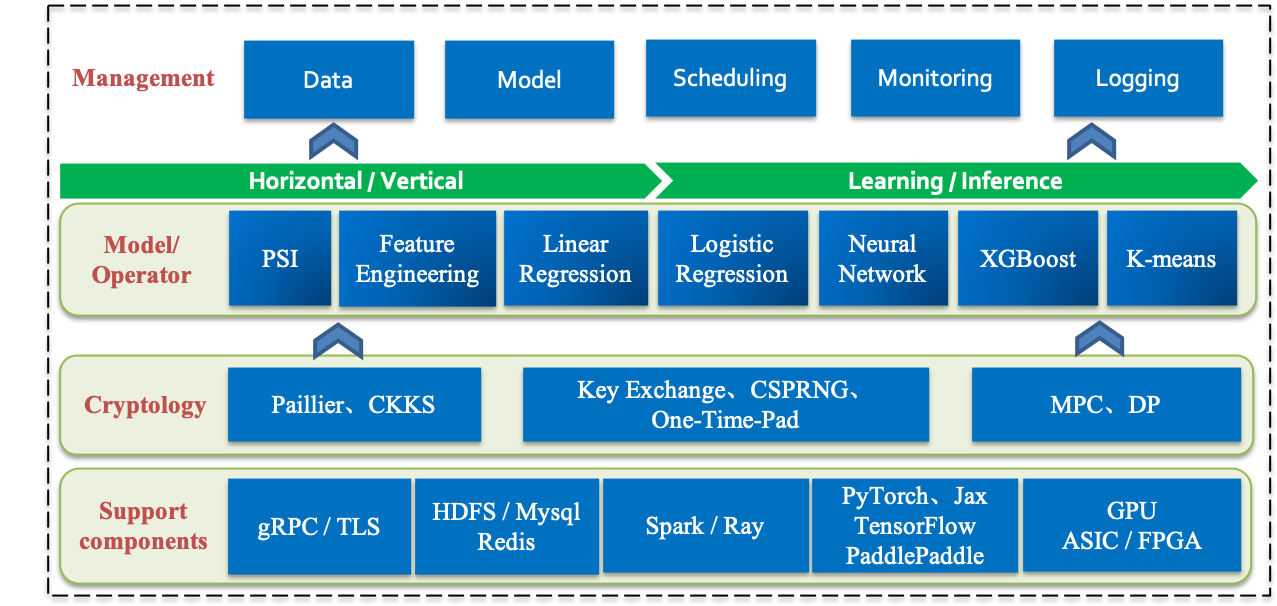
- Architects XFL with a 4-layer stack: support components (gRPC, Redis, HDFS, MySQL), cryptographic components (homomorphic encryption, differential privacy, secure multi-party computation), federated learning algorithms (FedAvg, FedProx, Scaffold), and a unified configuration interface.
- Leverages gRPC for secure, efficient inter-node communication and Redis for low-latency coordination in federated training.
- Integrates multiple encryption schemes—Paillier for vertical federated learning and CKKS for high-precision computation—ensuring data privacy during model aggregation.
- Supports distributed training across CPU and GPU, with hardware acceleration via ASIC/FPGA, and enables large-scale data processing using Spark.
- Provides a Docker-based deployment pipeline for rapid, reproducible, and scalable production use.
- Offers a plug-in architecture for encryption, communication, and aggregation modules, enabling easy extension and customization of algorithms.
Experimental results
Research questions
- RQ1How can a federated learning framework be designed to be both production-ready and user-friendly for industrial data scientists?
- RQ2What performance improvements can be achieved in vertical federated learning using optimized encryption and aggregation techniques?
- RQ3How do advanced aggregation algorithms like FedProx and Scaffold outperform FedAvg under non-IID data conditions in horizontal federated learning?
- RQ4Can a lightweight, modular framework maintain high performance across diverse hardware and deep learning frameworks while ensuring end-to-end privacy?
- RQ5To what extent can XFL tolerate network instability and high latency without degrading training efficiency or model accuracy?
Key findings
- XFL achieves outstanding performance in vertical federated learning, with vertical logistic regression and XGBoost operators reaching target KS values (0.653 and 0.586, respectively) efficiently on the Epsilon dataset.
- In horizontal federated learning with non-IID data (CIFAR-10), Scaffold reduced the number of global epochs required to reach 80% accuracy by less than half compared to FedAvg.
- FedProx and Scaffold significantly improve convergence speed and model accuracy under non-IID data distribution, outperforming FedAvg when data is not independently and identically distributed.
- XFL maintains high performance and low communication overhead even in high-latency and packet-loss-prone network environments, demonstrating robustness.
- The framework supports rapid deployment via Docker and integrates seamlessly with PyTorch, TensorFlow, PaddlePaddle, and Jax, enabling broad compatibility and ease of use.
- XFL's modular, extensible design allows for easy implementation and testing of new federated learning algorithms, making it suitable for both novices and experienced practitioners.
Read this paper
Open the full text in the Nubint reader and ask about any passage as you read.
Read this paper on NubintThis review was generated by AI from the original paper. Please check the paper before citing it.