
[Paper Review] Zooming Out on Zooming In: Advancing Super-Resolution for Remote Sensing
The paper introduces CLIPScore as a perceptual metric for remote-sensing super-resolution, builds a large-scale S2-NAIP dataset, compares GANs, diffusion, and CNN-based methods, and shows GANs (ESRGAN) outperform others with CLIPScore, while super-res outputs are less effective for machine-only use; it also trains a global model and releases data and code.
Super-Resolution for remote sensing has the potential for huge impact on planet monitoring by producing accurate and realistic high resolution imagery on a frequent basis and a global scale. Despite a lot of attention, several inconsistencies and challenges have prevented it from being deployed in practice. These include the lack of effective metrics, fragmented and relatively small-scale datasets for training, insufficient comparisons across a suite of methods, and unclear evidence for the use of super-resolution outputs for machine consumption. This work presents a new metric for super-resolution, CLIPScore, that corresponds far better with human judgments than previous metrics on an extensive study. We use CLIPScore to evaluate four standard methods on a new large-scale dataset, S2-NAIP, and three existing benchmark datasets, and find that generative adversarial networks easily outperform more traditional L2 loss-based models and are more semantically accurate than modern diffusion models. We also find that using CLIPScore as an auxiliary loss can speed up the training of GANs by 18x and lead to improved outputs, resulting in an effective model in diverse geographies across the world which we will release publicly. The dataset, pre-trained model weights, and code are available at https://github.com/allenai/satlas-super-resolution/.
Motivation & Objective
- Establish a metric that aligns with human judgments for remote-sensing super-resolution outputs.
- Create a large-scale, public-domain dataset (S2-NAIP) to enable scalable training and evaluation.
- Systematically compare SR methods (CNN, GAN, diffusion) on multiple remote-sensing datasets.
- Assess the usefulness of super-res outputs for downstream machine tasks versus human-driven visualization.
- Develop and deploy a globally applicable super-resolution model leveraging the above findings.
Proposed method
- Propose CLIPScore, a CLIP-based image similarity metric that correlates with human judgments for SR quality.
- Construct and release the S2-NAIP dataset with 1.2 million LR-HR pairs from Sentinel-2 and NAIP imagery.
- Benchmark SR methods (SRCNN, HighResNet, ESRGAN, SR3) across four datasets to evaluate perceptual quality via CLIPScore and LPIPS/cPSNR.
- Investigate whether SR outputs or features improve downstream tasks and analyze transfer learning using SR representations.
- Enhance ESRGAN with a CLIPScore-based auxiliary loss to accelerate training and improve outputs.
Experimental results
Research questions
- RQ1How well does CLIPScore correlate with human judgments for remote-sensing SR outputs?
- RQ2What is the impact of dataset scale (S2-NAIP) on SR performance across methods?
- RQ3Which SR method family (CNN, GAN, diffusion) yields the best perceptual quality on remote-sensing data?
- RQ4Are SR outputs beneficial for downstream machine tasks or primarily for human visualization?
- RQ5Can SR training be improved with CLIP-based auxiliary loss and domain knowledge to produce better results?
Key findings
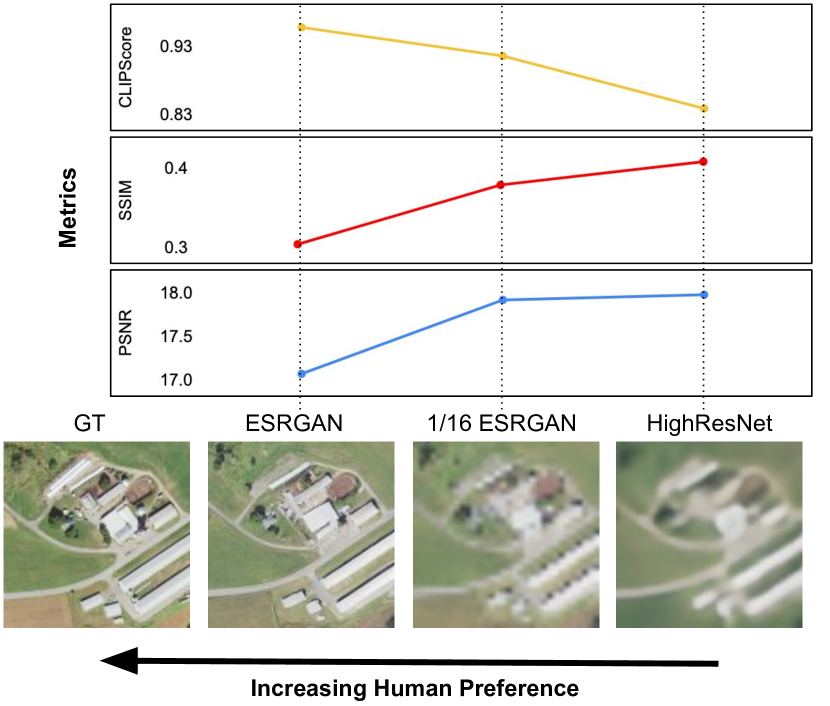
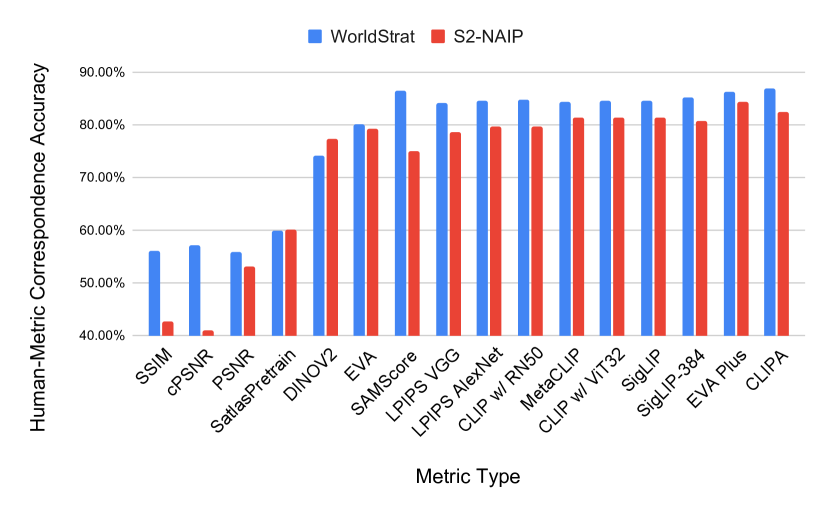
- PSNR and SSIM poorly correlate with human judgments for SR in remote sensing.
- CLIPScore (especially CLIPA-v2) achieves up to 84.6% agreement with human preferences on SR quality.
- GANs (ESRGAN) outperform diffusion and L2-based models in CLIPScore across four datasets.
- Training ESRGAN with a CLIPScore loss accelerates training by 18x and improves CLIPScore by about 9 points.
- SR outputs are not yet superior to using original LR imagery for downstream machine tasks, though SR representations can improve transfer learning.
- A large-scale S2-NAIP dataset and global ESRGAN model enable scalable, public deployment of SR outputs.
Read this paper
Open the full text in the Nubint reader and ask about any passage as you read.
Read this paper on NubintThis review was generated by AI from the original paper. Please check the paper before citing it.