
[论文解读] Variational Gibbs State Preparation on NISQ devices
作者提出一种变分量子算法,在 NISQ 设备上使用一个两寄存器的模块化 PQC,联合优化 Helmholtz 自由能,从而实现直接对 ancilla 测量得到的 Von Neumann 熵进行后处理以得到 Gibbs(有限温度)态。
The preparation of an equilibrium thermal state of a quantum many-body system on noisy intermediate-scale quantum (NISQ) devices is an important task in order to extend the range of applications of quantum computation. Faithful Gibbs state preparation would pave the way to investigate protocols such as thermalization and out-of-equilibrium thermodynamics, as well as providing useful resources for quantum algorithms, where sampling from Gibbs states constitutes a key subroutine. We propose a variational quantum algorithm (VQA) to prepare Gibbs states of a quantum many-body system. The novelty of our VQA consists in implementing a parameterized quantum circuit acting on two distinct, yet connected (via CNOT gates), quantum registers. The VQA evaluates the Helmholtz free energy, where the von Neumann entropy is obtained via post-processing of computational basis measurements on one register, while the Gibbs state is prepared on the other register, via a unitary rotation in the energy basis. Finally, we benchmark our VQA by preparing Gibbs states of the transverse field Ising and Heisenberg XXZ models and achieve remarkably high fidelities across a broad range of temperatures in statevector simulations. We also assess the performance of the VQA on IBM quantum computers, showcasing its feasibility on current NISQ devices.
研究动机与目标
- Motivate finite-temperature state preparation for quantum simulations and quantum algorithms.
- Develop a variational quantum algorithm that minimizes Helmholtz free energy to produce Gibbs states.
- Introduce a modular PQC with an ancilla to encode Boltzmann weights and a system register to realize energy eigenbasis rotations.
- Enable entropy evaluation via classical post-processing of ancilla measurement outcomes, avoiding direct entropy measurement on quantum hardware.
- Demonstrate performance on Ising models through statevector simulations and IBM quantum hardware experiments.
提出的方法
- Define Gibbs state and Helmholtz free energy as the objective to minimize.
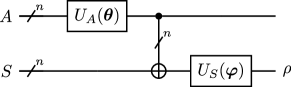
- Use a two-register variational circuit with an ancilla register A and a system register S connected by CNOTs.
- Prepare Boltzmann weights on A via a parameterized unitary UA such that p_i = |u_{i,0}|^2.
- Apply a system unitary US to map computational basis to Hamiltonian eigenstates, yielding rho = US diag(p) US†.
- Estimate Tr[H rho] from measurements on the system register.
- Post-process ancilla measurements to obtain the von Neumann entropy S(rho) without directly measuring entropy on the device.
实验结果
研究问题
- RQ1Can a two-register variational circuit efficiently approximate Gibbs states for generic Hamiltonians on NISQ devices?
- RQ2How accurately can the Helmholtz free energy be minimized to prepare Gibbs states across a range of temperatures?
- RQ3Does the proposed ancilla-system PQC enable reliable entropy estimation via classical post-processing?
- RQ4What is the performance of the VQA on Ising models in statevector, noisy simulation, and real IBM hardware?
- RQ5How do hardware connectivity and noise affect fidelity for increasing system size?
主要发现
- High fidelities (F ≈ 0.98+) are achieved for Gibbs states of the Ising model up to six qubits in statevector simulations across a broad temperature range.
- On IBM quantum hardware, the method remains feasible but fidelity degrades with larger system sizes and limited connectivity.
- Noisy simulations (SPSA optimizer) show good fidelity for two- and three-qubit cases; performance worsens for larger systems due to noise and connectivity.
- Tomography on ibm_nairobi demonstrates close agreement with analytical Gibbs states for two qubits at selected betas, with larger discrepancies in off-diagonal terms at higher beta.
- The approach yields a modular, Hamiltonian-agnostic structure where U_S can be problem-inspired, and U_A encodes Boltzmann weights.
- The method outperforms some prior variational Gibbs state approaches by avoiding truncations in entropy evaluation and using a direct free-energy objective.

更好的研究,从现在开始
从阅读论文到最终审阅,大幅缩短您的研究时间。
无需绑定信用卡
本解读由 AI 生成,并经人工编辑审核。