
[論文レビュー] Alchemical diastereomers from antisymmetric alchemical perturbations
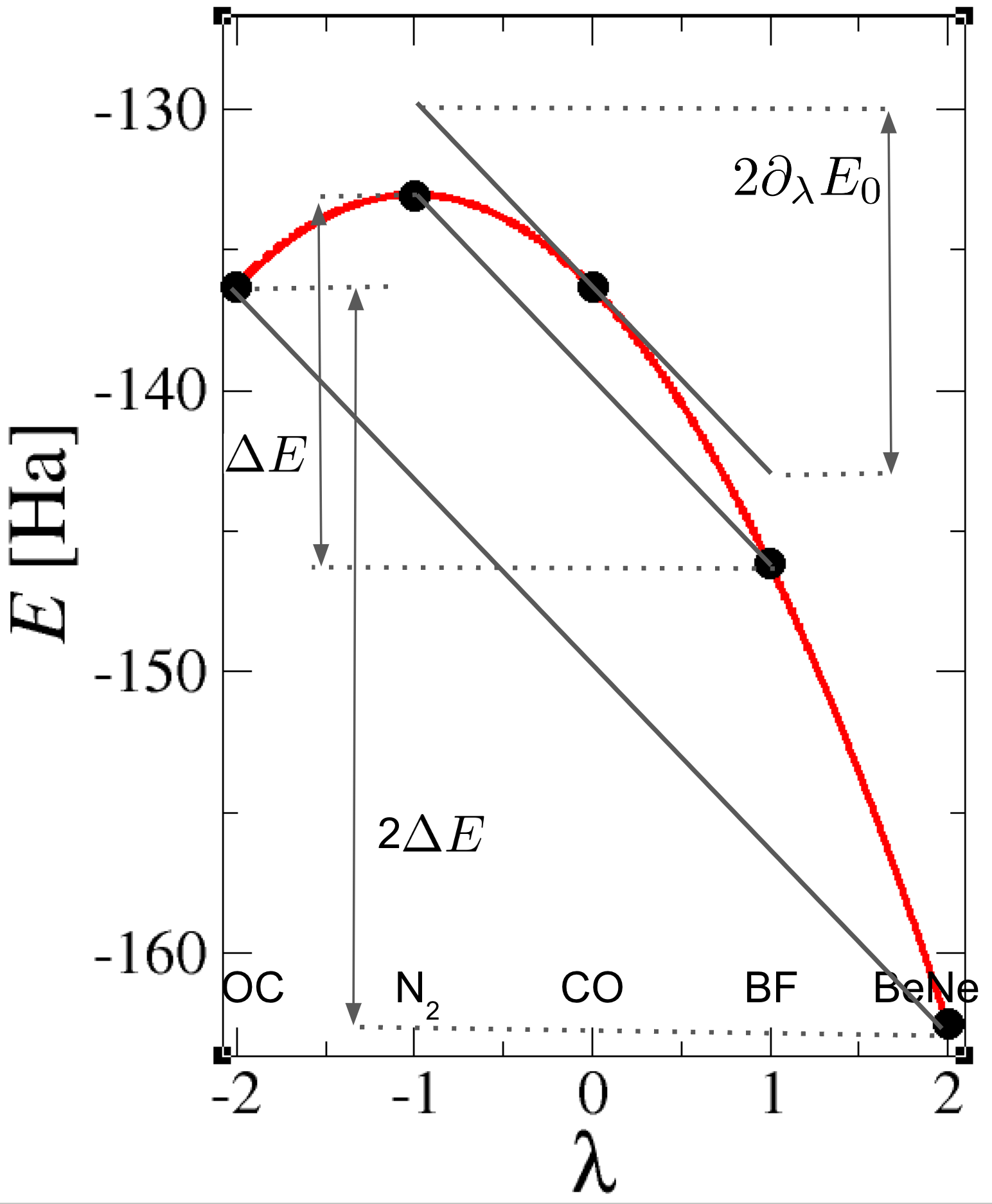
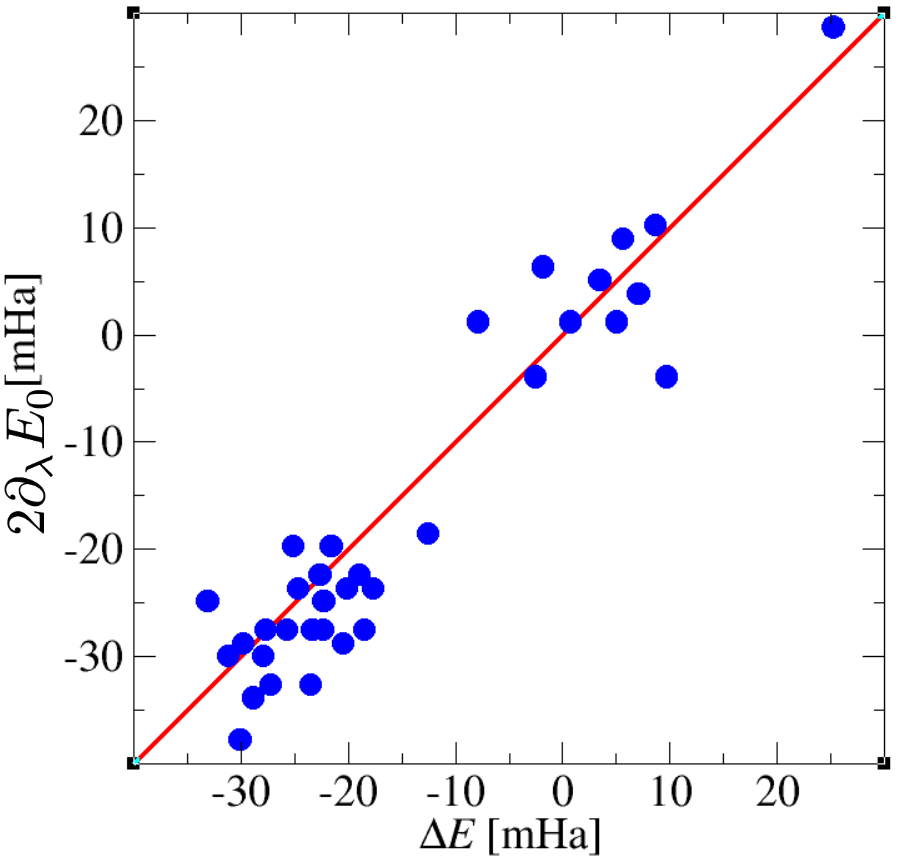
本論文では、非対称なアルケミカル・パラメータ摂動を用いてアロキシカル・ダイアステレオマーを導入し、平均化された電子的基準ハミルトニアンを用いる場合、偶数次エネルギー寄与が消えることを示した。主な項は、平均基準における2倍のヘルマン=フェインマン微分であり、35個のBNドープトロリルエン異性体について4.3mHaの平均絶対誤差で相対エネルギーを正確に予測可能であり、多次元化学的空間の効率的探索を可能にする。
The energy difference between two iso-electronic systems can be accurately approximated by the alchemical first order Hellmann-Feynmann derivative for the averaged Hamiltonian. This approximation is exact up to third order because even-order contributions cancel out. This finding holds for any iso-electronic compound pair (dubbed `alchemical diastereomers'), regardless of differences in configuration, composition, or energy, and consequently, relative energy estimates for all possible iso-electronic alchemical diastereomer pairs, require only O(1) self-consistent field cycles for any given averaging reference Hamiltonian. We discuss the relation to the Verlet algorithm, alchemical harmonic approximation (AHA) [J. Chem. Phys. 162, 044101 (2025)], relative properties such as forces, ionization potential or electron affinities, and Levy's formula for relative energies among iso-electronic systems that uses the averaged electron density of the two systems [J. Chem. Phys. 70, 1573 (1979)]. Numerical estimates accurately reflect trends in the charge-neutral iso-electronic diatomic molecule series with 14 protons (N$_2$, CO, BF, BeNe, LiNa, HeMg, HAl), with systematically increasing errors. Using alchemical Hellmann-Feynman derivatives for toluene, we demonstrate the concept's broader applicability by estimating relative energies for all 36 possible alchemical diastereomer pairs from vertical iso-electronic charge-neutral antisymmetric BN doping of toluene's aromatic ring, with mean absolute errors of a few milli-Hartrees.
研究の動機と目的
- 等電子的基準系に課される対称性制約を緩和することで、アルケミカル・キラリティ概念を一般化すること。
- 等電子化合物における非対称アルケミカル摂動下でのエネルギー差の挙動を調査すること。
- 摂動理論における主項が相対エネルギー推定に与える予測能力を評価すること。
- 1つの基準電子密度のみを用いて、多次元化学的空間の探索におけるフレームワークのスケーラビリティを実証すること。
- 非対称摂動の文脈においてメル・レヴィの公式を解釈し、高次奇数寄与を過剰に評価している点を特定すること。
提案手法
- 線形結合パrameter λ を用いて等電子化合物に摂動理論を適用し、ハミルトニアンを H(λ) = H₀ + λH′ と定義する。ここで H₀ は平均基準ハミルトニアンである。
- エネルギー差 ΔE を λ のべき級数に展開し、非対称摂動下ですべての偶数次寄与が消えることを解析的に示した。
- 主項は、平均基準ハミルトニアンで評価された2倍の ∂λE₀ として導出された。
- 電子構造およびヘルマン=フェインマン微分の計算には、PBE0関数法およびpcX-2基底関数を用いた密度汎関数理論(DFT)が使用された。
- 固定されたトロリルエン構造を用いて、14プロトン等電子系列(N₂、CO、BF など)および35個のBNドープトロリルエン異性体にこの手法を適用した。
- エネルギー差は、同じ電子密度を用いてヘルマン=フェインマン微分から計算され、計算コストの最小化が図られた。
実験結果
リサーチクエスチョン
- RQ1非対称なアルケミカル摂動を等電子化合物に適用した場合、偶数次エネルギー寄与はどのように変化するか?
- RQ2摂動展開における主項は、相対エネルギーに関してメル・レヴィの公式とどのように比較できるか?
- RQ3平均基準ハミルトニアンにおける1次ヘルマン=フェインマン微分は、アルケミカル・ダイアステレオマー間の相対エネルギーを正確に予測できるか?
- RQ41つの電子密度が、アルケミカル摂動理論における多次元化学的空間の効率的探索にどの程度寄与できるか?
- RQ5主項近似の精度は、摂動の大きさおよび系の複雑さに伴い、どのように変化するか?
主な発見
- 平均化された電子的基準ハミルトニアンを用いる非対称アルケミカル摂動では、すべての偶数次エネルギー寄与が消える。
- 主項は、平均基準ハミルトニアンで評価された2倍のヘルマン=フェインマン微分に対応する。
- メル・レヴィの公式は1次寄与を含むが、高次奇数寄与を、次数に比例して増加する係数で過剰に評価している。
- 14プロトン等電子系列では、主項が最小限の計算コストで相対エネルギーを正確に推定できる。
- トロリルエンの35個のBNドープアルケミカル・ダイアステレオマーにおいて、予測されたポテンシャルエネルギー差の平均絶対誤差(MAE)は4.3mHaであり、化学的精度に近い。
- このフレームワークにより、1つの基準電子密度のみを用いて、複数の化学的空間次元を同時に探索可能となり、計算コストの大幅な削減が達成された。
この論文を読む
Nubintのビューアで原文を開き、読みながら気になる箇所をすぐに質問できます。
Nubintでこの論文を読むこのレビューはAIが論文の原文をもとに作成しました。引用する前に原文をご確認ください。