
[論文レビュー] Classification of Classical Spin Liquids: Detailed Formalism and Suite of Examples
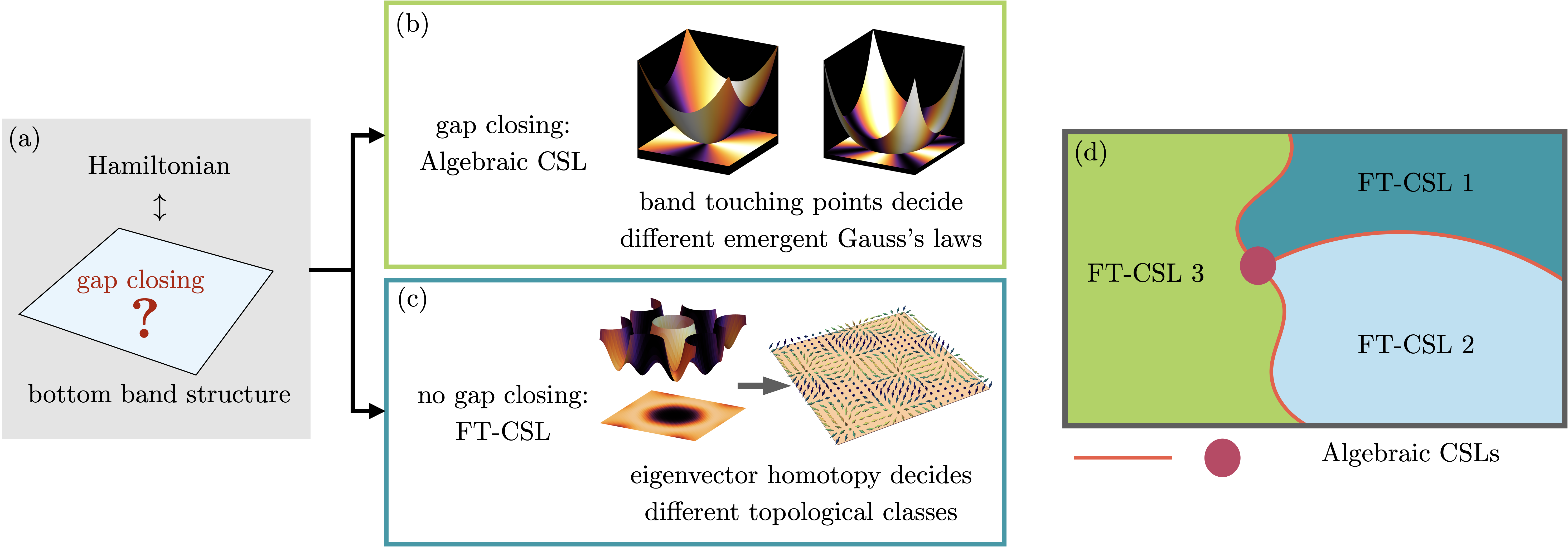
本稿は、ソフトスピンハミルトニアンのスペクトル的性質に基づき、古典的スピン液体(CSL)の包括的な分類体系を提案する。この体系では、ギャップなしの点と出現する一般化されたガウスの法則によって特徴づけられる代数的CSLと、フラットバンドの固有ベクトルのホモトピーによって特徴づけられる壊れやすい位相的CSLを区別する。この枠組みは、既知のCSLモデルを統一的に扱い、非一様なガウスの法則、ピンチライン特異性、壊れやすい位相的相間のゼロ温度遷移を示す新たな非典型相を予測する。
The hallmark of highly frustrated systems is the presence of many states close in energy to the ground state. Fluctuations between these states can preclude the emergence of any form of order and lead to the appearance of spin liquids. Even on the classical level, spin liquids are not all alike: they may have algebraic or exponential correlation decay, and various forms of long wavelength description, including vector or tensor gauge theories. Here, we introduce a classification scheme, allowing us to fit the diversity of classical spin liquids (CSLs) into a general framework as well as predict and construct new kinds. CSLs with either algebraic or exponential correlation-decay can be classified via the properties of the bottom flat band(s) in their soft-spin Hamiltonians. The classification of the former is based on the algebraic structures of gapless points in the spectra, which relate directly to the emergent generalized Gauss's laws that control the low temperature physics. The second category of CSLs, meanwhile, are classified by the fragile topology of the gapped bottom band(s). Utilizing the classification scheme we construct new models realizing exotic CSLs, including one with anisotropic generalized Gauss's laws and charges with subdimensional mobility, one with a network of pinch-line singularities in its correlation functions, and a series of fragile topological CSLs connected by zero-temperature transitions.
研究の動機と目的
- 古典的スピン液体(CSL)の多様な物理的挙動を捉えるための体系的分類フレームワークの構築を目的とする。
- frustrated 磁性系に見られる多様なCSLを理解するための統一的理論的枠組みの欠如に応えること。
- ソフトスピンハミルトニアンのスペクトル構造に基づき、代数的CSLと壊れやすい位相的CSLを区別してCSLを分類すること。
- 望ましい出現ゲージ理論および位相的性質を有する新しいCSLモデルを構築するための予測的ツールを提供すること。
- 分類をフラットバンド理論および実空間における基底状態 degeneracy と結びつけ、CSLの解析的・数値的探索を可能にすること。
提案手法
- 広範な基底状態デジェネラシーを有する古典的スピン液体をモデル化するための制約ハミルトニアンアプローチを形式化する。
- ソフトスピンハミルトニアンのスペクトルを分析し、底辺のフラットバンドとそれらが高エネルギー分散性バンドとどのように結合しているかに注目する。
- 代数的CSLを、スペクトル内のギャップ閉じ点の同定と、これらの点における固有ベクトル構造から抽出される出現一般化ガウスの法則によって分類する。
- 壊れやすい位相的CSLを、フラットバンドの固有ベクトルのホモトピー理論を用いて分類し、フラットバンドの固有ベクトルの位相的不変量を用いる。
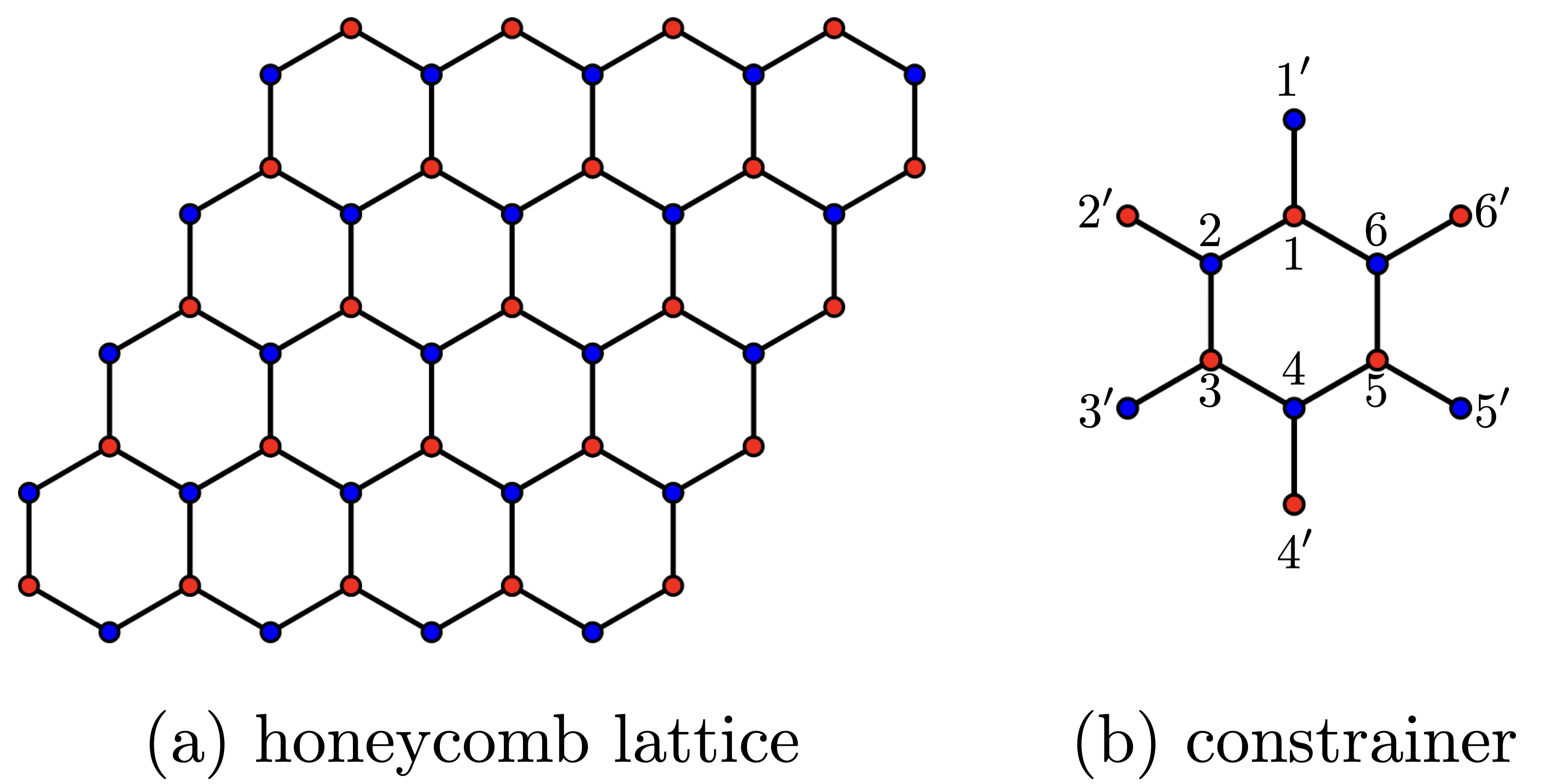
- 既知のモデル(例:kagome, pyrochlore, honeycomb-snowflake)にこの形式的枠組みを適用し、特異な性質を有する新しいモデルを構築する。
- 自己無撞着ガウス近似(SCGA)を用いてCSLの安定性および遷移を検討するが、ハードスピン制約を扱う際の限界を認識する。
実験結果
リサーチクエスチョン
- RQ1古典的スピン液体は、その低エネルギースペクトル的性質に基づき、どのように体系的に分類可能か?
- RQ2 代数的CSLに一般化ガウスの法則がどのようにして出現するのか、そしてギャップ閉じ点の構造とどのように関係するのか?
- RQ3 壊れやすい位相的CSLを分類する位相的不変量は何か? それらは代数的CSLにおけるものとどのように異なるか?
- RQ4 この分類スキームは、ピンチラインや準次元的電荷を有するような非自明な相関構造を示す新たなタイプのCSLを予測可能か?
- RQ5 壊れやすい位相的CSL相間のゼロ温度遷移は、固有ベクトルホモトピーおよびスペクトル位相論の枠組みでどのように現れるか?
主な発見
- この分類スキームは、kagome, pyrochlore, honeycomb-snowflake反強磁性体といった既知のCSLモデルを、スペクトル的および位相的性質に基づき統一的な枠組みに整理することに成功した。
- 代数的CSLは、ソフトスピンハミルトニアンスペクトル内のギャップなしの点の代数的構造によって分類され、これが出現一般化ガウスの法則の形を直接決定する。
- 壊れやすい位相的CSLは、底辺フラットバンドの固有ベクトルのホモトピー類によって分類され、異なる位相的不変量が異なる相を区別する。
- この枠組みは、非一様な一般化ガウスの法則を有する新たなCSLを予測し、次元を下回る移動性を示す電荷を有する、既知のゲージ理論の範囲を拡張する。
- スピン相関関数にピンチライン特異性のネットワークを有するモデルが構築され、CSLにおける新たなタイプの長波長相関構造を示した。
- 壊れやすい位相的CSL相間のゼロ温度遷移が、異なるホモトピー類の境界で発生することを示し、古典系における位相的相転移のメカニズムを提供した。
この論文を読む
Nubintのビューアで原文を開き、読みながら気になる箇所をすぐに質問できます。
Nubintでこの論文を読むこのレビューはAIが論文の原文をもとに作成しました。引用する前に原文をご確認ください。