
[論文レビュー] Complexity of Supersymmetric Systems and the Cohomology Problem
この論文は、超対称系におけるコホモロジー問題の量子計算複雑性を確立し、$k$-localコホモロジー問題が$\text{QMA}$-完全であることを証明するとともに、準ベッチ数の推定が$\text{DQC1}$-hardであるが$\text{BQP}$に属することを示している。さらに、変分量子固有状態法(VQE)アルゴリズムにおいてラプラシアン$\Delta$の代わりにスーパーチャージ演算子$B$を用いることで、構造的系では回路深さと測定回数を$d+1$倍改善でき、アルゴリズムのスケーリングが向上することを示している。
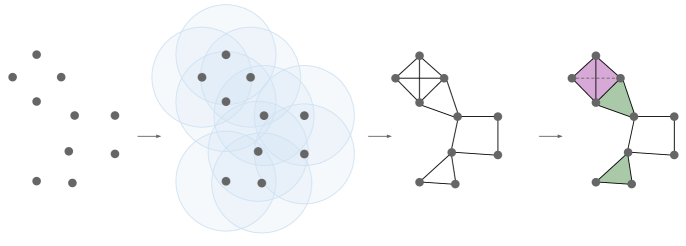
We consider the complexity of the local Hamiltonian problem in the context of fermionic Hamiltonians with $\mathcal N=2 $ supersymmetry and show that the problem remains $\mathsf{QMA}$-complete. Our main motivation for studying this is the well-known fact that the ground state energy of a supersymmetric system is exactly zero if and only if a certain cohomology group is nontrivial. This opens the door to bringing the tools of Hamiltonian complexity to study the computational complexity of a large number of algorithmic problems that arise in homological algebra, including problems in algebraic topology, algebraic geometry, and group theory. We take the first steps in this direction by introducing the $k$-local Cohomology problem and showing that it is $\mathsf{QMA}_1$-hard and, for a large class of instances, is contained in $\mathsf{QMA}$. We then consider the complexity of estimating normalized Betti numbers and show that this problem is hard for the quantum complexity class $\mathsf{DQC}1$, and for a large class of instances is contained in $\mathsf{BQP}$. In light of these results, we argue that it is natural to frame many of these homological problems in terms of finding ground states of supersymmetric fermionic systems. As an illustration of this perspective we discuss in some detail the model of Fendley, Schoutens, and de Boer consisting of hard-core fermions on a graph, whose ground state structure encodes $l$-dimensional holes in the independence complex of the graph. This offers a new perspective on existing quantum algorithms for topological data analysis and suggests new ones.
研究の動機と目的
- 超対称量子系に生じるコホモロジー問題の量子複雑性を特定すること。
- 超対称基底状態がコホモロジー群を符号化することを示すことにより、ハミルトニアン複雑性とホモロジー代数を橋渡しすること。
- 量子アルゴリズムにおけるベッチ数および準ベッチ数の推定の計算複雑性を分析すること。
- フェルミオン系における変分量子固有状態法(VQE)の効率を、ラプラシアン$\Delta$の代わりにスーパーチャージ演算子$B$を用いることで向上させること。
- $k$-localコホモロジー問題が、量子複雑性クラス$\text{QMA}$に完全であることを確立すること。
提案手法
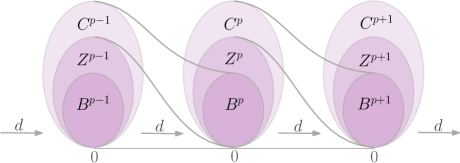
- $d^2 = 0$ を満たすcoboundary演算子$d$ を用いてコホモロジー問題を形式化し、ハミルトニアン$H = \{\mathcal{Q}, \mathcal{Q}^\dagger\}$ を持つ超対称量子力学的系に写像する。
- ジョルダン=ウィグナー変換を用いてフェルミオン演算子をキュービット演算子に写像し、量子コンピュータ上での量子シミュレーションを可能にする。
- スーパーチャージ$B = \mathcal{Q}$ とラプラシアン$\Delta = B^2$ の構造を分析し、それらのパウリ項への可換分解に注目する。
- VQEアルゴリズムにおける回路深さと測定回数を削減するため、$B$ と $\Delta$ を可換な項の集合に分解することを提案する。
- 独立性複体において、$B$ を用いることで$\Delta$と比較して可換な集合の数を$d+1$倍減少させられることを示し、VQEのスケーリングが向上することを示している。
- 複雑性理論的ツールを用いて、準ベッチ数推定が$\text{DQC1}$に対して難しいが、$\text{BQP}$に属することを示している。
実験結果
リサーチクエスチョン
- RQ1超対称系における$k$-localコホモロジー問題の量子計算複雑性は何か?
- RQ2ラプラシアン$\Delta$を用いる場合と比較して、スーパーチャージ演算子$B$ をVQEアルゴリズムに用いることで、効率が向上するか?
- RQ3位相的データ解析におけるベッチ数の代理としての準ベッチ数の推定は、近い未来の量子デバイスで実行可能か?
- RQ4基盤となるグラフの構造は、$B$ と $\Delta$ を可換パウリ項に分解する際の影響をどのように受けるか?
- RQ5フェルミオン格子模型における超対称基底状態とコホモロジー群の関係は何か?
主な発見
- $k$-localコホモロジー問題が$\text{QMA}$-完全であることが証明され、その根本的な量子困難性が確立された。
- 準ベッチ数推定が$\text{DQC1}$-hardであることが示され、弱いエンタングルメントを持つ量子コンピュータですら困難であることが示された。
- 準ベッチ数推定が$\text{BQP}$に含まれることを示し、普遍的量子コンピュータ上で効率的に解けることが示された。
- VQEにおいてラプラシアン$\Delta$の代わりにスーパーチャージ$B$ を用いることで、独立性複体において可換な集合の数が$d+1$倍減少し、回路深さと測定回数が向上した。
- ジョルダン=ウィグナー変換によりフェルミオン演算子は非局所的キュービット演算子に写像されるが、構造的グラフ順序付けを用いることで非局所性を最小限に抑え、分解効率を向上させることができる。
- この論文は、超対称量子力学と位相的データ解析の間に直接的なリンクを確立し、TDAにおけるコホモロジー問題が自然に量子複雑性クラスに位置づけられることを示した。
より良い研究を、今すぐ始めましょう
論文の読解から最終レビューまで、研究時間を劇的に削減しましょう。
クレジットカード登録不要
このレビューはAIが作成し、人間の編集者が確認しました。