
[論文レビュー] Digital Twin Generators for Disease Modeling
本論文では、神経ボルツマン機械とディープラーニングを用いて縦断的健康データから個別化された多変量連続時間臨床トレースを生成する、新しいニューラルネットワークアーキテクチャであるデジタルツインジェネレータ(DTG)を紹介する。同じアーキテクチャは、ハイパーパrameterチューニングのみで13の多様な疾患兆候において高い精度を達成し、パーソナライズドメディスンのためのユニバーサルデジタルツインへのスケーラブルな道筋を示している。
A patient's digital twin is a computational model that describes the evolution of their health over time. Digital twins have the potential to revolutionize medicine by enabling individual-level computer simulations of human health, which can be used to conduct more efficient clinical trials or to recommend personalized treatment options. Due to the overwhelming complexity of human biology, machine learning approaches that leverage large datasets of historical patients' longitudinal health records to generate patients' digital twins are more tractable than potential mechanistic models. In this manuscript, we describe a neural network architecture that can learn conditional generative models of clinical trajectories, which we call Digital Twin Generators (DTGs), that can create digital twins of individual patients. We show that the same neural network architecture can be trained to generate accurate digital twins for patients across 13 different indications simply by changing the training set and tuning hyperparameters. By introducing a general purpose architecture, we aim to unlock the ability to scale machine learning approaches to larger datasets and across more indications so that a digital twin could be created for any patient in the world.
研究の動機と目的
- 多様な疾患兆候にわたる個別患者の正確なデジタルツインを生成できる汎用的な機械学習フレームワークの開発。
- 複雑で確率的かつ多変量の臨床時系列データを、個別化された予測と臨床意思決定を支援する形でモデル化する課題への対処。
- 生物学的メカニズムの知識を必要とせず、実世界の縦断的健康記録に学習可能なスケーラブルで柔軟かつ解釈可能なデジタルツインモデルの実現。
- 多疾患データとエネルギーベースのモデリングを活用することで、将来的な疾患やデータモダリティにわたる一般化を可能にする、ユニバーサルデジタルツインモデルの基盤を構築すること。
提案手法
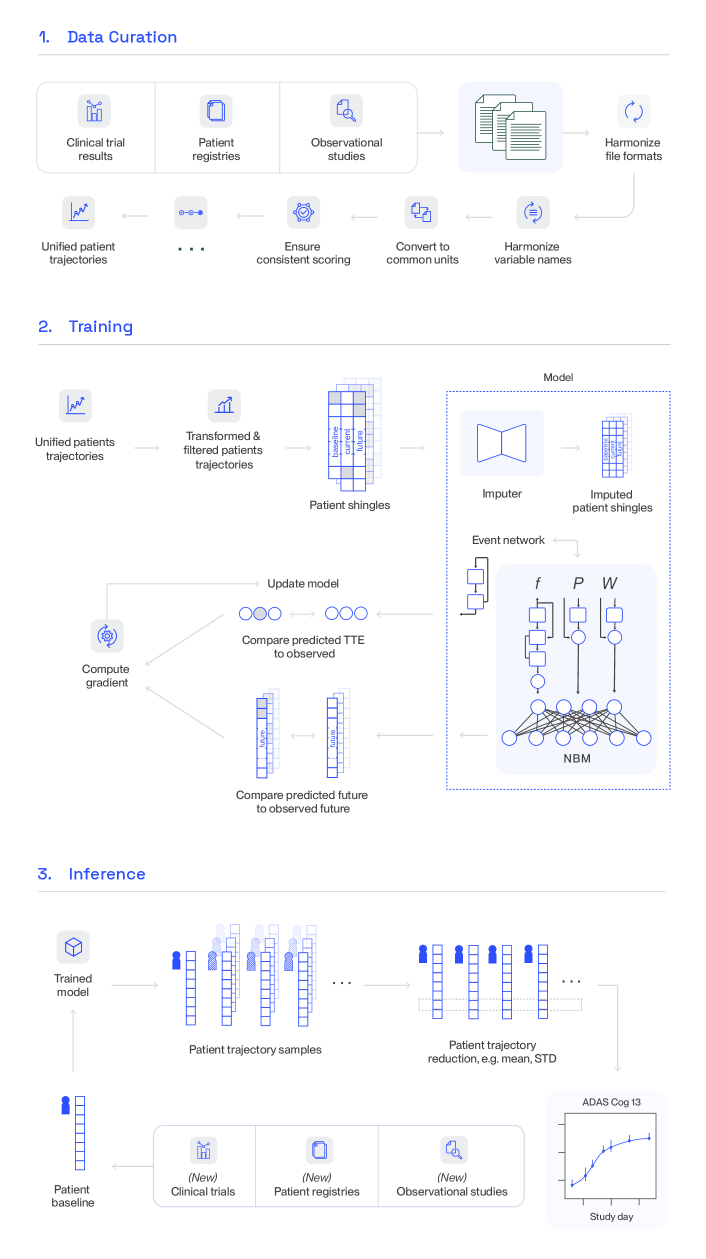
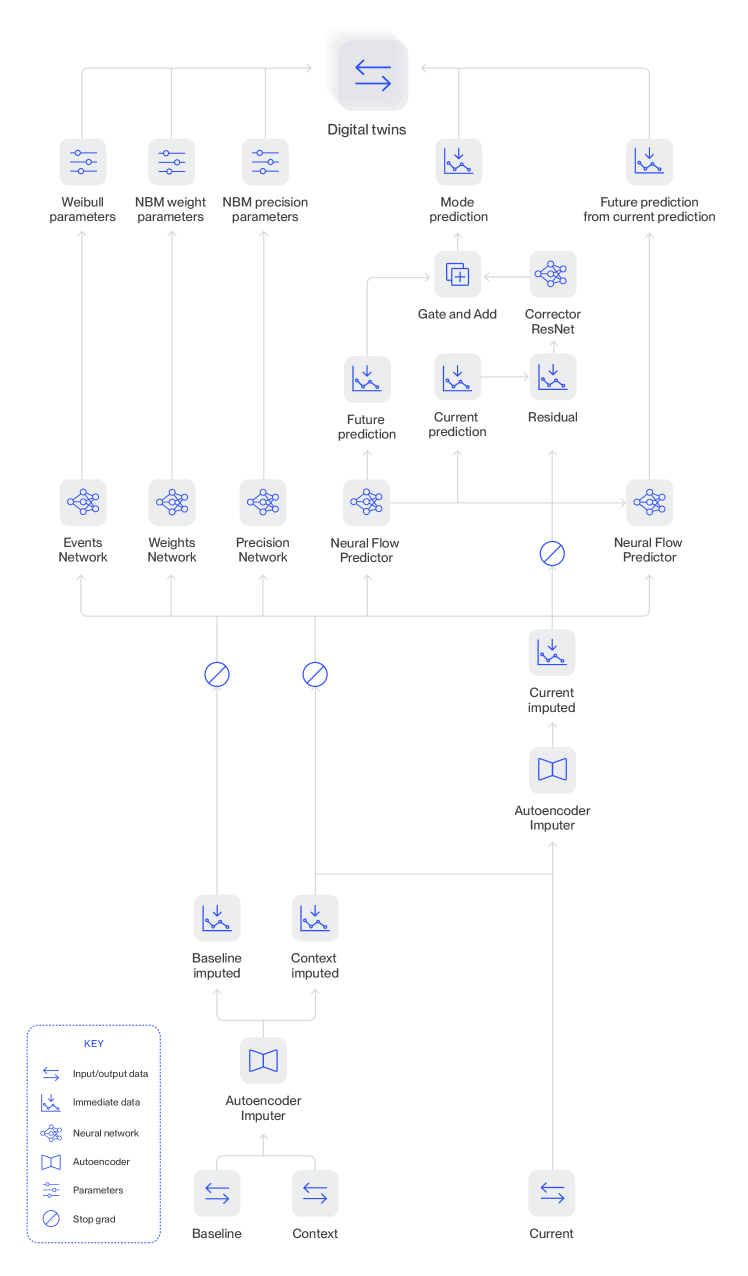
- 神経ボルツマン機械(NBM)を用い、深層ニューラルネットワークでパrameter化されたエネルギーベースモデルにより、連続時間における多変量臨床トレースの確率的ダイナミクスをモデル化する。
- 深層ニューラルネットワークを統合して、縦断的臨床データ内の時系列依存性および条件付き分布を符号化し、患者固有の将来の健康状態の生成を可能にする。
- 臨床試験、観察研究、疾患レジストリからの個別レベルの縦断的データセットを、入力としての表形式時系列データのみを用いて、エンドツーエンドで学習する。
- ハイパーパrameterチューニングにより、神経ネットワークのアーキテクチャを変更せずに、神経変性疾患、免疫・炎症、一般医学の3つの治療分野にまたがる13の異なる疾患兆候に適応可能である。
- 予測の不確実性を確率論的にモデル化でき、感度分析や予測の解釈性を高める。
- EHR、ゲノム、ウェアラブルデバイス、画像診断など多様な入力を受容できるニューラルネットワークによるNBMの再パラメータ化により、マルチモーダルデータへの拡張性を備えている。
実験結果
リサーチクエスチョン
- RQ1同じニューラルネットワークアーキテクチャが、縦断的臨床データのみを用いて、複数の多様な疾患兆候にわたる正確なデジタルツインを生成できるか?
- RQ2神経ボルツマン機械に基づく条件付き生成モデルが、現実の臨床トレースの確率的で多変量かつ時間依存性の高い性質をどの程度正確に捉えられるか?
- RQ3同じモデルアーキテクチャが、最小限のアーキテクチャ変更とハイパーパrameterチューニングのみで、治療分野を越えて一般化できるか?
- RQ4生成されたデジタルツインは、ベースラインモデルや臨床的直感と比較して、個別患者の予後予測においてどの程度の性能を示すか?
- RQ5ゲノム、画像診断、ウェアラブルデータなどの多様なデータモダリティを、将来のユニバーサルデジタルツインのための統合フレームワークに統合できるか?
主な発見
- 提案されたデジタルツインジェネレータ(DTG)アーキテクチャは、アーキテクチャの変更なしにハイパーパrameterチューニングのみで、13の異なる疾患兆候において高い精度で個別患者トレースを予測している。
- モデルは縦断的臨床データ内の複雑で多変量かつ確率的なダイナミクスを的確に捉えており、さまざまな治療シナリオ下での将来の健康状態の信頼性のあるシミュレーションを可能にしている。
- 性能評価では、DTGが観察データと整合性のある臨床的に妥当なトレースを生成できており、インシリコ臨床試験やパーソナライズド治療計画への応用が可能であることが示された。
- 感度分析を通じて解釈性が高く、入力変数の変化が予測結果に与える影響を明らかにしている。
- エネルギーベース学習に根ざしたモデルの基盤により、不確実性の定量化が可能であり、これは臨床意思決定支援やリスク評価にとって不可欠である。
- アーキテクチャは拡張可能であり、入力ニューラルネットワークを変更することで新たなデータモダリティへの適応が可能であり、ユニバーサルデジタルツインへの道筋を示唆している。
この論文を読む
Nubintのビューアで原文を開き、読みながら気になる箇所をすぐに質問できます。
Nubintでこの論文を読むこのレビューはAIが論文の原文をもとに作成しました。引用する前に原文をご確認ください。