
[論文レビュー] Evidence of the quantum-optical nature of high-harmonic generation
本論文は、半導体における高調波生成(HHG)が非古典的光を生成することを実験的に示しており、2モードスリクイングと2次強度相関測定によるコーシー=シュワルツ不等式の破れを明らかにした。商用ファイバーレーザーと一般的な半導体を用いて、レーザー強度を増加させると、光子統計が超ポisson的からポisson的へと移行することを確認し、多粒子もつれを裏付けた。HHGは室温で広帯域・マルチモードの量子光を生成するプラットフォームとして確立された。
High-harmonic generation is a light up-conversion process occurring in a strong laser field, leading to coherent bursts of extreme ultrashort broadband radiation [1]. As a new perspective, we propose that ultrafast strong-field electronic or photonic processes such as high-harmonic generation can potentially generate non-classical states of light well before the decoherence of the system occurs [2, 3]. This could address fundamental challenges in quantum technology such as scalability, decoherence or the generation of massively entangled states [4]. Here, we report experimental evidence of the non-classical nature of the harmonic emission in several semiconductors excited by a femtosecond infrared laser. By investigating single- and double beam intensity cross-correlation [5], we measure characteristic, non-classical features in the single photon statistics. We observe two-mode squeezing in the generated harmonic radiation, which depends on the laser intensity that governs the transition from Super-Poissonian to Poissonian photon statistics. The measured violation of the Cauchy-Schwarz inequality realizes a direct test of multipartite entanglement in high-harmonic generation [6]. This result is supported by the theory of multimodal detection and the Hamiltonian from which the effective squeezing modes of the harmonics can be derived [7, 8]. With this work, we show experimentally that high-harmonic generation is a new quantum bosonic platform that intrinsically produces non-classical states of light with unique features such as multipartite broadband entanglement or multimode squeezing. The source operates at room temperature using standard semiconductors and a standard commercial fiber laser, opening new routes for the quantum industry, such as optical quantum computing, communication and imaging.
研究の動機と目的
- 高調波生成(HHG)の量子光学的性質が、非古典的光の源としてどのように機能するかを調査すること。
- デコherenceが発生する前に、HHGがスリクイングやもつれ光子のような非古典的状態を生成できるかどうかを検証すること。
- 一般的でコンactなレーザーおよび半導体システムを用いて、HHGが多粒子もつれとマルチモードスリクイングを実験的に生成することを示すこと。
- 2次強度相関関数の直接測定により、非古典的相関の存在を検証すること。
- HHGをスケーラブルで室温で運用可能な量子フォトニクス技術のプラットフォームとして利用可能かどうかを検討すること。
提案手法
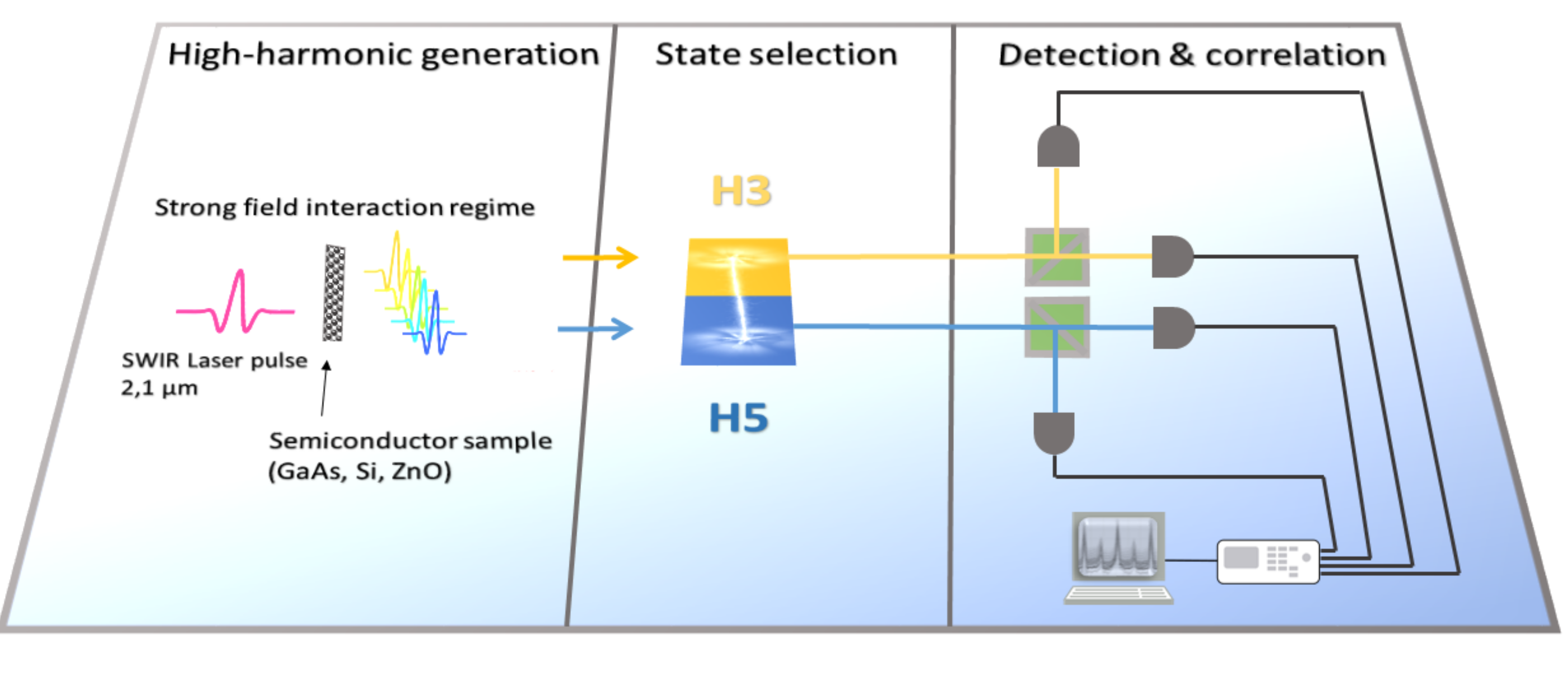
- 室温でZnO、Si、GaAsにフェムト秒赤外ファイバーレーザーを照射し、高調波生成(HHG)を駆動した。
- 2次相関関数 $g^{(2)}$ を抽出するために、単一および二重ビームのハンブリー・ブラウン=トゥイッス(HBT)強度交差相関測定を実施した。
- 単一光子カウンティングを用いて光子統計を測定し、超ポisson的およびポisson的統計の偏差を検出することで、古典的挙動からの逸脱を特定した。
- 実験データから $R$ パラメータを計算し、古典的コーシー=シュワルツ不等式の破れを検証した。これは非古典的マルチモード相関の特徴である。
- スプライスフィルタリングと偏光制御を用いて、特定の高調波成分(H3およびH5)を分離し、バックグラウンドノイズを最小限に抑えた。
- 制御された光学的損失を導入することで、$g^{(2)}$ 測定を損失に強いものとした。これにより、非古典的信号の頑健性を確認した。
実験結果
リサーチクエスチョン
- RQ1半導体における高調波生成(HHG)は、スリクイングやもつれ光子のような非古典的光状態を生成できるか?
- RQ2レーザー強度を増加させると、高調波放射の光子統計(例:$g^{(2)}$)はどのように変化するか?
- RQ3コーシー=シュワルツ不等式の破れによって示される、高調波放射における多粒子もつれの実験的証拠はあるか?
- RQ4室温で、一般的に入手可能なレーザーおよび半導体を用いて、HHGにおける非古典的特徴を観測できるか?
- RQ5測定された量子光学的性質が、検出系における光学的損失に対してどの程度頑健であるか?
主な発見
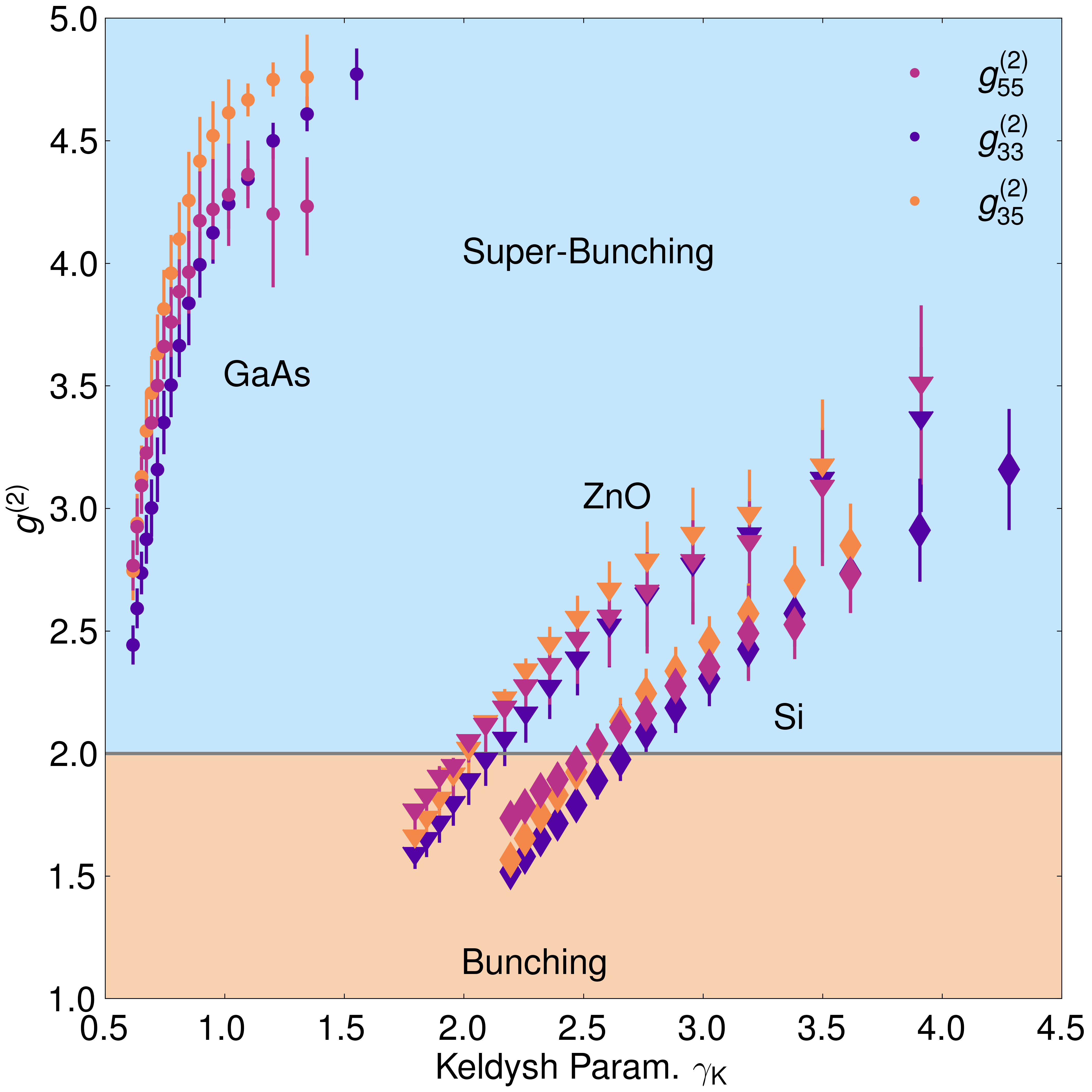
- ZnOおよびSiにおける高調波放射の2次相関関数 $g^{(2)}$ は、レーザー強度を増加させると、超ポisson的($g^{(2)} > 2$)からポisson的($g^{(2)} \approx 1$)へと減少し、古典的から非古典的光子統計への移行を示した。
- 古典的コーシー=シュワルツ不等式の破れが実験的に観測され、複数の試料(ZnO、Si、GaAs)で $R > 1$ が得られた。これにより、非古典的マルチモード相関の存在が裏付けられた。
- 測定されたすべての高調波ペア(H3–H5)で $R$ パラメータが古典的限界(1)を超えた。これは、高調波放射に多粒子もつれが存在することを直接示す証拠であった。
- 制御された光学的損失下でも、光子統計および $g^{(2)}$ 値が安定していたため、非古典的信号が検出器ノイズや減衰に対して頑健であることが確認された。
- 高調波生成の摂動的から非摂動的領域への移行は、高調波生成効率のクロスオーバーによって明確に示され、$g^{(2)}$ の挙動の変化と相関していた。
- 3種類の異なる半導体(ZnO、Si、GaAs)において結果が一貫しており、GaAsではより強い束縛(bunching)が観測され、材料依存の非古典的特徴が示された。
この論文を読む
Nubintのビューアで原文を開き、読みながら気になる箇所をすぐに質問できます。
Nubintでこの論文を読むこのレビューはAIが論文の原文をもとに作成しました。引用する前に原文をご確認ください。