
[論文レビュー] Formation of primordial black hole binaries and their merger rates
本稿は、初期宇宙における2体および3体過程に注目し、原始ブラックホール(PBH)二重星の形成および合体率に関する包括的な理論枠組みを構築する。$ f_{\text{PBH}} \lesssim 0.1 $ の場合、初期2体二重星が合体率を支配するが、$ f_{\text{PBH}} $ が高くなると動的衝突による抑制が顕著になり、クラスタリングの強化とより硬い二重星の形成により、3体チャネルが支配的になる可能性がある。
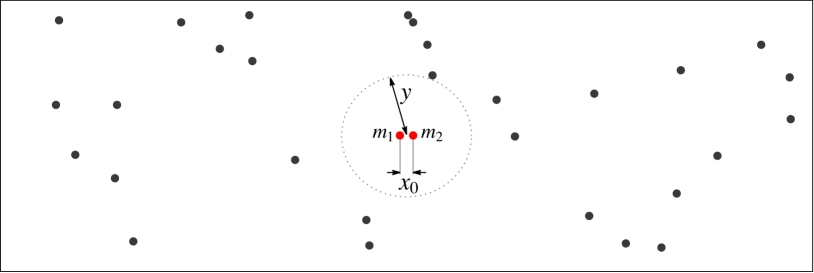
We review the theory behind the formation of primordial black hole binaries and their merger rates. We consider the binary formation in the early and late Universe, emphasising the former as it gives the dominant contribution of the present primordial black hole merger rate. The binaries formed in the early Universe are highly eccentric so their interactions with other primordial black holes can significantly increase their coalescence times and thereby suppress the merger rate. We discuss in detail how the suppression of the merger rate arising from such interactions can be estimated and how such interactions lead to the formation of another, much harder, binary population that contributes to the present merger rate if more than 10% of dark matter consists of primordial black holes with a relatively narrow mass distribution. When the primordial abundance is below 1%, encounters between primordial black holes are unlikely and their effect on the merger rate becomes negligible.
研究の動機と目的
- 初期宇宙における原始ブラックホール(PBH)二重星の形成メカニズムを理解し、現在の合体率への寄与を明らかにすること。
- 特に高PBH割合における他のPBHとの動的衝突が、初期2体二重星の合体率をどの程度抑制するかを定量化すること。
- 異なるPBH質量関数およびクラスタリング条件のもとで、初期形成と後期形成の二重星チャネルの相対的重要性を評価すること。
- 3体力学および質量関数の拡張を補正として含めた、異なる形成チャネルにおける合体率密度の解析的表現を導出すること。
- 初期PBHクラスタリングが二重星形成および破壊に与える影響、特に初期3体チャネルにおいて評価すること。
提案手法
- 幾何的単位($ c = G = 1 $)を用い、$ \ln m $ に関して正規化されたPBH質量関数 $ \psi(m) $ を定義し、PBH集団の統計的取り扱いを可能にする。
- 4つのチャネル(初期2体、初期3体、後期2体、後期3体)について、合体率密度 $ \mathrm{d}R/\mathrm{d}\ln m_1\mathrm{d}\ln m_2 $ を導出する。
- 重力波エネルギー損失および3体力学の解析的モデルを適用し、角運動量分布および硬化を支配するパラメータ $ \mathcal{K} \approx 4.0 $ と $ \gamma $ を組み込む。
- PBHクラスタリングの効果を $ f_{\text{PBH}} $ の再スケーリングを通じてモデル化し、局所的密度増加を $ \delta $ として扱い、破壊および形成率への影響を評価する。
- 数値シミュレーションを用いて重要な定数(例:$ \mathcal{K} \approx 4.0 $)を特定し、$ f_{\text{PBH}} $、$ \gamma $、速度分散の異なる領域におけるスケーリング行動を検証する。
- 明示的なレート式(例:式97–100)を導出し、$ f_{\text{PBH}} $、$ \langle m \rangle $、$ \eta $、$ \sigma_v $、$ \delta_{\text{eff}} $ への依存性を含め、チャネル支配の程度を定量化する。
実験結果
リサーチクエスチョン
- RQ1初期宇宙における2体および3体過程が、現在の原始ブラックホール二重星の合体率にどの程度寄与するか。
- RQ2特に高PBH割合における他のPBHとの動的衝突が、初期2体二重星の合体率に及ぼす影響は何か。
- RQ3初期3体チャネルが2体チャネルを上回る条件は何か。これは $ f_{\text{PBH}} $ および初期クラスタリングにどのように依存するか。
- RQ4後期形成チャネル(2体および3体)は、合計合体率にどの程度寄与するか。環境要因として何がそれらを強化するか。
- RQ5初期PBHクラスタリングは、異なる二重星形成チャネルの相対的抑制または増幅にどのように影響するか。
主な発見
- $ f_{\text{PBH}} \lesssim 0.1 $ の場合、初期2体チャネルがPBH合体率を支配し、$ \gamma = 1 $ および $ \mathcal{K} = 4.0 $ を仮定した場合、単色質量 $ m = 30\,M_\odot $ に対して合体率密度は $ \sim 7.9 \times 10^4 \, \text{Gpc}^{-3}\text{yr}^{-1} $ に達する。
- 初期3体チャネルは $ f_{\text{PBH}} \gtrsim 0.1 $ で支配的となり、合体率は $ f_{\text{PBH}}^{144\gamma/259 + 47/37} $ のようにスケーリングする。これは $ f_{\text{PBH}} $ 依存性が強く、2体チャネルを上回る。
- 初期3体チャネルの合体率は、低い離心率と高い結合エネルギーのおかげで、衝突による破壊に対してはるかに耐性があり、2体チャネルよりも安定である。
- 後期チャネル(2体および3体)は、$ \delta_{\text{eff}} $ が高く、$ \sigma_v $ が低いという楽観的仮定のもとでも、それぞれ $ \sim 3.4 \times 10^{-6} \, \text{Gpc}^{-3}\text{yr}^{-1} $ および $ \sim 1.3 \times 10^{-16} \, \text{Gpc}^{-3}\text{yr}^{-1} $ と、支配的でない。
- 初期クラスタリングは、3体チャネルの $ f_{\text{PBH}} $ の高いべき乗に起因し、2体チャネルよりも3体チャネルをより強く強化するが、同時に2体二重星の破壊も増加させ、結果として $ R_{E2} $ の全体的な抑制が生じる。
この論文を読む
Nubintのビューアで原文を開き、読みながら気になる箇所をすぐに質問できます。
Nubintでこの論文を読むこのレビューはAIが論文の原文をもとに作成しました。引用する前に原文をご確認ください。