
[論文レビュー] Gravitationally sensitive structured x-ray optics using nuclear resonances
本論文は、核共鳴を用いた構造的X線波ガイド(SXWG)を用いて、重力赤方偏移を介して微小な高度変化を検出可能なコンactで重力に敏感なX線波ガイド系を提案する。45Sc や 182Ta などの同素体における高Q核遷移を活用することで、外部のビームスプリッターを用いずにX線モード間のラビ振動を誘発し、ミリメートルスケールの重力感度を実現する。
Einstein's general theory of relativity not only revolutionized human understanding of the universe, but also brought many gravitational applications in large scale, such as gravitational-wave astronomy, gravitational lensing, and the operation of the global positioning system. However, it still remains a challenge to implement applications for gravitational effects at small spacial extensions on Earth. Here, we investigate a structured waveguide system that allows for the control of an x-ray profile at altitude separations of millimeters and even shorter using the nuclear resonant scattering of x rays. Our present results suggest a potential compact scheme for turning the Earth's gravity into a practical application of x-ray optics.
研究の動機と目的
- ミリメートル未塔の空間スケールで重力赤方偏移に敏感なコンパクトで卓上型のX線光学系を開発すること。
- 45Sc や 182Ta などの例における核共鳴の極めて高いエネルギー分解能を活用し、実験室環境で重力効果を検出すること。
- 従来のビームスプリッターを用いずに、構造的波ガイド内での重力誘起X線モード分裂およびラビ振動を実証すること。
- 核共鳴の全幅半最大(FWHM)であるΔZGを、核Qファクターの関数として重力感度を定量化すること。
提案手法
- 周期的な核分布(例:45Sc, 57Fe)を有する構造的波ガイド内におけるX線の核共鳴散乱を用い、X線横モード間の共鳴結合を形成する。
- 重力赤方偏移下での基底状態と励起状態間の核コherenCe ρeg のダイナミクスを記述するため、光学ブロッホ方程式をモデル化する。
- 高度zの関数として重力赤方偏移ΔG ≈ −zEtGME/(ℏΓc²RE²) を組み込み、有効なオフセットΔ + ΔG を変更する。
- 出力X線強度分布|E(x,y)|²およびモード分布の忠実度F1(y), F2(y)を測定するため、位置に敏感な検出器を用いる。
- 核Qファクター(Q = Et/ℏΓ)に反比例するスケーリングを示す、重力感度ΔZG = √3(ℏΓ/Et)(c²RE²)/(GME) を定義する。
- 異なる高度(例:1.72 cm, 2.00 cm, 2.32 cm)におけるSXWG内を通過するX線の伝搬をシミュレートし、ラビ振動ダイナミクスおよびモード分裂を観察する。

実験結果
リサーチクエスチョン
- RQ1ミリメートルスケールの高度差において、重力赤方偏移が構造的波ガイド内のX線モード分布に測定可能な変化を引き起こすか?
- RQ2核Qファクターが45Sc や 182Ta などの共鳴同素体において、重力感度ΔZGにどのように依存するか?
- RQ3外部のビームスプリッターを用いずに、核共鳴を介して波ガイド内でのX線モード間のラビ振動を誘発・制御できるか?
- RQ4高Q核遷移を用いたX線光学系で、重力効果を検出するための最小高度分解能はどの程度か?
- RQ5横方向のX線強度分布|E(x,y)|²は、重力赤方偏移および結合強度の変動をどのように反映するか?
主な発見
- 45Sc(Q ≈ 10^19)および 182Ta(Q ≈ 10^19)を用いる場合、重力感度ΔZG ≈ 1 mmを達成し、ミリメートルスケールの高度変化に起因するX線分裂を検出可能である。
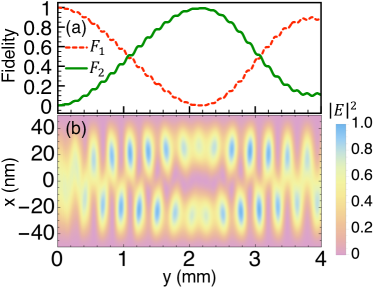
- z = 2.00 cm では、モード忠実度F2が最大値(F2 ≈ 1)に達し、これは半ラビサイクル遷移ψ1 → ψ2を示している。
- z = 2.32 cm および z = 1.72 cm では、結合強度|Ω1|が低下し、F1 > F2 となり、モード分裂ではなく横方向の広がりのみが観察される。
- 重力感度ΔZGは1/Qに比例し、103Rh(Q > 10^23)ではナノメートルスケールの分解能(ΔZG ~ nm)を予測する。
- 107Ag や 109Ag(Q ~ 10^22)はマイクロメートルスケールの重力感度を可能にし、229Th(Q ~ 10^20)ではミリメートル未塔の分解能を実現する。
- 本システムは構造的X線の体系的生成が可能であり、ビームスプリッターを用いずにラビ振動を通じて重力に敏感なX線干渉計として機能する。
より良い研究を、今すぐ始めましょう
論文の読解から最終レビューまで、研究時間を劇的に削減しましょう。
クレジットカード登録不要
このレビューはAIが作成し、人間の編集者が確認しました。