
[論文レビュー] Improved machine learning algorithm for predicting ground state properties
本論文は、幾何的バイアスをもつ非線形特徴マップとL1正則化回帰を用いて、n量子ビットのギャップを持つ局所ハミルトニアンの基底状態性質を、O(log n)のトレーニングデータポイントのみで予測する古典的機械学習アルゴリズムを提示する。この手法は、近似的に線形のO(n log n)のトレーニングおよび予測時間を達成し、従来のO(n^c)のサンプル複雑性に比べて顕著に改善され、45量子ビットまでの系で高い精度を示す。
Finding the ground state of a quantum many-body system is a fundamental problem in quantum physics. In this work, we give a classical machine learning (ML) algorithm for predicting ground state properties with an inductive bias encoding geometric locality. The proposed ML model can efficiently predict ground state properties of an $n$-qubit gapped local Hamiltonian after learning from only $\mathcal{O}(\log(n))$ data about other Hamiltonians in the same quantum phase of matter. This improves substantially upon previous results that require $\mathcal{O}(n^c)$ data for a large constant $c$. Furthermore, the training and prediction time of the proposed ML model scale as $\mathcal{O}(n \log n)$ in the number of qubits $n$. Numerical experiments on physical systems with up to 45 qubits confirm the favorable scaling in predicting ground state properties using a small training dataset.
研究の動機と目的
- 量子多体系の基底状態性質を効率的に予測する古典的機械学習アルゴリズムの開発。
- 幾何的局所性をインダクティブバイアスとして組み込むことで、従来のML手法のサンプル複雑性をO(n^c)からO(log n)に低減すること。
- 量子ビット数nにおける計算時間スケーリングを近似的に線形に保ち、より大きな系での効率的予測を可能にすること。
- 小さなランダムにサンプリングされたトレーニングデータセットを用いて、最大45量子ビットの物理的系においても頑健な性能を示すこと。
- 量子状態へのアクセスやハミルトニアン構造の知識を必要とせず、さまざまなハミルトニアンパラメータ化と観測量に対して手法を検証すること。
提案手法
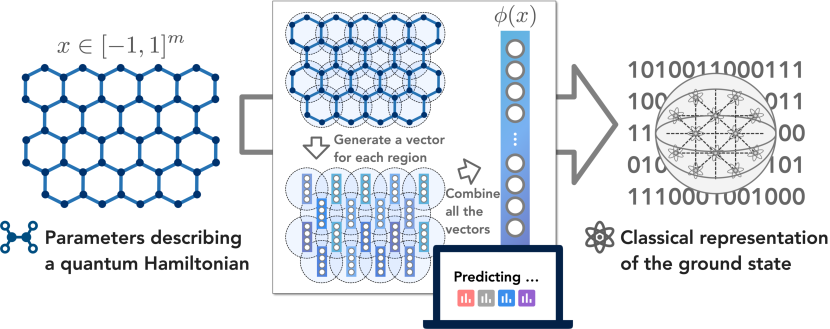
- アルゴリズムは、ハミルトニアンのパラメータ空間における局所的領域を高次元特徴ベクトルにマップする非線形特徴マップφ(x)を用いる。
- 各局所的領域は格子上のエッジや相互作用に対応し、調整可能なパrameter R, γを有するランダムフーリエ特徴を用いて特徴を計算する。
- 特徴空間上でL1正則化回帰(LASSO)を実行し、Tr(Oρ(x))を近似する線形予測子w*を学習する。
- 特徴マップは、ベクトルxを局所的成分に分解し、それぞれにφを適用して結果を連結することで構築される。
- モデルハイパーパrameter R, γ, α(正則化強度)は、データのホールドアウトサブセット上で4分割交差検証を用いて選択される。
- 数値実験では、サンプルデータから基底状態性質を推定するために、T個のランダム化されたパウリ測定を用いた古典的シャドウが使用される。
実験結果
リサーチクエスチョン
- RQ1ギャップを持つ局所ハミルトニアンの基底状態性質を、量子ビット数の対数スケールのトレーニングデータのみで古典的MLモデルが予測可能か?
- RQ2特徴マップに幾何的局所性をインダクティブバイアスとして組み込むことで、多項式スケーリングを下回るサンプル複雑性の低減が可能か?
- RQ3提案手法が、高い精度を維持しながら近似的に線形のO(n log n)のトレーニングおよび予測時間スケーリングを達成できるか?
- RQ4最小限のデータでトレーニングした場合、さまざまな系のサイズと観測量に対してモデルの性能はいかが?
- RQ5トレーニングデータサイズと古典的シャドウの測定数に変化があっても、手法は頑健か?
主な発見
- 提案手法は、cが大きな定数であるO(n^c)のスケーリングに比べて顕著に改善されたO(log n)のサンプル複雑性を達成した。
- トレーニングおよび予測時間はO(n log n)にスケーリングし、45量子ビットまでの系において効率的な推論を可能にした。
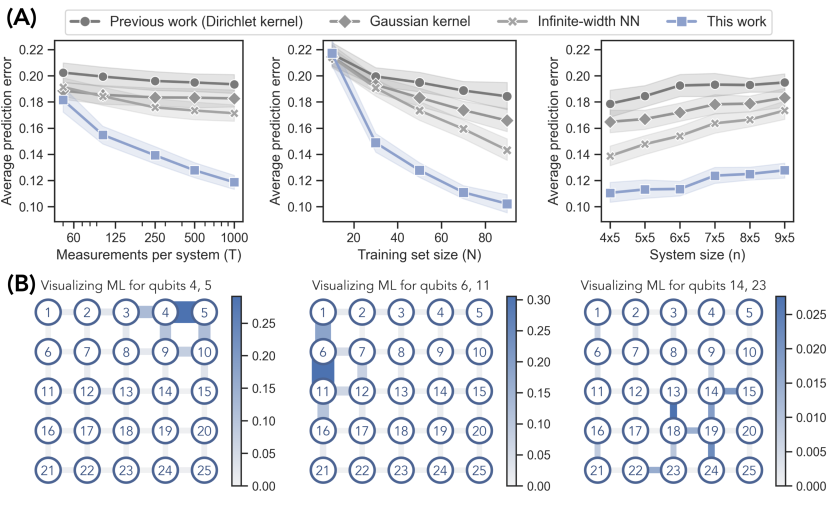
- 数値実験では、わずか約50件のトレーニングデータポイントでも、1500~3500件の相関関数予測の平均で統計的に妥当な予測誤差を示した。
- さまざまな系のサイズにおいて、低歪みの平均二乗誤差を維持し、相関関数の正規化標準偏差は約0.191であった。
- トレーニングデータサイズ(pM、p ∈ {0.1, 0.3, 0.5, 0.7, 0.9})および古典的シャドウサイズ(T ∈ {50, 100, 250, 500, 1000})を変化させても性能は安定した。
- 交差検証によるモデル選択により、最適なハイパーパrameter R, γ, αが適切に特定され、テストデータに対する一貫した一般化性能が得られた。
この論文を読む
Nubintのビューアで原文を開き、読みながら気になる箇所をすぐに質問できます。
Nubintでこの論文を読むこのレビューはAIが論文の原文をもとに作成しました。引用する前に原文をご確認ください。