
[論文レビュー] Krylov Complexity in Lifshitz-type Scalar Field Theories
この論文は、整数の動的指数 $z$ を持つ有限温度における自由な Lifshitz スカラー場理論における Lanczos 係数と Krylov 複雑度を調査する。相対論的スケーリングでないにもかかわらず、Lanczos 係数は遅延時間において普遍的な線形増加を示し、これは $z$ に依存しない $2/\pi\beta$ の勾配を持つ指数的 K-複雑度へとつながる。一方、質量と UV 切断は挙動に影響を与え、K-複雑度と K エントロピーは有限サイズ効果の下で異なるスケーリングを示す。
We investigate various aspects of the Lanczos coefficients in a family of free Lifshitz scalar theories, characterized by their integer dynamical exponent, at finite temperature. In this non-relativistic setup, we examine the effects of mass, finite ultraviolet cutoff, and finite lattice spacing on the behavior of the Lanczos coefficients. We also investigate the effect of the dynamical exponent on the asymptotic behavior of the Lanczos coefficients, which show a universal scaling behavior. We carefully examine how these results can affect different measures in Krylov space, including Krylov complexity and entropy. Remarkably, we find that our results are similar to those previously observed in the literature for relativistic theories.
研究の動機と目的
- 整数の動的指数 $z$ を持つ非相対論的 Lifshitz 型スカラー場理論における Lanczos 係数の振る舞いを理解すること。
- 質量、有限な UV 切断、格子間隔が、これらの理論における Krylov 複雑度とエントロピーに与える影響を調査すること。
- 非相対論的設定における普遍的演算子成長仮説の普遍性を検証すること。
- 相対論的モデルと比較し、K-複雑度と K エントロピーが異なる臨界指数や質量領域においても同様のスケーリングを示すかどうかを評価すること。
提案手法
- 局所的演算子とハミルトニアンのネストド・コンmutatorから Krylov 基底を構築するために Lanczos アルゴリズムが用いられる。
- Lifshitz スカラー理論の連続的および離散化バージョンにおいて、Lanczos 係数 $b_n$ が数値的に計算される。
- 有限温度効果は熱的密度行列を介して取り入れられ、Krylov 複雑度 $K_{\mathcal{O}}(t)$ は Krylov 基底における演算子の時間発展から計算される。
- K-エントロピー $S_{\mathcal{O}}(t)$ は、Krylov 基底における演算子展開係数の確率分布から評価される。
- 連続理論を正則化し、Lanczos 係数の飽和と複雑度の増加に与える影響を調査するために、ハードな UV 切断と有限な格子間隔が導入される。
- 数値的シミュレーションは、$z$、質量 $m$、温度 $\beta^{-1}$ を変化させながら実施され、スケーリングの挙動と漸近的傾向が抽出される。
実験結果
リサーチクエスチョン
- RQ1整数の動的指数 $z$ を持つ自由な Lifshitz スカラー理論において、有限温度下での Lanczos 係数はどのように振る舞うか?
- RQ2非相対論的かつスケール不変な場理論においても、$b_n$ の線形増加という普遍的演算子成長仮説が成立するか?
- RQ3質量と有限な UV 切断は、Krylov 複雑度と K エントロピーの漸近的挙動にどのように影響を与えるか?
- RQ4有限サイズ効果の下で、Lifshitz 理論における K-複雑度と K エントロピーの関係は何か?
- RQ5観察された Krylov 複雑度の挙動は、$z$ の値にかかわらず普遍的か。臨界指数が力学に顕著に影響を与えるか?
主な発見
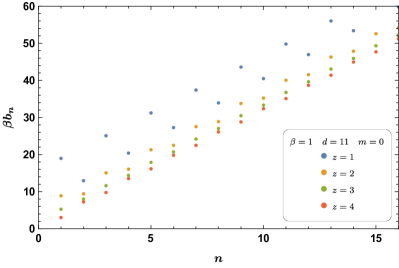
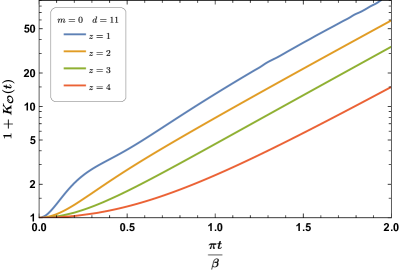
- 質量ゼロの連続的状態では、Lanczos 係数 $b_n$ は $n$ に対して線形に増加し、その勾配は $z$ に依存しない。K-複雑度は、$z$ に依存しない $\lambda = 2\pi/\beta$ の遅延時間指数で指数的増加を示す。
- K-分散は遅延時間で定数に安定化し、$z$ が大きくなるにつれてフラクチュエーションが減少するため、高 $z$ の理論では量子ノイズが低減することが示唆される。
- 質量のある理論では、$b_n$ の勾配は $\pi/\beta$(質量ゼロの極限)で上限に抑えられ、質量とともに単調に減少する。一方、奇数偶数のズレは $z$ と共に増加し、$m^z$ に比例する。
- ハードな UV 切断がある場合、Lanczos 係数は初期には線形に増加するが、後に飽和し、その結果、K-複雑度は遅延時間で指数的増加から線形増加へと遷移する。
- K-エントロピーは飽和段階で概ね対数的増加を示し、これは線形複雑度増加と整合的である。数値的には $1 + K_{\mathcal{O}}(t) \sim e^{a S_{\mathcal{O}}(t)}$($a < 1$)と表されるが、この関係は普遍的ではない。
- 質量ゼロおよび質量ありの両ケースにおいて、K-複雑度と K エントロピーの挙動は定性的に類似しており、$z$ や $m$ が増加するにつれて両者とも減少し、量子フラクチュエーション長が短くなることを反映している。
この論文を読む
Nubintのビューアで原文を開き、読みながら気になる箇所をすぐに質問できます。
Nubintでこの論文を読むこのレビューはAIが論文の原文をもとに作成しました。引用する前に原文をご確認ください。