
[論文レビュー] Large Area Optical Frequency Detectors for Single-Shot Phase Readout
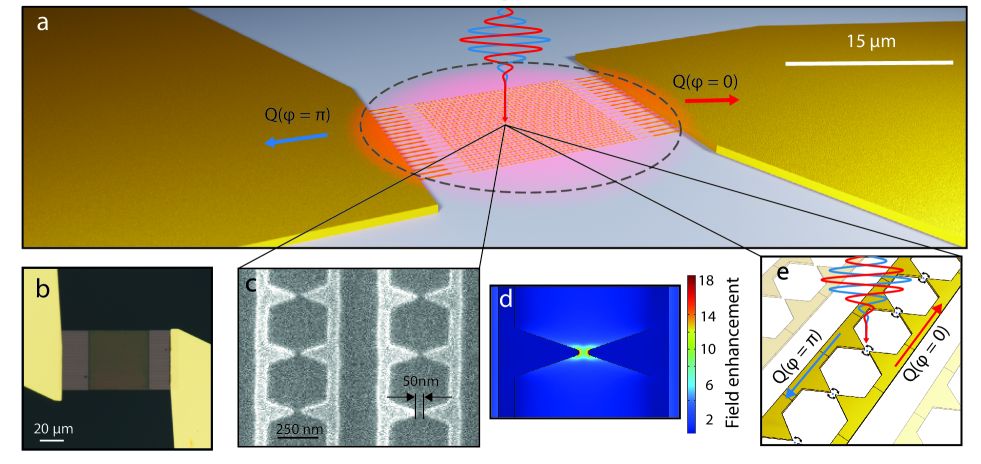
本論文は、数サイクルのミッドインフラレッドレーザーパルスのシングルショット自己位相(CEP)検出を可能にする、大面積で電気的に結合されたプラズモニックナノアンテナネットワークを実証している。18 fs、2.7-µm中心波長、84 nJのエネルギーを有する2サイクル未満のパルスを用いて、2,000個以上の相互接続された金ナノアンテナをコherentに駆動することで、1ショットあたり2,300電子を超えるCEPに敏感な電荷収率を達成した。これにより、信号平均化を要せず、実用的でシングルショットの位相読み出しを実現した。
Attosecond science has demonstrated that electrons can be controlled on the sub-cycle time scale of an optical wave, paving the way toward optical frequency electronics. Using controlled few-cycle optical waveforms, the study of sub-cycle electron emission has enabled the generation of attosecond ultraviolet pulses and the control of attosecond currents inside of solids. However, these experiments rely on high-energy laser systems not suitable for integration with microcircuits. To move towards integrated optical frequency electronics, a system suitable for integration into microcircuits capable of generating detectable signals with low pulse energies is needed. While current from plasmonic nanoantenna emitters can be driven at optical frequencies, low charge yields have been a significant limitation. In this work we demonstrate that large-scale electrically-connected plasmonic nanoantenna networks, when driven in concert, enable a much higher charge yield sufficient for shot-to-shot carrier-envelope phase detection, which is a hallmark of the underlying sub-cycle processes. We use a tailored sub-2-cycle mid-infrared waveform of only tens of nanojoules of energy to drive in excess of 2000 carrier-envelope-phase-sensitive electrons from interconnected plasmonic nanoantenna arrays that we detect on a single-shot basis using conventional electronics. Our work shows that electronically integrated plasmonic nanoantennas are a viable approach to integrated optical frequency electronics. By engineering the nanoantennas to the particular use case, such as carrier-envelope phase detection, and optimizing the density and total amount, the output signals are fully controlled. This approach to optical frequency electronics will further enable many interesting applications, such as petahertz-bandwidth electric field sampling or the realization of logic gates operating at optical frequencies.
研究の動機と目的
- アトセカンドエレクトロニクスに適した、スケーラブルで統合された光学周波数検出器を、シングルショットのキャリア・エンvelope位相(CEP)読み出しに対応可能に開発すること。
- 現在、数千ショットにわたる信号平均化を要する、個々のプラズモニックナノアンテナの低電子収率(1ショットあたり1e−未満)という課題を克服すること。
- 低エネルギーのミッドインフラレッド数サイクルパルスを用いることで、光学周波数エレクトロニクスをマイクロ回路に実用的に統合すること。
- 大面積で非共鳴なナノアンテナアレイのコherent結合が、CEP感度を保持したまま電荷収率を顕著に向上させられることを実証すること。
- 従来のシングルショットエレクトロニクスを用いて、100 nJ未満のパルスエネルギーで検出可能なCEP依存信号を達成すること。
提案手法
- 検出器は、電子線リソグラフィーおよびリフトオフプロセスを用いて作製された、2,000個の電気的に接続された金プラズモニックナノアンテナから成る225 µm²アレイから構成されている。
- ナノアンテナは、独自開発された2サイクル未満のミッドインフラレッドレーザーソース(18 fs、2.7 µm中心波長、84 nJパルスエネルギー)によって駆動されており、50 kHzの繰り返し周波数で動作している。
- システムは、ナノアンテナアレイからのシングルショット電荷信号を検出するために、1 GV/Aの利得と50 kHz帯域幅を持つトランスインダクタンスアンプを用いている。
- レーザー強度の同期とパルスソーティングのために、50 kHz帯域幅のピロエレクトリック検出器が使用されている。
- 50 kHzのトリガーシグナルを用いて、シングルショットイベントを特定・分類し、CEP依存信号の回収を可能にしている。
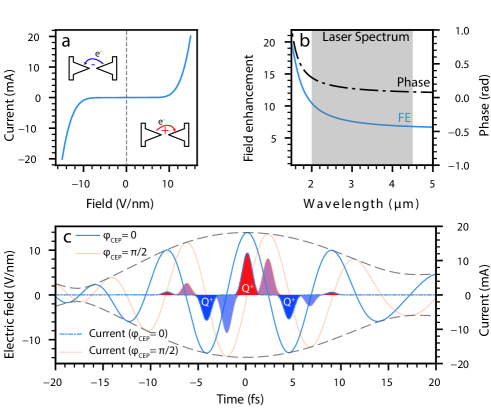
- レーザーのCEPを600 ms間、2π/100 msの速度で線形にスイープすることで、CEP依存の電荷放出をマップしている。
実験結果
リサーチクエスチョン
- RQ1大面積で電気的に接続されたプラズモニックナノアンテナアレイは、低エネルギーパルスを用いても、シングルショット・CEPに敏感な電子放出を達成できるか?
- RQ2非共鳴ナノアンテナのコherent励起は、孤立したアンテナの1ショットあたり1電子未満の限界を超えて、電荷収率を向上させられるか?
- RQ3100 nJ未満のエネルギーを持つミッドインフラレッド数サイクルパルスが、統合ナノ構造で検出可能なシングルショットCEP信号を生成できるか?
- RQ4ナノアンテナの数とその空間的配置が、総合的電荷収率と信号対雑音比に及ぼす影響はどの程度か?
- RQ5信号平均化を要せず、従来の低帯域幅の読み出しエレクトロニクスを用いてCEP検出が可能か?
主な発見
- 2,000個の相互接続ナノアンテナから成る225 µm²アレイから、1レーザーショットあたり2,300電子のCEPに敏感な電荷収率を達成した。
- 個々のナノアンテナは1ショットあたり最大3.3電子を放出し、類似構造の既存結果と比較して10倍以上に向上した。
- 84 nJのパルスエネルギーでの動作を成功裏に達成し、低エネルギー・アトラス環境下での運用可能性を示した。
- アレイの高い集団的電荷収率のおかげで、信号平均化を要せず、シングルショット検出を実現した。
- 2.7 µmのパルスを用いることで、短波長に比べて半周期あたりの電子放出が増加した。
- 非共鳴励起により、ナノアンテナ先端での電場の時間的波形が完全に保持され、高いCEP感度が維持された。
この論文を読む
Nubintのビューアで原文を開き、読みながら気になる箇所をすぐに質問できます。
Nubintでこの論文を読むこのレビューはAIが論文の原文をもとに作成しました。引用する前に原文をご確認ください。