
[論文レビュー] Large-scale universality in quantum reaction-diffusion from Keldysh field theory
本稿は、$A+A\to\emptyset$ 完全消滅反応を示すフェルミガスにおける量子反応拡散の普遍的運動方程式を導出するため、ケルディシュ場理論フレームワークを構築する。反応制限領域において、粒子密度が平均場予測とは異なる次元依存の指数で代数的に減少することを示し、図式論的手法を用いて時間に依存する一般化ギブス集団(TGGE)を体系的に導出し、場理論的手法によりTGGE仮定の妥当性を検証する。
We consider the quantum reaction-diffusion dynamics in $d$ spatial dimensions of a Fermi gas subject to binary annihilation reactions $A+A o \emptyset$. These systems display collective nonequilibrium long-time behavior, which is signalled by an algebraic decay of the particle density. Building on the Keldysh formalism, we devise a field theoretical approach for the reaction-limited regime, where annihilation reactions are scarce. By means of a perturbative expansion of the dissipative interaction, we derive a description in terms of a large-scale universal kinetic equation. Our approach shows how the time-dependent generalized Gibbs ensemble assumption, which is often employed for treating low-dimensional nonequilibrium systems, emerges from systematic diagrammatics. It also allows to exactly compute -- for arbitrary spatial dimension -- the decay exponent of the particle density. The latter is based on the large-scale description of the quantum dynamics and it differs from the mean-field prediction even in dimension larger than one. We moreover consider spatially inhomogeneous setups involving an external potential. In confined systems the density decay is accelerated towards the mean-field algebraic behavior, while for deconfined scenarios the power-law decay is replaced by a slower non-algebraic decay.
研究の動機と目的
- 量子反応拡散系における大スケールの普遍的挙動の場理論的基礎を確立すること。
- 反応制限領域において、体系的な図式論的手法から時間に依存する一般化ギブス集団(TGGE)を導出すること。
- 任意の空間次元 $d$ において、平均場予測を上回る正確な粒子密度崩壊指数を計算すること。
- トラップポテンシャルなどの空間非一様性が崩壊ダイナミクスに与える影響を調査すること。
- 開放系におけるべき乗則の崩壊と、非代数的緩和との関係を明確にすること。
提案手法
- 散逸的ダイナミクスのための量子マスター方程式を記述するため、ケルディシュ経路積分形式を用いる。
- 作用における散逸的相互作用頂点の摂動展開を行い、一次の空間時間微分を保持する。
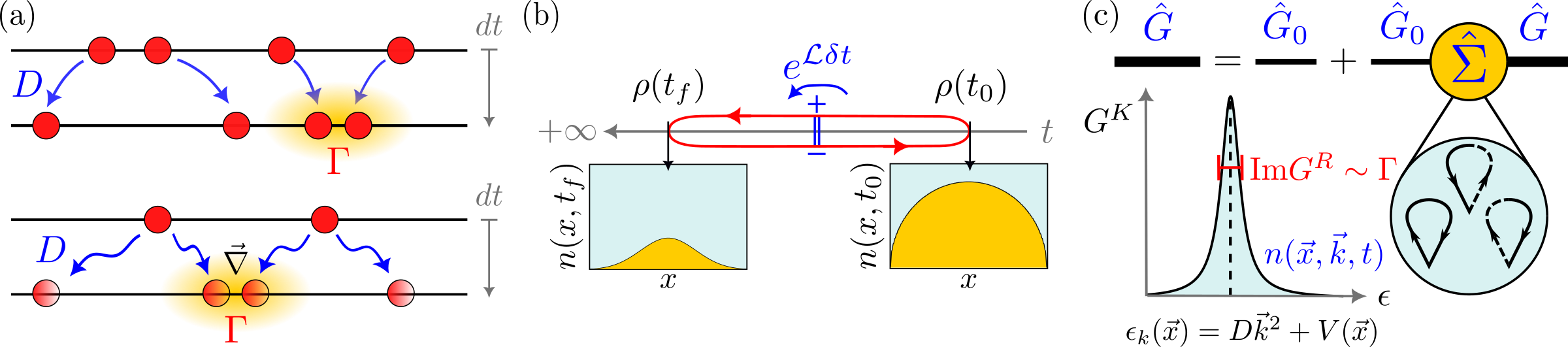
- Wigner関数 $n(\vec{x},\vec{k},t)$ に対して、ボルツマン型方程式に相当する大スケールの普遍的運動方程式を導出する。
- スペクトル表現およびWigner変換を用いて、ケルディシュグリーン関数 $G^K$ をWigner分布にマッピングする。
- フェニマン図式、特にタッドポールを用いて、準粒子の有限寿命を計算し、TGGEアンザッツと接続する。
- 数値的にクエンチプロトコル(トラップ解放および二重井戸から単一井戸へのクエンチ)を解析し、有効崩壊指数を抽出する。
実験結果
リサーチクエスチョン
- RQ1任意の空間次元 $d$ において、量子反応拡散系の粒子密度は平均場理論を逸脱してどのように崩壊するか?
- RQ2広く用いられている時間に依存する一般化ギブス集団(TGGE)仮定は、場理論的原則から体系的に導出可能か?
- RQ3$d>1$ 次元における平均場を逸脱する崩壊指数の起源は何か?また、大スケール量子ダイナミクスからどのようにして生じるか?
- RQ4トラップポテンシャルなどの空間非一様性は、粒子密度の長時間崩壊挙動にどのように影響を与えるか?
- RQ5開放系ではなぜべき乗則の崩壊が生じるのか?そして、何に置き換わるのか?
主な発見
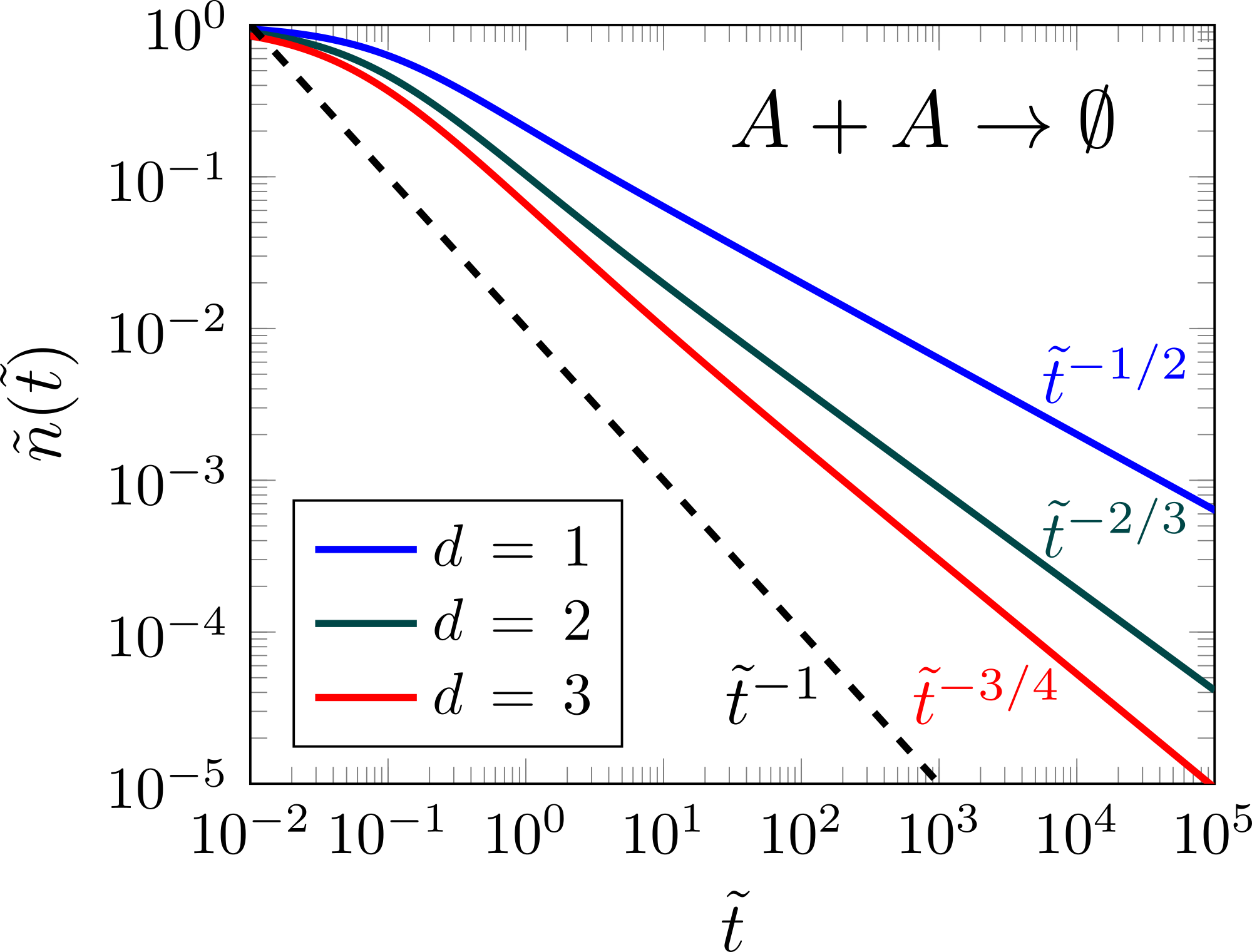
- 粒子密度は、$d>1$ 次元であっても平均場予測とは異なる指数で代数的に崩壊する。これは非自明な量子補正の存在を示唆する。
- 時間に依存する一般化ギブス集団(TGGE)は、空間時間勾配の一次に於いてケルディシュ図式論から自然に出現し、その使用に対する場理論的根拠が得られる。
- 大スケール場理論を用いた解析的計算により、正確な崩壊指数が得られ、微視的詳細に依存しない普遍的挙動が示された。
- 閉じ込められた系(二重井戸から単一井戸へのクエンチ)では、混合の増強により平均場値に近づく加速された崩壊指数が観測される。
- 開放的状況(トラップ解放)では、べき乗則の崩壊が、より遅い非代数的崩壊に置き換わり、有効指数は時間とともに減少する。
- 有限のトラップ解放パラメータ $\Omega$ に対して、最大有効指数 $\xi_M$ を示す中間的べき乗則領域が観測され、$\Omega$ が増加するにつれてその領域は縮小し、早期にシフトする。
より良い研究を、今すぐ始めましょう
論文の読解から最終レビューまで、研究時間を劇的に削減しましょう。
クレジットカード登録不要
このレビューはAIが作成し、人間の編集者が確認しました。