
[論文レビュー] Learning stiff chemical kinetics using extended deep neural operators
本稿では、自己符号化器の統合と新規のパartition-of-Unity (PoU-)DeepONetを特徴とする拡張されたDeepONetフレームワークを提案し、硬化化学速度問題の解伝播演算子を学習する。初期条件の低次元化された潜在表現上で訓練することで、相対L2誤差が0.01%未満に抑えられ、推論が約10⁻²秒で実行可能となり、計算効率において従来のスティフ・ソルバーを著しく上回りながら、複雑な合成ガスおよびベンチマーク反応系において高い精度を維持する。
We utilize neural operators to learn the solution propagator for the challenging chemical kinetics equation. Specifically, we apply the deep operator network (DeepONet) along with its extensions, such as the autoencoder-based DeepONet and the newly proposed Partition-of-Unity (PoU-) DeepONet to study a range of examples, including the ROBERS problem with three species, the POLLU problem with 25 species, pure kinetics of the syngas skeletal model for $CO/H_2$ burning, which contains 11 species and 21 reactions and finally, a temporally developing planar $CO/H_2$ jet flame (turbulent flame) using the same syngas mechanism. We have demonstrated the advantages of the proposed approach through these numerical examples. Specifically, to train the DeepONet for the syngas model, we solve the skeletal kinetic model for different initial conditions. In the first case, we parametrize the initial conditions based on equivalence ratios and initial temperature values. In the second case, we perform a direct numerical simulation of a two-dimensional temporally developing $CO/H_2$ jet flame. Then, we initialize the kinetic model by the thermochemical states visited by a subset of grid points at different time snapshots. Stiff problems are computationally expensive to solve with traditional stiff solvers. Thus, this work aims to develop a neural operator-based surrogate model to solve stiff chemical kinetics. The operator, once trained offline, can accurately integrate the thermochemical state for arbitrarily large time advancements, leading to significant computational gains compared to stiff integration schemes.
研究の動機と目的
- 反応CFDシミュレーションにおける硬化化学速度の計算ボトル neck を解決すること。
- 化学時間スケールを超えた大規模な時間進捗に対して外挿可能なデータ駆動型サーヴィレートモデルを開発すること。
- CO/H₂合成ガス炎などの複雑な多成分燃焼系のモデリングにおける効率性と精度を向上させること。
- 物理的忠実性を損なう計算コストの高い統合スキームやモデル還元技術への依存を減らすこと。
- 訓練済みニューラルオペレータを用いて、一時的燃焼プロセスのリアルタイムまたはニアリアルタイムシミュレーションを可能にすること。
提案手法
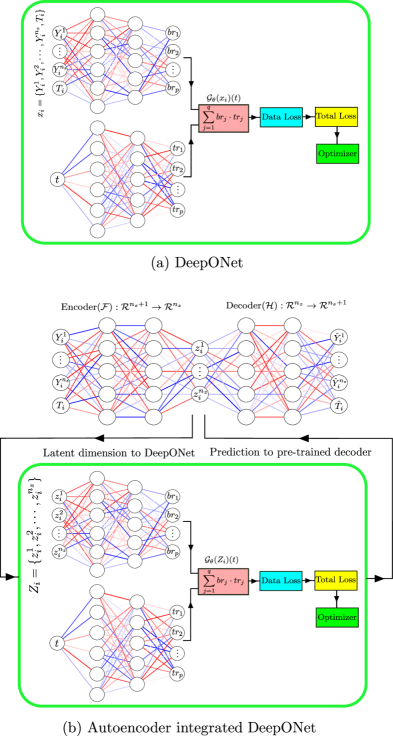
- 初期条件から時間発展した熱力学的状態への写像を学習するため、DeepONetアーキテクチャを採用する。
- 高次元の初期条件データを低次元の潜在空間に圧縮するために自己符号化器を統合し、トレーニングコストの低減と一般化性能の向上を図る。
- 多様な入力分布にわたる局所的近似精度を向上させるために、パartition-of-Unity (PoU-)DeepONetを用いる。
- 等価比と温度でパrameter化された合成初期条件および2次元乱流ジェット炎からの直接数値シミュレーションスナップショットを用いてモデルを訓練する。
- 学習の安定化と収束性の向上を図るため、トレーニングデータの対数値に正規化を適用する。
- 潜在予測からのフルステート解の再構成をデコーダーを用いて行い、元の状態空間における忠実性を保証する。
実験結果
リサーチクエスチョン
- RQ1DeepONetおよびその拡張は、硬化化学速度系の解伝播演算子を正確に学習し、一般化できるか?
- RQ2自己符号化器統合DeepONetフレームワークは、標準DeepONetと比較して、トレーニングコストと推論精度の面でどのように異なるか?
- RQ3訓練済みオペレータは、分布外の初期条件や長時間の進捗に対してどの程度外挿可能か?
- RQ4本フレームワークは、たとえば乱流CO/H₂ジェット炎のような複雑で現実世界の燃焼系に対しても高い精度を維持できるか?
- RQ5従来のスティフODEソルバーと比較して、推論時間とトレーニング効率の面での計算的利得はどの程度か?
主な発見
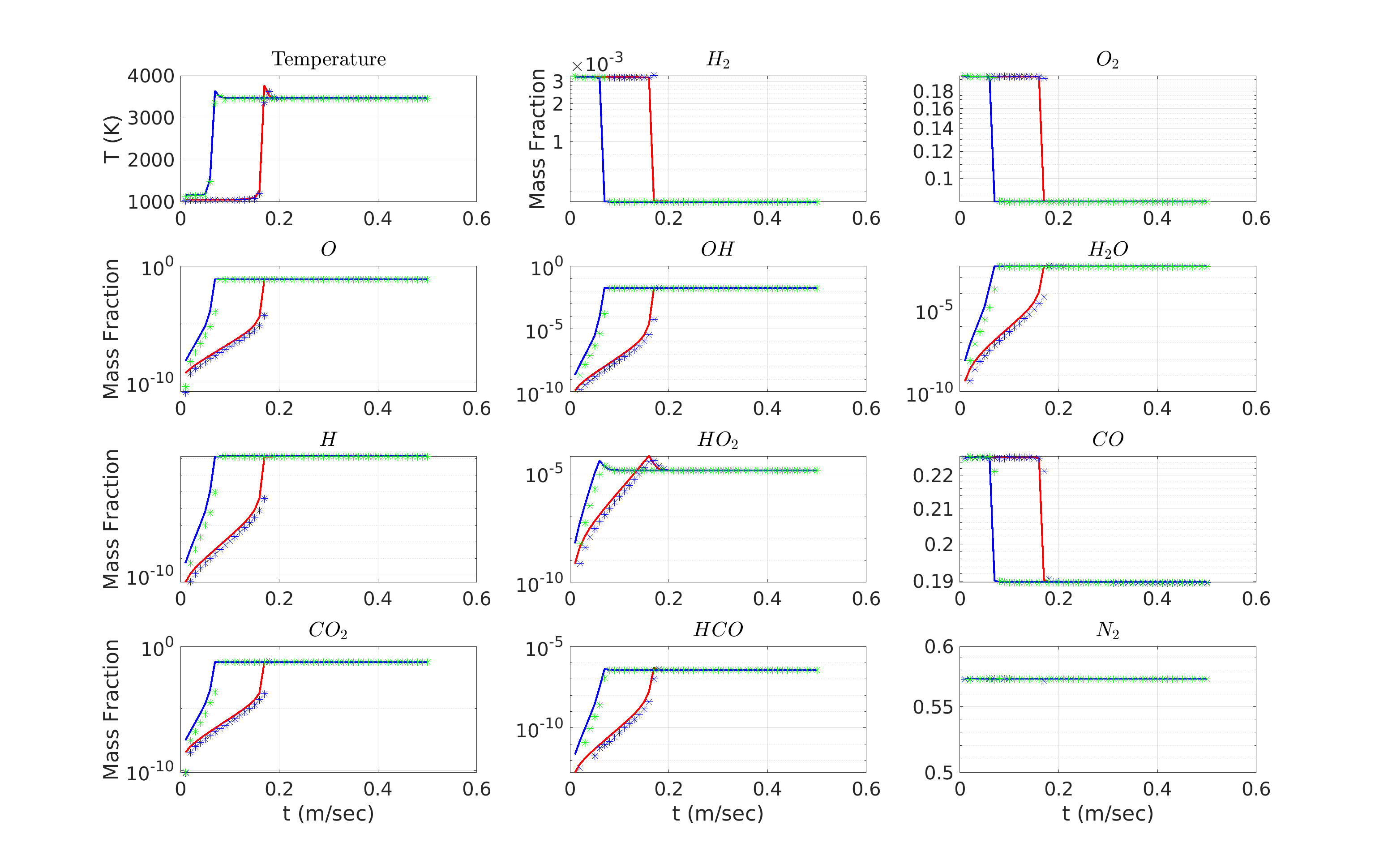
- 自己符号化器統合DeepONetは、合成ガスモデルにおいて潜在空間で平均相対L2誤差0.01%、再構成されたフルステート解においても0.01%を達成した。
- 例3ではAE+DeepONetを用いることでトレーニング時間が約5.7倍短縮され、例4では約3.8倍短縮された。
- 未知のテストサンプルにおける推論時間は約10⁻²秒であり、即時の解予測が可能となった。
- PoU-DeepONetおよびAE+DeepONetフレームワークは、ベンチマーク問題(ROBERS, POLLU)および現実の燃焼シナリオの両方で頑健な性能を示した。
- 訓練ウィンドウをはるかに超える時間スケールにわたり、外挿が成功しており、優れた一般化能力を示した。
- 物理的忠実性を保ちながら、従来のスティフ・ソルバーに比べて計算効率が著しく優れていた。
この論文を読む
Nubintのビューアで原文を開き、読みながら気になる箇所をすぐに質問できます。
Nubintでこの論文を読むこのレビューはAIが論文の原文をもとに作成しました。引用する前に原文をご確認ください。