
[論文レビュー] Measurement-induced entanglement and teleportation on a noisy quantum processor
この論文は、中間測定を回避するために時空双対性を活用することで、70量子ビットの超伝導量子プロセッサ上で測定誘発エンタングルメントおよびトランスポートを実証した。著者らはハイブリッド量子古典デコーディングプロトコルを用いて、異なる量子情報位相を診断し、ノイズが障害要因ではなく診断ツールとして機能することを明らかにした。これにより、NISQ時代のハードウェアで有限サイズの位相転移の兆候を観測可能となった。
Measurement has a special role in quantum theory: by collapsing the wavefunction it can enable phenomena such as teleportation and thereby alter the "arrow of time" that constrains unitary evolution. When integrated in many-body dynamics, measurements can lead to emergent patterns of quantum information in space-time that go beyond established paradigms for characterizing phases, either in or out of equilibrium. On present-day NISQ processors, the experimental realization of this physics is challenging due to noise, hardware limitations, and the stochastic nature of quantum measurement. Here we address each of these experimental challenges and investigate measurement-induced quantum information phases on up to 70 superconducting qubits. By leveraging the interchangeability of space and time, we use a duality mapping, to avoid mid-circuit measurement and access different manifestations of the underlying phases -- from entanglement scaling to measurement-induced teleportation -- in a unified way. We obtain finite-size signatures of a phase transition with a decoding protocol that correlates the experimental measurement record with classical simulation data. The phases display sharply different sensitivity to noise, which we exploit to turn an inherent hardware limitation into a useful diagnostic. Our work demonstrates an approach to realize measurement-induced physics at scales that are at the limits of current NISQ processors.
研究の動機と目的
- 中間測定やデコherenceといったハードウェア制限に直面しながらも、大規模NISQプロセッサ上で測定誘発量子情報位相を実験的に実現すること。
- 多数体量子系における確率的測定結果の課題に対処するため、後選別を回避するハイブリッド量子古典診断プロトコルの開発。
- ノイズと量子位相構造の相互作用を活用し、ハードウェアの制限を、異なるエンタングルメント位相を特定する診断ツールに転用すること。
- 実験データと古典的シミュレーションを関連付けるデコーディングプロトコルを用いて、監視された量子回路における有限サイズの位相転移の兆候を示すこと。
- 動的で測定が多数含まれる回路を、実験的に実装可能な静的かつ空間的に拡張された回路に変換するため、時空双対性の有効利用を検証すること。
提案手法
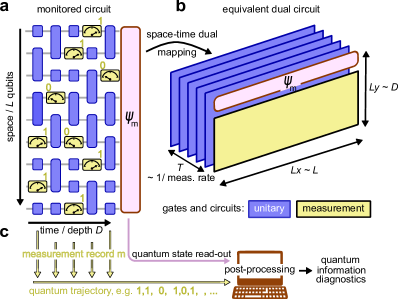
- 中間測定を含む1次元の監視付き量子回路を、すべての測定を最終時刻に集約した2次元の浅い回路に変換するため、時空双対性マッピングを用いる。これにより超伝導プロセッサでの実装が可能になる。
- SWAPゲートとアーキテクチャ用キュービットを用いて、元の回路からの量子状態を空間的に拡張されたアーキテクチャ用キュービットレジスタにトランスポートし、測定を回路の最終段階にずらす。
- サブセットのキュービットに対してランダム測定と後選別を実施し、第二リーマンエントロピーを推定することで、エンタングルメントスケーリングのプローブとする。
- 古典的シミュレーションと実験的結果を関連付けるハイブリッド量子古典順序パラメータ(交差エントロピーベンチマークに類似)を設計し、位相転移の検出を可能にする。
- 全系エントロピーに一致するベースラインのエントロピー密度を差し引くことで、ノイズ低減技術を適用し、真のエンタングルメントの兆候を分離する。
- 実験的測定記録と古典的シミュレーション軌道を比較するデコーディングプロトコルを用い、系の背後にある位相を同定する。
実験結果
リサーチクエスチョン
- RQ1ハードウェア制限に直面しながらも、70量子ビットの超伝導量子プロセッサ上で測定誘発エンタングルメントおよびトランスポートを実験的に実現できるか?
- RQ2時空双対性を活用することで、中間測定を回避し、監視付き量子回路のスケーラブルな実装を可能にする方法は何か?
- RQ3NISQデバイスにおけるノイズは、性能の低下要因としての役割を越えて、異なる量子情報位相を区別する診断ツールとして機能できるか?
- RQ4ハイブリッド量子古典デコーディングプロトコルを用いることで、実験データから観測できる有限サイズの位相転移の兆候は何か?
- RQ5エンタングルメントスケーリングおよびトランスポートの忠実度に対するノイズの感受性は、測定誘発位相ごとにどのように異なるか?
主な発見
- 著者らは、時空双対性を用いて中間測定を排除することで、最大70量子ビットの超伝導キュービット上で測定誘発量子情報位相の実現と診断に成功した。
- 実験的測定記録と古典的シミュレーションを関連付けるデコーディングプロトコルを通じて、体積則と領域則のエンタングルメント位相で顕著な異なる挙動が観測され、有限サイズの位相転移の兆候が確認された。
- ノイズに対する感受性が位相ごとに著しく異なり、一部の位相ではノイズがより耐性があり、ノイズが障害要因ではなく診断ツールとして再利用可能であることが示された。
- 第二リーマンエントロピーは、体積則と領域則のエンタングルメントと整合する明確なスケーリング行動を示し、ノイズ低減処理後のデータから明確な位相境界が特定された。
- ハイブリッド量子古典順序パラメータにより、後選別を必要とせず、確率的測定における非同調平均問題を克服し、非自明な量子情報構造の検出が可能になった。
- 実験結果は古典的シミュレーションとの比較により検証され、観測された位相において測定誘発トランスポートおよびエンタングルメントスケーリングの存在が裏付けられた。
この論文を読む
Nubintのビューアで原文を開き、読みながら気になる箇所をすぐに質問できます。
Nubintでこの論文を読むこのレビューはAIが論文の原文をもとに作成しました。引用する前に原文をご確認ください。