
[論文レビュー] MNISQ: A Large-Scale Quantum Circuit Dataset for Machine Learning on/for Quantum Computers in the NISQ era
MNISQは、NISQ時代の機械学習を目的とした大規模な495万件のデータポイントを有する量子回路データセットを提供する。古典的MNISTに類似したデータを量子回路およびQASM形式に符号化しており、量子カーネル法では97%の精度を達成し、古典的モデル(S4)ではQASMトークン化シーケンスで77%の精度を示す。これは、量子優位性の可能性と、量子データに対する古典的モデルの実用性の両方を示している。
We introduce the first large-scale dataset, MNISQ, for both the Quantum and the Classical Machine Learning community during the Noisy Intermediate-Scale Quantum era. MNISQ consists of 4,950,000 data points organized in 9 subdatasets. Building our dataset from the quantum encoding of classical information (e.g., MNIST dataset), we deliver a dataset in a dual form: in quantum form, as circuits, and in classical form, as quantum circuit descriptions (quantum programming language, QASM). In fact, also the Machine Learning research related to quantum computers undertakes a dual challenge: enhancing machine learning exploiting the power of quantum computers, while also leveraging state-of-the-art classical machine learning methodologies to help the advancement of quantum computing. Therefore, we perform circuit classification on our dataset, tackling the task with both quantum and classical models. In the quantum endeavor, we test our circuit dataset with Quantum Kernel methods, and we show excellent results up to $97\%$ accuracy. In the classical world, the underlying quantum mechanical structures within the quantum circuit data are not trivial. Nevertheless, we test our dataset on three classical models: Structured State Space sequence model (S4), Transformer and LSTM. In particular, the S4 model applied on the tokenized QASM sequences reaches an impressive $77\%$ accuracy. These findings illustrate that quantum circuit-related datasets are likely to be quantum advantageous, but also that state-of-the-art machine learning methodologies can competently classify and recognize quantum circuits. We finally entrust the quantum and classical machine learning community the fundamental challenge to build more quantum-classical datasets like ours and to build future benchmarks from our experiments. The dataset is accessible on GitHub and its circuits are easily run in qulacs or qiskit.
研究の動機と目的
- NISQ時代の機械学習における量子および古典的機械学習のベンチマークを目的とした、大規模かつ二重形式(量子回路およびQASM)のデータセットの作成。
- 量子回路分類タスクにおける量子モデルと古典的モデルの比較評価を可能にする。
- 量子回路データが最新の古典的モデルによって効果的に学習可能であることを示す一方で、量子優位性の可能性も示す。
- 将来の量子-古典的機械学習研究のための公開可能で再現可能なベンチマークを提供する。
提案手法
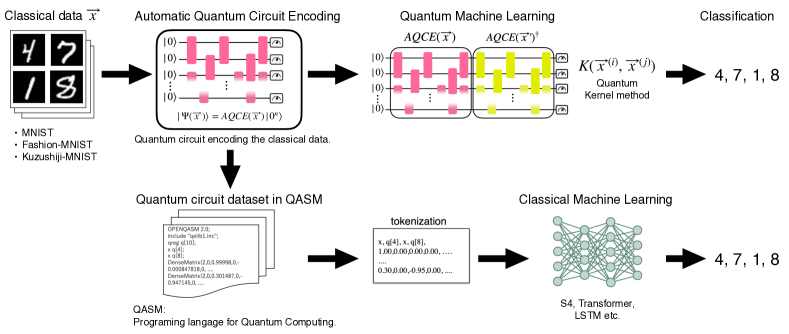
- 古典的画像データ(MNIST、Fashion-MNIST、Kuzushiji-MNIST)をアモニチュード符号化を用いて量子回路に変換することでデータセットを構築する。
- 各回路は2つの形式で表現される:量子回路(量子モデルの学習用)およびQASMコード(古典的モデルの学習用)。
- モデルの耐障害性を評価するため、データの忠実度(80%、90%、95%)に基づいて9つのサブデータセットに分割する。
- 古典的モデル(S4、Transformer、LSTM)は、数値を小数第3位まで切り捨てて離散トークンとみなしたQASMシーケンスのトークン化された形式で学習される。
- 分類の目的で、ヒルベルト=シュミットカーネルを用いて量子回路データに直接量子カーネル法を適用する。
- ハイパーパramータの最適化は、忠実度80%のmnist_786サブセットを検証用に用い、AdamWとコサインスケジューリング、重み減衰を併用する。
実験結果
リサーチクエスチョン
- RQ1QASM形式に符号化された量子回路を分類する際、非自明な量子力学的構造を持つデータに対して、古典的機械学習モデルが効果的に機能するか?
- RQ2量子回路データに対する量子カーネル学習は高い精度を達成するか? これは、このタスクにおける潜在的な量子優位性を示唆するか?
- RQ3量子回路データのノイズ(忠実度)が増加するにつれて、モデルの性能はどのように変化するか?
- RQ4S4、Transformer、LSTMといった最先端のシーケンスモデルは、QASM形式での量子回路表現に一般化可能か?
- RQ5MNISQデータセットは、将来の量子-古典的機械学習研究のベンチマークとして適しているか?
主な発見
- 量子カーネル法はMNISQデータセットでテスト精度97%を達成し、量子回路分類タスクにおける優れた性能を示した。
- S4モデルは、同じタスクでQASMトークン化シーケンスに対して77%の精度を達成し、Transformer(58.84%)およびLSTM(55.68%)を上回った。
- 高忠実度データでは、古典的モデルがほぼベースライン性能(約55%)を示し、量子構造が非自明ではあるが学習可能であることを示した。
- TransformerおよびLSTMモデルは、データ忠実度の向上に伴い性能向上がほとんど見られず、回路表現におけるノイズに敏感でないことが示唆された。
- MNISQデータセットはGitHubで公開されており、完全なメタデータとチュートリアルを併記しており、将来の研究における再現可能なベンチマークを可能にしている。
- データセットはqulacsおよびQiskitでも実行可能であり、量子および古典的機械学習の実験に広くアクセス可能である。
![Figure 2: Schematic diagram of how to embed classical data into the probability amplitude of a quantum state the using the AQCE [ 20 ] algorithm.](https://ar5iv.labs.arxiv.org/html/2306.16627/assets/x2.png)
より良い研究を、今すぐ始めましょう
論文の読解から最終レビューまで、研究時間を劇的に削減しましょう。
クレジットカード登録不要
このレビューはAIが作成し、人間の編集者が確認しました。