
[論文レビュー] Near Delay-Optimal Scheduling of Batch Jobs in Multi-Server Systems
本稿では、新しいうちに優れた(NBU)サービス時間分布を有するマルチサーバーシステムにおけるバッチジョブに対して、近似的に遅延最適なスケジューリング方針—最少未割当タスク(FUT)、最短到着期限(EDD)、先着順(FCFS)—を提案する。FUTが平均遅延の最適値からの定数加法的遅延ギャップを達成することを証明し、FCFSが平均最大遅延およびp-ノルム遅延において最適値の2倍以内であることを示し、新規のサンプルパス確率的順序付け技法を用いる。
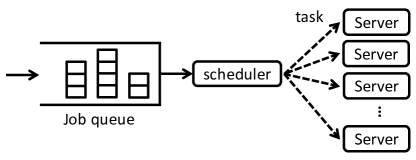
We study a class of scheduling problems, where each job is divided into a batch of unit-size tasks and these tasks can be executed in parallel on multiple servers with New-Better-than-Used (NBU) service time distributions. While many delay optimality results are available for single-server queueing systems, generalizing these results to the multi-server case has been challenging. This motivated us to investigate near delay-optimal scheduling of batch jobs in multi-server queueing systems. We consider three lowcomplexity scheduling policies: the Fewest Unassigned Tasks first (FUT) policy, the Earliest Due Date first (EDD) policy, and the First-Come, First-Served (FCFS) policy. We prove that for arbitrary number, batch sizes, arrival times, and due times of the jobs, these scheduling policies are near delay-optimal in stochastic ordering for minimizing three classes of delay metrics among all causal and non-preemptive policies. In particular, the FUT policy is within a constant additive delay gap from the optimum for minimizing the mean average delay, and the FCFS policy within twice of the optimum for minimizing the mean maximum delay and the mean p-norm of delay. The key proof tools are several novel samplepath orderings, which can be used to compare the sample-path delay of different policies in a near-optimal sense.
研究の動機と目的
- 一般化された単一サーバー遅延最適結果をマルチサーバーシステムに拡張することが極めて困難であるという遅延最適スケジューリングの課題に対処する。
- マルチサーバー決定的システムにおける平均遅延最小化のNP困難性およびマルチクラスマルチサーバー設定における確率的スケジューリングの非効率性を克服する。
- 任意のジョブパラメータに対して、さまざまな遅延指標について、低複雑性で因果的かつ非プリエンプティブなスケジューリング方針を構築し、それらが証明可能な近似的最適性を有することを目的とする。
- 特定のシステムモデル仮定に依存しない、統一的なサンプルパス手法を用いてポリシー性能を比較するための確率的順序付けを確立する。
提案手法
- マルチサーバーシステムにおける因果的・非プリエンプティブなタスク割り当てを目的とした、低複雑性のスケジューリング方針(FUT、EDD、FCFS)を導入する。
- 異なるポリシーの遅延性能を比較するための新規なサンプルパス順序付けを用い、システムモデルの完全な仕様を必要とせずに確率的優位性の比較を可能にする。
- 確率的優位性($\leq_{\text{st}}$)および増加凸順序($\leq_{\text{icx}}$)などの確率的順序を用い、NBU分布下での残存サービス時間の上限を導出する。
- 指数分布の確率変数が残存NBUサービス時間の確率的支配的代理変数として機能することを活用し、完了遅延の上界を導出する。
- ポリシーの軌道間のカップリングを構築し、弱い作業効率順序を証明することで、あるポリシーが他の因果的・非プリエンプティブポリシーと比較して、サンプルパス遅延において常に同等以上に良好であることを保証する。
- 活性サーバー上の最大残存サービス時間の条件付き期待値を用いて遅延ギャップの解析的上限を導出し、記憶記憶性の性質と順序統計量の性質を活用する。
実験結果
リサーチクエスチョン
- RQ1任意のジョブパラメータおよびNBUサービス時間分布を有するマルチサーバーバッチジョブシステムにおいて、低複雑性スケジューリング方針は近似的に遅延最適性を達成可能か?
- RQ2FUT方針は最適平均平均遅延からどの程度近いか?最適値からの加法的遅延ギャップは何か?
- RQ3FCFS方針は平均最大遅延および遅延のp-ノルムを最小化する際に、どの程度の性能保証を得られるか?
- RQ4システム固有の仮定に依存せずに、異なるスケジューリング方針間の遅延を比較する統一的なサンプルパス手法を開発可能か?
- RQ5FUT、EDD、FCFS方針が一般クラスの遅延指標について、どのような条件下で近似的に遅延最適性を達成するか?
主な発見
- FUT方針は、最適平均平均遅延からの定数加法的遅延ギャップを達成し、その上限はサーバーのサービスレートとジョブあたりのタスク数にのみ依存する。
- FCFS方針は、平均最大遅延および平均$ p $-ノルム遅延の両方において、最適値の2倍以内に収まり、乗法的性能保証を提供する。
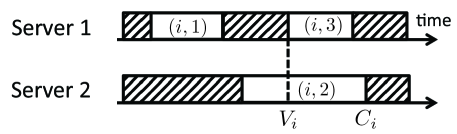
- FUT方針において、すべてのタスクが割り当てられた時点以降の期待完了遅延は、$\sum_{l=1}^{k_i \wedge m} \frac{1}{\sum_{j=1}^{l} \mu_j}$ で上限が与えられ、さらに $\ln(k_i \wedge m) + 1$ によって上界が与えられる。
- NBU分布下での部分的に完了したタスクの残存サービス時間は、同じ平均を持つ指数分布の確率変数に確率的に支配され、これにより取り扱いやすい上限が得られる。
- サンプルパス手法により、FUTは任意の他の因果的・非プリエンプティブ方針よりも弱く作業効率が高く、サンプルパス比較において遅延性能が常に優れているか等しいことが保証される。
- ジョブの到着時刻、到着期限、バッチサイズ、ジョブ数が任意であっても、定常分布が存在しない非定常到着過程に対しても、結果は有効である。
より良い研究を、今すぐ始めましょう
論文の読解から最終レビューまで、研究時間を劇的に削減しましょう。
クレジットカード登録不要
このレビューはAIが作成し、人間の編集者が確認しました。