
[論文レビュー] Toward Value-oriented Renewable Energy Forecasting: An Iterative Learning Approach
本稿では、二段階の運転コスト(日前・リアルタイムディスpatch)の期待値を最小化する価値志向型のポイント予測手法を提案する。予測モデルの訓練を二段階最適化問題として定式化することで、予測値を運用結果に段階的に合わせる。品質志向型手法と比較して総コストを15 %削減し、確率的プログラミングと比較して4,500倍高速である。
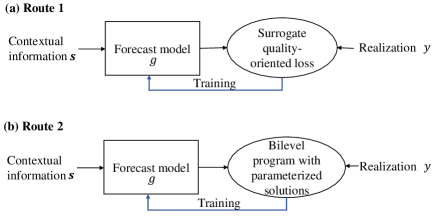
Energy forecasting is an essential task in power system operations. Operators usually issue forecasts and leverage them to schedule energy dispatch ahead of time. However, forecast models are typically developed in a way that overlooks the operational value of the forecasts. To bridge the gap, we design a value-oriented point forecasting approach for sequential energy dispatch problems with renewable energy sources. At the training phase, we align the loss function with the overall operation cost function, thereby achieving reduced operation costs. The forecast model parameter estimation is formulated as a bilevel program. Under mild assumptions, we convert the upper-level objective into an equivalent form using the dual solutions obtained from the lower-level operation problems. Additionally, a novel iterative solution strategy is proposed for the newly formulated bilevel program. Under such an iterative scheme, we show that the upper-level objective is locally linear regarding the forecast model output, and can act as the loss function. Numerical experiments demonstrate that, compared to commonly used statistical quality-oriented point forecasting methods, forecasts obtained by the proposed approach result in lower operation costs. Meanwhile, the proposed approach is more computationally efficient than traditional two-stage stochastic programs.
研究の動機と目的
- 電力系統ディスパッチにおける統計的に正確な予測とその実際の運用価値のギャップを解消すること。
- 日前およびリアルタイムエネルギーディスパッチにおける予想される運転コストを直接最適化する予測フレームワークの開発。
- 電力系統における標準的な「予測してから最適化する」パラダイムと併用可能な計算効率の高い予測を実現すること。
- 運用コストを最適化する予測が、統計的精度を最適化する予測よりも優れていることを示すこと、特に風力発電の導入率が高い状況下で顕著である。
- 予測モデルのパラメータを運用結果と二段階最適化を介して結びつけるスケーラブルで反復的な訓練フレームワークを確立すること。
提案手法
- 予測モデルの訓練を二段階計画問題として定式化:上位層では予測モデルのパラメータを最適化し、期待される二段階運転コストを最小化する。下位層では、予測値を入力として日前およびリアルタイムディスパッチ問題を解く。
- 上位層の損失関数を下位層最適化から得られる最適運転コストに基づいて導出する反復的解法戦略を採用する。
- 上位層の目的関数が予測モデル出力に関して局所的に線形であることを示し、勾配ベース最適化が可能であることを裏付ける。
- 予測に基づく運転コストと真の実現に基づく運転コストのレジットに基づく代理損失関数を採用し、効率的な学習を可能にする。
- 日前およびリアルタイム段階の両方で線形プログラミング(LP)定式化を用いた集中型風力発電ディスパッチ問題に本手法を適用する。
- 下位層ディスパッチ問題の解法と勾配降下法による予測モデルパラメータの更新を交互に繰り返すことで、二段階計画問題を反復的に解く。

実験結果
リサーチクエスチョン
- RQ1運用コストを最小化するように訓練された予測モデルが、実世界のディスパッチ問題において従来の品質志向型予測を上回るか。
- RQ2提案された価値志向型予測手法は、二段階確率的プログラミングと比較して計算効率に優れているか。
- RQ3二段階ディスパッチにおいて、予測精度(RMSEで測定)と運用コスト削減のトレードオフの程度はどの程度か。
- RQ4反復的二段階最適化学習フレームワークは、複数の時間期間にわたり予測出力と最適ディスパッチ意思決定を効果的に一致させているか。
- RQ5提案手法は、完全な確率的最適化を必要とせず、再生可能エネルギーの導入率が高い状況下でも低運転コストを維持できるか。
主な発見
- 提案手法は、RMSEがやや高いにもかかわらず、品質志向型予測手法と比較して平均総運転コストを15 %削減した。
- 提案手法の平均運転コストは2,036ドルであり、確率的プログラムの2,051ドルと比較して優れたコストパフォーマンスを示した。
- 計算時間は確率的プログラムの17.8秒から提案手法の3.99ミリ秒にまで短縮され、4,500倍の高速化が達成された。
- 提案手法では平均日前コストが2,106ドルであり、確率的プログラムの2,201ドルと比較してより効率的なスケジューリングが実現された。
- 提案手法ではリアルタイムコストが-70ドル(負の値)であり、バランス調整が効果的で罰則が低減しているのに対し、確率的プログラムでは-150ドルであった。
- 予測出力に関して損失関数が局所的に線形であることが維持されており、勾配降下法による安定的かつ効率的な最適化が可能である。
より良い研究を、今すぐ始めましょう
論文の読解から最終レビューまで、研究時間を劇的に削減しましょう。
クレジットカード登録不要
このレビューはAIが作成し、人間の編集者が確認しました。