
[論文レビュー] Warlock: an automated computational workflow for simulating spatially structured tumour evolution
Warlock は、2次元グリッド上で生物学的に現実的なパrameterを用いて、腫瘍内進化をデミー(deme)ベースのエージェントベースモデル(demon)で高速かつ並列にシミュレートできるオープンソースで Snakemake に依存する計算ワークフローである。この手法は、エージェントベースシミュレーションと解析的集団遺伝学を橋渡しし、多部位および単細胞シークエンシングデータとの直接比較を可能にすることで、モデル選択とパrameter推定を可能にする。
A primary goal of modern cancer research is to characterize tumour growth and evolution, to improve clinical forecasting and individualized treatment. Agent-based models support this endeavour but existing models either oversimplify spatial structure or are mathematically intractable. Here we present warlock, an open-source automated computational workflow for fast, efficient simulation of intratumour population genetics in any of a diverse set of spatial structures. Warlock encapsulates a deme-based oncology model (demon), designed to bridge the divide between agent-based simulations and analytical population genetics models, such as the spatial Moran process. Model output can be readily compared to multi-region and single-cell sequencing data for model selection or biological parameter inference. An interface for High Performance Computing permits hundreds of simulations to be run in parallel. We discuss prior applications of this workflow to investigating human cancer evolution.
研究の動機と目的
- 空間的腫瘍進化を研究する分野において、計算的に高負荷なエージェントベースモデルと数学的に取り扱いやすい集団遺伝学的モデルの間のギャップを埋めるため。
- 多様な空間的構造をカバーする、スケーラブルで再現可能かつアクセス可能な計算ワークフローを、腫瘍内集団遺伝学のシミュレーションに開発するため。
- High Performance Computing (HPC) における SLURM インテグレーションを活用し、数百のシミュレーションを効率的に並列実行するため。
- シミュレーション出力と多部位および単細胞シークエンシングデータとの直接比較を可能にし、モデルの妥当性評価とパrameter推定を実現するため。
- 計算腫瘍学者および集団遺伝学者がシミュレーション、解析、可視化を統合した使いやすいオープンソースプラットフォームを提供するため。
提案手法
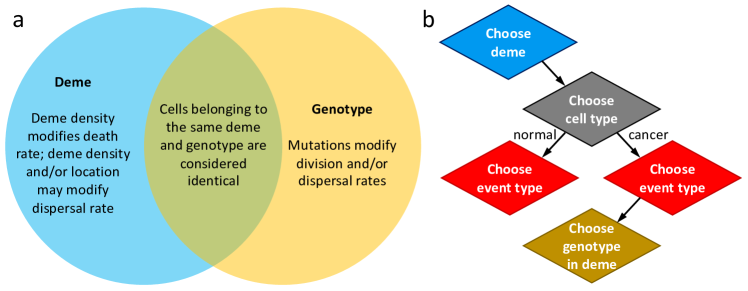
- 各デミーが2次元グリッド上に配置された均一混合細胞集団を表すデミー基盤の腫瘍学的モデル(demon)を採用し、細胞イベント(増殖、死滅、拡散)はギルスピー確率的シミュレーションアルゴリズムに従う。
- 個々の細胞ではなく、ゲノタイプおよびデミーの集団サイズを追跡することで計算効率を向上させ、イベント選択には二分探索木を用いる。
- 変異率(1回の細胞分裂あたり最大1つの変異)、無限サイト仮定下でのドライバーおよびパassingenger変異、および可変な細胞拡散モード(侵襲的またはデミー分裂型)といった生物学的に現実的なパrameterをサポートする。
- Snakemake を用いて計算ワークフローを自動化し、ローカル環境および HPC 環境での実行を可能にし、SLURM ワークロードマネージャーとの統合を支援する。
- 依存関係管理に Anaconda を統合し、結果の後処理および可視化のための R パッケージ(demonanalysis)を提供する。
- 正常組織への侵襲をシミュレート可能で、正常細胞は増殖・死滅するが変異や拡散は行わないため、腫瘍発症初期段階の進化を研究可能である。
実験結果
リサーチクエスチョン
- RQ1空間的構造は、腺腫瘍における腫瘍内遺伝的ヘテロネアティの出現とダイナミクスにどのように影響を与えるか?
- RQ2異なる空間的配置のもとでのシミュレートされた腫瘍進化は、ヒトがんの多部位シークエンシングデータで観察された進化パターンを再現できるか?
- RQ3変異アレル頻度分布や系統発生樹といったモデル出力は、生物学的パrameterの推定や、競合する進化モデルの選択にどの程度利用可能か?
- RQ4多様なパrameterセットの高スルーレットなシミュレーションは、感度分析およびモデル選択を効率的に行うためにどの程度可能か?
- RQ5HPC とモジュラーフレームワークで再現可能なワークフローの統合は、計算腫瘍学研究のシミュレーションパイプラインをどのように簡素化できるか?
主な発見
- Warlock は、HPC を介して並列実行可能な数百のシミュレーションを可能にし、多様な空間的構造における腫瘍内進化の高速かつスケーラブルなシミュレーションを実現する。
- デミー基盤のモデル(demon)は、空間的モーラン過程、エーデン成長、ボーター・モデルといった、集団遺伝学的プロセスの主要な側面を正確に再現する。
- シミュレーションの結果、腫瘍の構造的特徴(空間的制約や拡散モードの違い)が、ヒトのがんで観察される多様な進化モードを説明できることを示した。
- ミュラー図や空間的クローン分布といったモデル出力は、臨床的多部位および単細胞シークエンシングデータとの直接比較が可能で、モデル妥当性の検証に役立つ。
- このワークフローは、合成シークエンシングデータおよび系統発生樹の生成に成功し、バイオマーカーの同定や治療反応の予測に不可欠な要素を提供する。
- Snakemake、SLURM、Anaconda の統合により、再現性、ポータビリティ、さまざまな計算環境でのアクセス可能性が保証される。

この論文を読む
Nubintのビューアで原文を開き、読みながら気になる箇所をすぐに質問できます。
Nubintでこの論文を読むこのレビューはAIが論文の原文をもとに作成しました。引用する前に原文をご確認ください。