
[論文レビュー] Wigner Analysis of Particle Dynamics and Decoherence in Wide Nonharmonic Potentials
本稿では、散漫で非調和的ポテンシャルにおける粒子の運動を、デコherenceを伴って解析的に記述するためのウィグナー関数形式を展開する。フレーム変換と2つの主要な近似(一定角度近似および線形化デコherence近似)を用いることで、非線形で開放的量子系におけるマクロな量子重ね合わせ状態の正確なモデル化が可能となる。この手法は、非線形性およびデコherenceが無視できる極限においてガウス波パッケットの運動を回復する。
We derive an analytical expression of a Wigner function that approximately describes the time evolution of the one-dimensional motion of a particle in a nonharmonic potential. Our method involves two exact frame transformations, accounting for both the classical dynamics of the centroid of the initial state and the rotation and squeezing about that trajectory. Subsequently, we employ two crucial approximations, namely the constant-angle and linearized-decoherence approximations. These approximations are effective in the regime of wide potentials and small fluctuations, namely potentials that enable spatial expansions orders of magnitude larger than the one of the initial state but that remain smaller compared to the relevant dynamical length scale (e.g., distance between turning points). Our analytical result elucidates the interplay between classical and quantum physics and the impact of decoherence during nonlinear dynamics. This analytical result is instrumental to design, optimize and understand proposals using nonlinear dynamics to generate macroscopic quantum states of massive particles.
研究の動機と目的
- 広がりのある非調和的ポテンシャルに置かれた粒子のウィグナー関数の時間発展をモデル化すること。
- 位相空間の拡張が初期状態よりも数個のオーダー以上に大きい大規模量子ダイナミクスの領域を扱うこと。
- 古典的ダイナミクス、量子非線形性、デコherenceの相互作用を捉える解析的フレームワークを構築すること。
- 巨視的量子重ね合わせ状態を生成するためのプロトコルの設計および最適化のためのツールを提供すること。
- 弱い結合で高温バスターミナルにさらされる開放的量子系へ半古典的手法を拡張すること。
提案手法
- 古典的重心軌道のための正確なフレーム変換と、その周囲の回転および歪みのためのもう一つの正確なフレーム変換を適用する。
- 回転フレーム内での非線形ダイナミクスの統合を簡略化するために、一定角度近似を導入する。
- 高温バスターミナルおよび白色雑音ポテンシャルゆらぎへの弱い結合をモデル化するために、線形化デコherence近似を実装する。
- 変換されたフレーム内での時間発展ウィグナー関数の解析的表現を導出し、元のフレームに戻す。
- 二重井戸ポテンシャルにおける古典的転送点での干渉縞を記述するために、アイルリ関数形式を用いる。
- 非線形性およびデコherenceが無視できる極限において、ヘラーらのガウス波パッケットの運動を回復する。
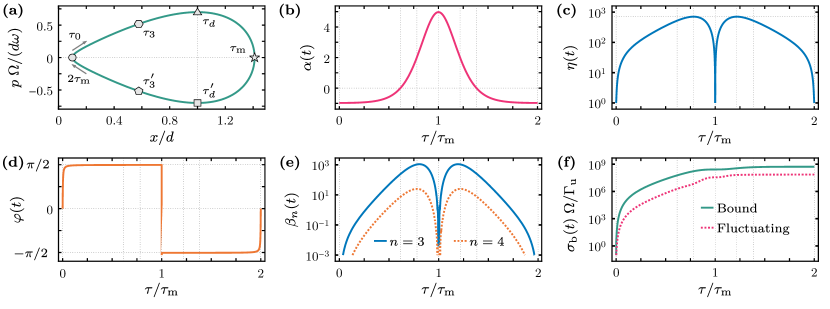
実験結果
リサーチクエスチョン
- RQ1広がりのある非調和的ポテンシャルに置かれた粒子に対して、ウィグナー関数をどのように解析的に近似できるか。
- RQ2大規模なコherent拡張と小さなゆらぎの領域において有効な近似は何か。
- RQ3非線形ダイナミクス中、デコherenceが干渉縞の周期にどのように影響を与えるか。
- RQ4どのような極限で、この手法が標準的なガウス波パッケットの運動を回復するか。
- RQ5この解析的フレームワークは、質量、ポテンシャルの深さ、制御パラメータなどの系パラメータと干渉縞間隔のスケーリング関係を予測できるか。
主な発見
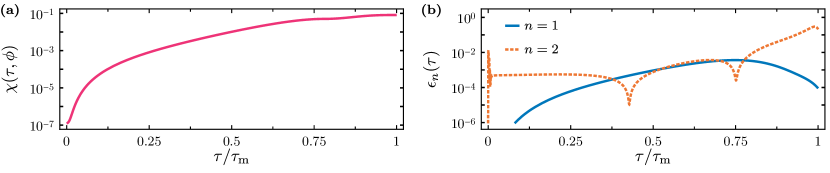
- 解析的ウィグナー関数は、ポテンシャルの長尺度が初期状態サイズよりもはるかに大きい場合に、弱いデコherenceを伴う広がりのある非調和的ポテンシャル内での粒子運動に対して優れた近似を与える。
- 転送点における干渉縞の間隔は、$ x_{\textrm{f}} \sim \left(\frac{\Omega}{\omega}\right)^{2/3} \left(\frac{1}{d}\right)^{1/3} f(x_{\textrm{s}}/d) $ とスケーリングする。ここで $ f $ は、正規化された初期変位 $ x_{\textrm{s}}/d $ のみに依存する。
- 非線形性およびデコherenceが無視できる極限において、本手法はヘラーらのガウス波パッケットの運動を回復する。
- 一定角度近似および線形化デコherence近似は、広がりのあるポテンシャルおよび小さなゆらぎの領域で有効であり、解析的取り扱いを可能にする。
- 干渉縞はアイルリ関数の積として記述され、確率分布は重心フレーム内でのウィグナー関数を用いた積分変換により導出される。
- 解析的結果により、非線形ダイナミクスを用いて巨視的量子重ね合わせ状態を生成するためのプロトコルの設計および最適化が可能になる。
より良い研究を、今すぐ始めましょう
論文の読解から最終レビューまで、研究時間を劇的に削減しましょう。
クレジットカード登録不要
このレビューはAIが作成し、人間の編集者が確認しました。