
[논문 리뷰] Curriculum reinforcement learning for quantum architecture search under hardware errors
CRLQAS는 노이즈가 있는 양자 환경에서 커리큘럼 기반 강화 학습을 양자 아키텍처 탐색에 도입하며, 3D 텐서 회로 인코딩, 불법적 행동, 무작위 중단, 그리고 Adam-SPSA 옵티마이저를 통해 현실적인 노이즈 하에서 여러 분자에 대해 화학 정확도(chemical accuracy)를 달성한다.
The key challenge in the noisy intermediate-scale quantum era is finding useful circuits compatible with current device limitations. Variational quantum algorithms (VQAs) offer a potential solution by fixing the circuit architecture and optimizing individual gate parameters in an external loop. However, parameter optimization can become intractable, and the overall performance of the algorithm depends heavily on the initially chosen circuit architecture. Several quantum architecture search (QAS) algorithms have been developed to design useful circuit architectures automatically. In the case of parameter optimization alone, noise effects have been observed to dramatically influence the performance of the optimizer and final outcomes, which is a key line of study. However, the effects of noise on the architecture search, which could be just as critical, are poorly understood. This work addresses this gap by introducing a curriculum-based reinforcement learning QAS (CRLQAS) algorithm designed to tackle challenges in realistic VQA deployment. The algorithm incorporates (i) a 3D architecture encoding and restrictions on environment dynamics to explore the search space of possible circuits efficiently, (ii) an episode halting scheme to steer the agent to find shorter circuits, and (iii) a novel variant of simultaneous perturbation stochastic approximation as an optimizer for faster convergence. To facilitate studies, we developed an optimized simulator for our algorithm, significantly improving computational efficiency in simulating noisy quantum circuits by employing the Pauli-transfer matrix formalism in the Pauli-Liouville basis. Numerical experiments focusing on quantum chemistry tasks demonstrate that CRLQAS outperforms existing QAS algorithms across several metrics in both noiseless and noisy environments.
연구 동기 및 목표
- NISQ 하드웨어 제약 하에서 VQE에 맞춘 PQC의 자동 설계를 고무한다.
- 회로 공간을 효율적으로 탐색하기 위한 커리큘럼 기반 RL QAS(CRLQAS) 프레임워크를 개발한다.
- 노이즈를 다루고 더 짧고 게이트 효율적인 회로를 촉진하는 메커니즘을 포함한다.
- Pauli-전이 행렬을 이용한 최적화된 노이즈 시뮬레이션 파이프라인과 GPU 가속을 제공한다.
제안 방법
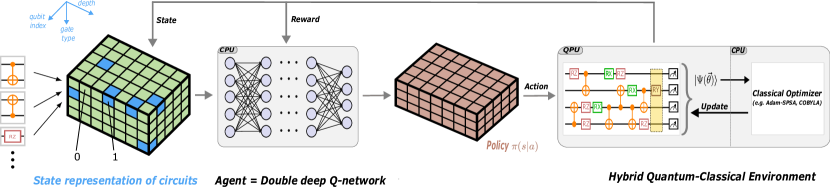
- 상태와 모멘트(깊이)를 표현하기 위한 양자 회로의 3D 텐서 기반 이진 인코딩.
- 유효하지 않거나 상쇄되는 게이트 시퀀스를 가지치기하기 위한 불법적 행동 메커니즘.
- 짧은 회로를 선호하도록 학습 편향을 주는 무작위 중단(RH).
- 적응 모멘텀과 가변 샷 예산을 갖춘 두 가지 Adam-SPSA 변형으로 노이즈 하에서 수렴 속도를 높인다.
- GPU 가속 오프라인 PTM 기반 노이즈 융합으로 더 큰 큐빗 수까지 빠른 노이즈 시뮬레이션을 가능하게 한다.
실험 결과
연구 질문
- RQ1교과과정 학습이 기존 방법과 비교하여 노이즈가 있는 VQA에서 QAS 성능을 어떻게 향상시킬 수 있는가?
- RQ2하드웨어 노이즈 하에서 작고 정확한 PQCs를 효율적으로 탐색하도록 가장 잘 작동하는 인코딩, 행동 가지치기, 최적화 전략은 무엇인가?
- RQ3CRLQAS가 현실적인 IBM 디바이스 노이즈 하에서 벤치마크 분자에 대해 화학 정확도를 달성할 수 있는가?
- RQ4PTM 기반의 빠른 노이즈 시뮬레이션이 학습 효율성과 스케일링에 어떤 영향을 미치는가?
주요 결과
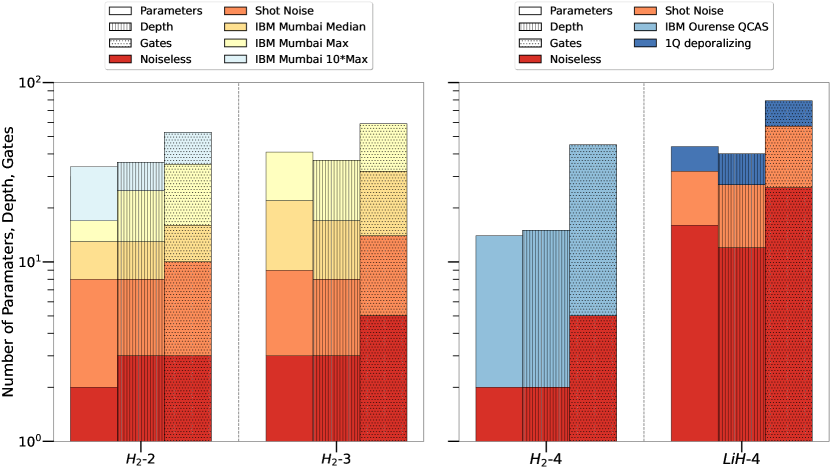
- CRLQAS는 H2(2–4 큐빗), LiH(4–6 큐빗), H2O(8 큐빗)에서 무노이즈 및 노이즈가 있는 VQE 작업에 대해 기존 QAS 방법들을 능가한다.
- CRLQAS는 여러 설정에서 더 적은 게이트와 더 얕은 깊이로 화학 정확도를 달성하며, 예를 들어 RH를 사용한 H2-4에서 표-주장의 맥락에서 에너지 오차가 약 8e-8에 근접한다.
- 현실적인 노이즈 하에서 CRLQAS는 선택된 분자와 노이즈 프로파일에 대해 화학 정확도 이내의 기저 상태 에너지를 산출하고, 기초 방법에 비해 회로 크기를 축소한다.
- 연속 감소와 다단계 유연성을 갖춘 Adam-SPSA 변형은 수렴 속도를 높여 함수 평가를 대략 절반으로 줄인다.
- GPU/JAX를 이용한 PTM 기반 오프라인 노이즈 융합은 학습 속도를 최대 6배까지 가속하고 확장 가능한 노이즈 시뮬레이션을 가능하게 한다.
이 논문 읽기
누빈트 뷰어에서 원문을 열고, 읽으면서 궁금한 곳을 바로 물어보세요.
누빈트에서 이 논문 읽기이 리뷰는 AI가 논문 원문을 바탕으로 만들었습니다. 인용하기 전에 원문을 확인해 주세요.