
[논문 리뷰] Effective bi-layer model Hamiltonian and density-matrix renormalization group study for the high-Tc superconductivity in La$_{3}$Ni$_{2}$O$_{7}$ under high pressure
본 논문은 고압 하에서 La3Ni2O7에 대해 효과적인 이중층 이온 궤도 모델을 제시하고 최소한의 설정에서 DMRG를 사용하여 경쟁적인 CDW 경향과 스핀-싱글렛 초전도 상관성을 보여주며, 층내 및 층간 페어링 채널을 시사한다.
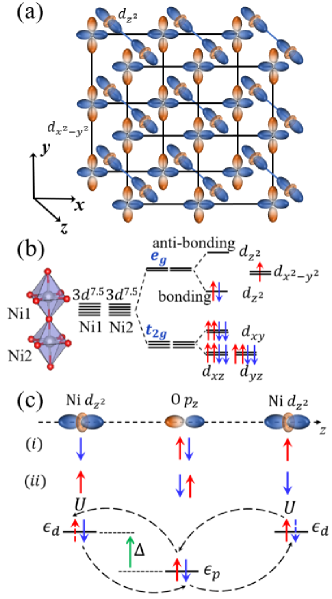
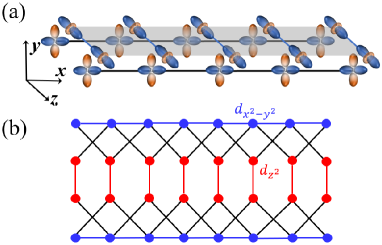
High-Tc superconductivity with possible $T_{c}\approx 80K$ has been reported in the single crystal of $ ext{La}_{3} ext{Ni}_{2} ext{O}_{7}$ under high pressure. Based on the electronic structure given from the density functional theory calculations, we propose an effective bi-layer model Hamiltonian including both $3d_{z^{2}}$ and $3d_{x^{2}-y^{2}}$ orbital electrons of the nickel cations. The main feature of the model is that the $3d_{z^{2}}$ electrons form inter-layer $σ$-bonding and anti-bonding bands via the apical oxygen anions between the two layers, while the $3d_{x^{2}-y^{2}}$ electrons hybridize with the $3d_{z^{2}}$ electrons within each NiO$_2$ plane. The chemical potential difference of these two orbital electrons ensures that the $3d_{z^{2}}$ orbitals are close to half-filling and the $3d_{x^{2}-y^{2}}$ orbitals are near quarter-filling. The strong on-site Hubbard repulsion of the $3d_{z^{2}}$ orbital electrons gives rise to an effective inter-layer antiferromagnetic spin super-exchange $J$. Applying pressure can self-dope holes on the $3d_{z^{2}}$ orbitals with the same amount of electrons doped on the $3d_{x^{2}-y^{2}}$ orbitals. By performing numerical density-matrix renormalization group calculations on a minimum setup and focusing on the limit of large $J$ and small doping of $3d_{z^{2}}$ orbitals, we find the superconducting instability on both the $3d_{z^{2}}$ and $3d_{x^{2}-y^{2}}$ orbitals by calculating the equal-time spin singlet pair-pair correlation function. Our numerical results have provided useful insights in the high-Tc superconductivity in single crystal La$_3$Ni$_2$O$_7$ under high pressure.
연구 동기 및 목표
- 궤도 해상 이중층 프레임워크를 통해 고압에서 La3Ni2O7의 고-Tc 초전도체 탐색 의욕을 자극한다.
- DFT 인사이트를 바탕으로 3d_{z^2} 및 3d_{x^2−y^2} 궤도를 포함하는 효과적인 이중층 모델을 구성한다.
- 단순 기하에서 수치 DMRG를 통해 기저 상태 특성과 가능한 초전도 불안정을 연구한다.
제안 방법
- 층간 3d_{z^2} 시그마-결합과 층내 3d_{x^2−y^2} 물리를 포함하는 효과적인 이중층 해밀토니안을 유도하며, 3d_{z^2}에 강한 온사이트 U를 포함한다.
- 층간 교환 J을 3d_{z^2} 스핀 사이에 포함시키고, 층 내에서 두 궤도를 연결하는 유한한 하이브리다이제이션 t_{x^{2}-y^{2},z^{2}}를 도입한다.
- t_{z^{2}}를 에너지 단위로 설정하고 t_{x^{2}-y^{y2}}=0.8, t_{x^{2}-y^{2},z^{2}}=0.4; z^2의 층내 홉핑은 무시하고 z^2에서 이중 점유를 금지한다.
- 최소 1D 설정(L=32)에서 DMRG를 사용하여 전하 밀도, 스핀 밀도 및 등시간 스핀-싱글렛 페어-페어 상관관계 D(i,j)를 계산한다.
- 큰 J와 작은 z^2 도핑 한계를 분석하여 가능한 CDW 패턴과 초전도 불안정을 식별한다.
실험 결과
연구 질문
- RQ1제안된 이중층 모델이 큰 J와 낮은 z^2 도핑 영역에서 초전도 상관관계를 지지하는가?
- RQ2두 궤도에서의 전하 밀도 파동(CDW) 패턴의 특징은 무엇이며, 이것이 잠재적 페어링 채널과 어떻게 상호작용하는가?
- RQ3어떤 궤도들이 주로 초전도성을 이끄는가, 이 프레임워크에서의 페어링의 성격은 무엇인가(층내 대 층간)?
- RQ4압력으로 유도된 자체 도핑이 3d_{z^2}와 3d_{x^2−y^2} 궤도 간의 구멍/전자 분포에 어떤 영향을 미치는가?
주요 결과
- DMRG 최소 설정에서 3d_{z^2} 전자에서 파장 5의 CDW 주문이 나타나고 3d_{x^2−y^2} 전자에서는 대략 파장 3이다.
- 핀닝 필드 하에서 두 궤도 모두 로컬 스핀 밀도가 짧은 범위에 머무르고 파라메트릭하며, 장거리 자기 순서가 없음을 시사한다.
- 등시간 스핀-싱글렛 페어-페어 상관관계가 두 궤도에서 대수적으로 감소하며, 지수는 3d_{z^2}에서 K_sc = 1.51(1), 3d_{x^2−y^2}에서 K_sc = 0.74(7)로 초전도성의 준장거리 경향을 시사한다.
- 3d_{z^2} 페어링은 층간 싱글렛 형성에 기인하고, 3d_{x^2−y^2} 페어링은 두 궤도 간의 하이브리다이제이션에서 기인한다.
- 층내 페어링은 3d_{x^2−y^2}에서 층간 페어링보다 강하며, 도민 전자와의 하이브리다이제이션을 통해 코히어런스를 얻는 페어링 시나리오와 일치한다.
이 논문 읽기
누빈트 뷰어에서 원문을 열고, 읽으면서 궁금한 곳을 바로 물어보세요.
누빈트에서 이 논문 읽기이 리뷰는 AI가 논문 원문을 바탕으로 만들었습니다. 인용하기 전에 원문을 확인해 주세요.