
[논문 리뷰] Measurement-induced entanglement transitions in quantum circuits of non-interacting fermions: Born-rule versus forced measurements
논문은 Born-rule과 monitoring된 Gaussian 회로에서의 강제 측정이 서로 다른 보편성 클래스에 속하며 엔트렝먼트 전이의 임계지수들이 다름을 보인다. 두 차원 주된 원리 비선형 시그마 모델에서 서로 다른 replica 극한으로 field-theoretic 이해를 제공한다.
We address entanglement transitions in monitored random quantum circuits of non-interacting fermions, in particular, the question of whether Born-rule and forced measurements yield the same universality class. For a generic circuit with no symmetry other than fermion parity, acting on a one-dimensional Majorana chain, we numerically obtain several critical exponents, providing clear evidence that the two transitions with Born-rule and forced measurements are in different universality classes. We provide a theoretical understanding for our numerical results by identifying the underlying statistical mechanics model which follows from the general correspondence, established in Jian et al., Phys. Rev. B 106, 134206, between non-unitary circuits of non-interacting fermions and the ten-fold Altland-Zirnbauer (AZ) symmetry classes. The AZ class is the same for Born-rule and forced measurements of the circuits. For the circuit under consideration (in AZ class DIII), the statistical mechanics model describing the transition is the principal chiral non-linear sigma model whose field variable is an ${ m SO}(n)$ matrix in the replica limits $n o 0$ and $n o 1$ for forced and Born-rule measurements, respectively. The former is in an Anderson localization universality class while we show that the latter is in a novel universality class beyond Anderson localization. Both entanglement transitions are driven by proliferation of $\mathbb{Z}_2$ topological defects. The different replica limits account for the difference in the universality classes. Furthermore, we provide numerical and symmetry-based arguments that the entanglement transition in the previously-studied monitored circuit of Majorana fermions based on the loop model with crossings, a highly fine-tuned circuit, belongs to a universality class different from both transitions in the generic circuits discussed in this paper.
연구 동기 및 목표
- 모든 경우를 알 수 있는 최소한의 대칭성(페르미온 페리티)을 가진 1D Majorana 체인의 모니터링된 Gaussian 회로에서 엔트렝먼트 전이를 조사한다.
- Born-rule과 강제 측정이 같은 보편성 클래스를 산출하는지 판단한다.
- AZ 대칭 분류에서 각 전이를 설명하는 기저 통계역학 모델을 확인한다.
제안 방법
- S^2의 단위 벡터에 의해 매개변수화된 Kraus 연산자를 갖는 가장 가까운 이웃의 두 사이트 게이트와 일반화된 측정을 사용하여 모니터링된 Gaussian 회로를 모델링한다.
- Born-rule과 강제 측정의 통계를 구분하고 그들의 replica 극한(n→0은 강제, n→1은 Born-rule)과의 관계를 밝힌다.
- 페르미니 표현을 통해 회로 역학을 Altland-Zirnbauer DIII 클래스의 정적 해밀토니안 문제로 매핑한다.
- SO(n)×SO(n) 대칭을 갖는 2차원 주된 원리 비선형 시그마 모델로 엔트렝먼트 전이를 기술한다.
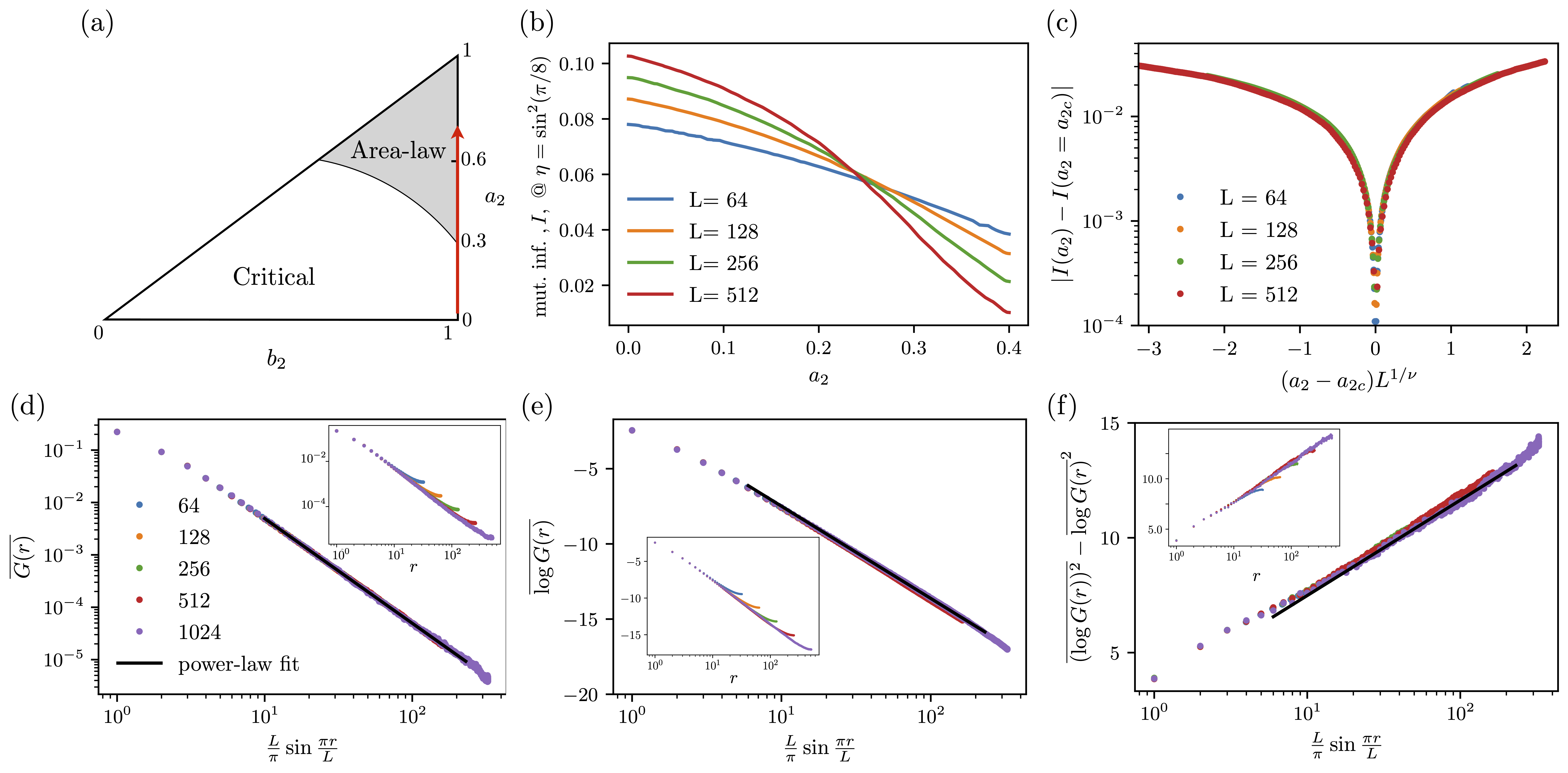
- 상관함수와 다중스케일(multifractal) 특성을 분석하여 임계 지수와 보편성 클래스를 구분한다.
실험 결과
연구 질문
- RQ1모니터링된 Gaussian 회로에서 비상호작용 페르미온의 Born-rule과 강제 측정이 엔트렝먼트 전이에 대해 같은 보편성 클래스에 속하는가?
- RQ2이러한 전이들을 설명하는 유효한 이론은 AZ 클래스 DIII 내에서 무엇인가?
- RQ3Replica 극한(n→0 대 n→1)이 전이에서의 임계 지수와 다중특성에 어떤 영향을 주는가?
- RQ4전이가 Z2 위상 결함의 증식에 의해 주도되는가, 그리고 이것이 Anderson localization과 어떤 차이가 있는가?
- RQ5관련 회로의 루프-모델(교차 포함)과 Born-rule/강제 측정 전이를 어떻게 비교하는가?
주요 결과
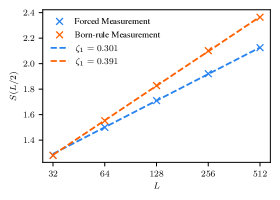
- Born-rule과 강제 측정은 Majorana 체인 회로에서 엔트렝먼트 전이가 서로 다른 보편성 클래스에 속한다.
- 두 전이는 모두 2차원 SO(n)×SO(n) 주된 원리 비선형 시그마 모델로 기술되며, replica 극한은 강제에서 n→0, Born-rule에서 n→1이다.
- 강제 측정은 동일한 AZ 클래스 내에서 Anderson localization 보편성 클래스로 매핑되며, Born-rule 측정은 Anderson localization을 넘어서는 새로운 보편성 클래스를 산출한다.
- 두 전이는 모두 Z2 위상 결함의 증식에 의해 주도되지만, 서로 다른 replica 극한으로 인해 임계 거동이 다르게 나타난다.
- 수치적 증거는 두 전이 간의 상관함수의 감쇠 지수 및 다중특성 스케일링이 다름을 보여준다.
이 논문 읽기
누빈트 뷰어에서 원문을 열고, 읽으면서 궁금한 곳을 바로 물어보세요.
누빈트에서 이 논문 읽기이 리뷰는 AI가 논문 원문을 바탕으로 만들었습니다. 인용하기 전에 원문을 확인해 주세요.