
[논문 리뷰] Representation-space diffusion models for generating periodic materials
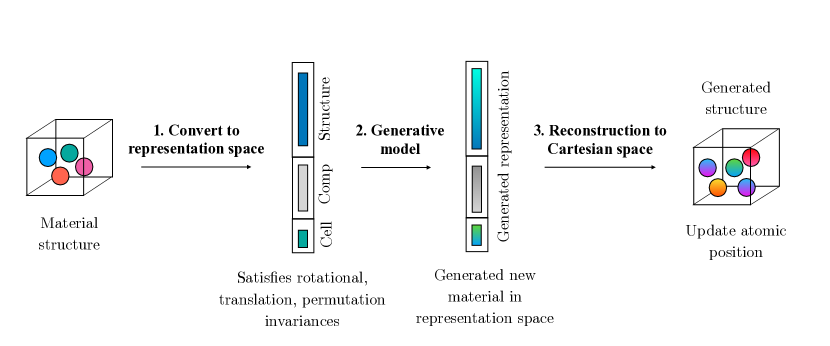
이 논문은 주기적 물질을 생성하기 위해 미분 가능하고 물리기반의 표현 공간에서 노이즈 제거를 수행하는 새로운 확산 모델인 StructRepDiff를 소개한다. 이 표현 공간은 결정 대칭성과 주기성을 자연스럽게 반영한다. 불변 구조적 기술자에 기반해 훈련하고, 기울기 기반 최적화를 통해 카르테시안 좌표를 재구성함으로써, 기존의 맞춤형 손실 함수 없이도 훈련을 단순화하고 불변성을 보장하면서도 벤치마크 데이터셋에서 최고 성능을 달성한다.
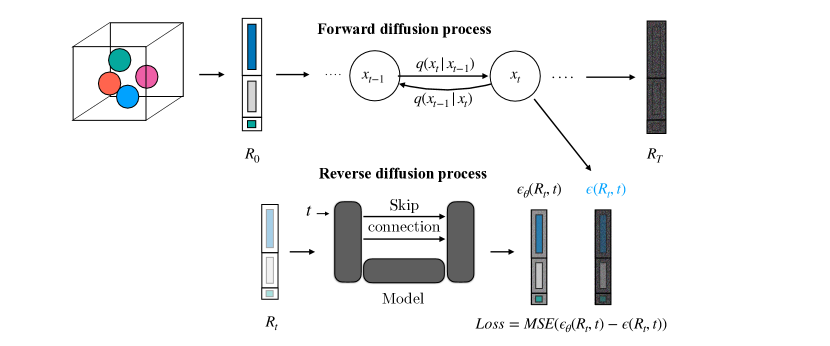
Generative models hold the promise of significantly expediting the materials design process when compared to traditional human-guided or rule-based methodologies. However, effectively generating high-quality periodic structures of materials on limited but diverse datasets remains an ongoing challenge. Here we propose a novel approach for periodic structure generation which fully respect the intrinsic symmetries, periodicity, and invariances of the structure space. Namely, we utilize differentiable, physics-based, structural descriptors which can describe periodic systems and satisfy the necessary invariances, in conjunction with a denoising diffusion model which generates new materials within this descriptor or representation space. Reconstruction is then performed on these representations using gradient-based optimization to recover the corresponding Cartesian positions of the crystal structure. This approach differs significantly from current methods by generating materials in the representation space, rather than in the Cartesian space, which is made possible using an efficient reconstruction algorithm. Consequently, known issues with respecting periodic boundaries and translational and rotational invariances during generation can be avoided, and the model training process can be greatly simplified. We show this approach is able to provide competitive performance on established benchmarks compared to current state-of-the-art methods.
연구 동기 및 목표
- 이동, 회전, 주기성에 대한 적절한 불변성을 갖춘 고품질 주기적 물질을 생성하는 데 도전하는 것.
- 기존 방법들이 카르테시안 공간에서 생성함으로써 대칭성과 경계 조건이 자주 위반되는 한계를 극복하는 것.
- 구조적 불변성을 자연스럽게 포함하는 표현 공간에서 작동함으로써 모델 훈련을 단순화하는 것.
- 통합적이고 미분 가능한 표현을 사용해 제한적이고 다양한 물질 데이터셋에서도 경쟁 가능한 생성 성능를 달성하는 것.
제안 방법
- 이동, 회전, 주기성에 대해 불변인, 미분 가능한 물리기반의 구조적 기술자를 사용하여 핵심 표현 공간을 구성한다.
- 이 표현 공간에 직접 확산 모델을 훈련시켜 대칭 제약 조건을 수동으로 처리할 필요 없이 새로운 물질 구조를 생성한다.
- 최종 표현 벡터는 구조적 기술자, 조성, 격자 세트 벡터를 조합하여 전체 결정 정보를 인코딩한다.
- 효율적인 기울기 기반 재구성 알고리즘이 단위 세포 내에서 생성된 표현을 3D 카르테시안 좌표로 변환한다.
- 대칭성 보장을 위해 맞춤형 스코어 함수나 아키텍처 수정을 추가로 필요로 하지 않으며, 표현 공간 자체가 이러한 성질을 보장한다.
- 이 방법은 어떤 미분 가능하고 불변인 표현에도 일반화 가능하므로, 현재 구현을 초월해 넓은 응용 가능성을 지닌다.
실험 결과
연구 질문
- RQ1결정 대칭성을 자연스럽게 반영하는 표현 공간에서 훈련된 확산 모델이 카르테시안 공간 기반 생성보다 주기적 물질 생성에서 뛰어난 성능을 낼 수 있는가?
- RQ2미분 가능하고 물리기반의 구조적 기술자를 사용할 경우, 원시 좌표 기반 모델 대비 훈련 안정성과 생성 품질이 어떻게 향상되는가?
- RQ3표현에서 기울기 기반 재구성으로 인해 결합 길이와 결정 대칭성이 얼마나 잘 유지되며, 높은 생성 정밀도를 유지할 수 있는가?
- RQ4표현 공간 기반 생성은 모델 아키텍처 내에서 복잡한 불변성 보장 구성 요소의 필요성을 줄이는가?
- RQ5다양한 물질 벤치마크에서 최고 수준의 모델과 비교해 성능 및 분포 커버리지 측면에서 어떻게 성과를 내는가?
주요 결과
- MP-20 데이터셋에서 StructRepDiff는 99.79%의 유효성, 99.67%의 커버리지, 0.673의 FID를 기록하여 세 지표에서 2위, 유효성에서는 1위를 기록했다.
- Perov-5 데이터셋에서 모델는 99.84%의 유효성, 99.79%의 커버리지, 0.289의 FID를 기록하여 FID에서는 2위, 유효성에서는 1위를 기록했다.
- Carbon-24 데이터셋에서 StructRepDiff는 100.00%의 유효성과 99.56%의 커버리지, FID 0.1187로 2위를 기록했다.
- PCA 공간에서 생성된 구조는 훈련 데이터 분포와 유사했으며, 그림 5에 나타나 있듯이 생성 샘플(빨간색)이 훈련 분포(검은색)를 완전히 커버했다.
- 모델는 정확한 ABX3 스토이키오메트리와 입방/왜곡된 입방 대칭성을 갖춘 퍼보스카이트를 성공적으로 생성했으며, 고도로 연결된 네트워크를 가진 탄소 구조도 생성했다.
- 속성 최적화나 조건부 생성 없이도 경쟁 가능한 성능를 보였으며, 이는 다양한 저자원 데이터셋에서의 강건성과 일반화 능력을 입증한다.
이 논문 읽기
누빈트 뷰어에서 원문을 열고, 읽으면서 궁금한 곳을 바로 물어보세요.
누빈트에서 이 논문 읽기이 리뷰는 AI가 논문 원문을 바탕으로 만들었습니다. 인용하기 전에 원문을 확인해 주세요.