
[논문 리뷰] RoboScript: Code Generation for Free-Form Manipulation Tasks across Real and Simulation
RoboScript는 시뮬레이션 및 실제 환경 배포를 위한 고수준 언어 지시어에서 실행 가능한 로봇 제어 코드로 이어지는 통합된 코드 생성 파이프라인을 소개한다. ROS, Gazebo, MoveIt와 통합함으로써 자연어에서 운동 계획에 이르기까지 엔드 투 엔드 실행을 가능하게 하며, 추론 실험 결과 perception 노이즈로 인해 성능이 최대 15.0% 하락함을 확인하여 실제 로봇 자율주행에서 정확한 perception의 핵심적 역할을 강조한다.
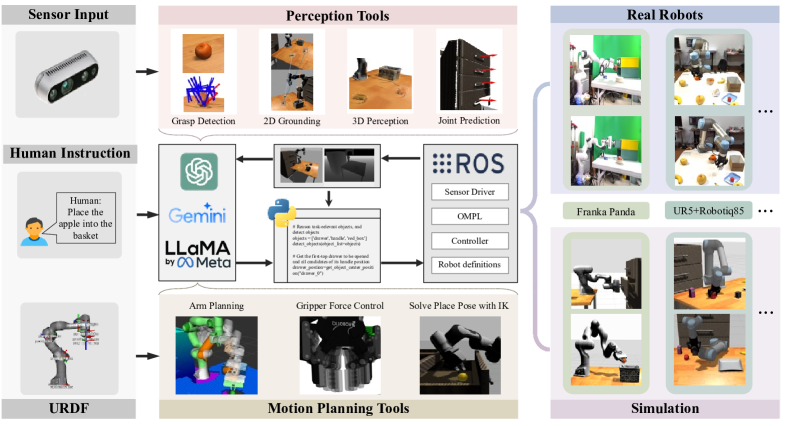
Rapid progress in high-level task planning and code generation for open-world robot manipulation has been witnessed in Embodied AI. However, previous studies put much effort into general common sense reasoning and task planning capabilities of large-scale language or multi-modal models, relatively little effort on ensuring the deployability of generated code on real robots, and other fundamental components of autonomous robot systems including robot perception, motion planning, and control. To bridge this ``ideal-to-real'' gap, this paper presents extbf{RobotScript}, a platform for 1) a deployable robot manipulation pipeline powered by code generation; and 2) a code generation benchmark for robot manipulation tasks in free-form natural language. The RobotScript platform addresses this gap by emphasizing the unified interface with both simulation and real robots, based on abstraction from the Robot Operating System (ROS), ensuring syntax compliance and simulation validation with Gazebo. We demonstrate the adaptability of our code generation framework across multiple robot embodiments, including the Franka and UR5 robot arms, and multiple grippers. Additionally, our benchmark assesses reasoning abilities for physical space and constraints, highlighting the differences between GPT-3.5, GPT-4, and Gemini in handling complex physical interactions. Finally, we present a thorough evaluation on the whole system, exploring how each module in the pipeline: code generation, perception, motion planning, and even object geometric properties, impact the overall performance of the system.
연구 동기 및 목표
- 자연어 지시어에서 배포 가능한 코드 생성을 가능하게 하여 로봇 조작 분야에서 '이상적 상태에서 실제 상태'로의 격차를 해소하기 위해.
- ROS 추상화를 통해 시뮬레이션(Gazebo)과 실제 로봇(Franka, UR5)을 모두 지원하는 통합 파이프라인을 개발하기 위해.
- 세マン틱 이해를 넘어서 물리적 공간, 제약 조건, 물체 성질에 대한 추론을 평가하는 벤치마크를 구축하기 위해.
- perception 정확도, 운동 계획의 견고성, 기하학적 성질이 시스템 성능에 미치는 영향을 평가하기 위해.
- conda 호환성 있는 ROS(Robostack)를 활용해 다양한 로봇 형태와 그립퍼 유형 간의 원활한 배포를 가능하게 하기 위해.
제안 방법
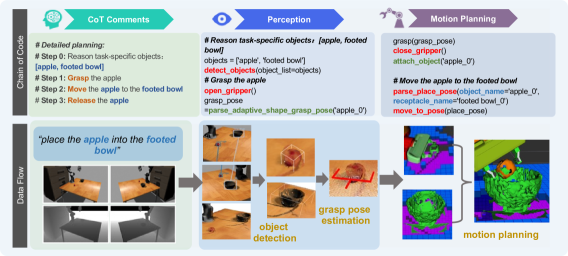
- 프레임워크는 모듈러한 파이프라인을 사용한다: RGBD 센서와 자연어 지시어에서 입력을 받고, AnyGrasp와 같은 perception 도구와 다중 시점 융합을 통한 3D 장면 재구성으로 처리한다.
- Perception 출력은 MoveIt 경유로 운동 계획에 공급되며, 역기구학과 충돌 회피를 통해 궤적을 생성한다.
- 모든 코드는 대규모 언어 모델(GPT-3.5, GPT-4, Gemini)을 사용해 생성되며, 문법 검증 및 Gazebo에서의 시뮬레이션 테스트를 통해 배포 가능성 확보한다.
- ROS 기반 코드 생성 테스팅 인터페이스를 통해 문법적 정확성을 보장하고, conda 호환성 있는 Robostack를 활용해 실제 로봇에 직접 배포 가능하다.
- perception-in-the-loop 파이프라인은 예측된 그립 자세와 경계 상자 정보를 계획에 입력으로 사용하며, 실제 환경의 perception 오차를 시뮬레이션한다.
- 포괄적인 벤치마크는 물리적 제약 조건, 작업 공간 한계, 물체 기하학적 성질에 대한 추론을 평가하며, 노이즈를 줄이기 위해 정답 데이터를 제공한다.
실험 결과
연구 질문
- RQ1perception 노이즈는 실제 로봇 배포 시 운동 계획의 성공률에 어떤 영향을 미치는가?
- RQ2GPT-4와 Gemini와 같은 LLM이 GPT-3.5보다 물리적 제약 조건과 물체 성질에 대한 추론에서 얼마나 뛰어나게 성능을 내는가?
- RQ3perception, 계획, 제어의 통합은 실제 환경에서의 로봇 조작 작업 성공률에 어떤 영향을 미치는가?
- RQ4로봇 형태(Franka 대비 UR5)와 그립퍼 유형은 코드 생성 및 작업 실행에 어떤 영향을 미치는가?
- RQ5통합된 코드 생성 파이프라인은 다양한 로봇 플랫폼 간에 안정적인 sim-to-real 전이를 보장할 수 있는가?
주요 결과
- perception 노이즈로 인해 피킹 앤 플레이스 작업과 도어 열기 작업에서 각각 14.0%와 15.0%의 성공률 감소가 발생하여 perception이 실제 환경에서의 주요 병목 요소임을 확인했다.
- 2D 기반 지정 오류로 인해 로봇 암이 포함된 잘못된 3D 경계 상자가 생성되어 MoveIt에서 해결 불가능한 자기 충돌이 발생하고 운동 계획 실패로 이어졌다.
- GPT-4는 GPT-3.5와 Gemini에 비해 물리적 제약 조건과 물체 기하학적 성질에 대한 추론에서 뛰어난 성능을 보였으며, 특히 복잡한 공간 추론 작업에서 두드러졌다.
- 시스템은 Franka Panda와 UR5에 모두 성공적으로 실제 환경에서 배포되었으며, 하드웨어 플랫폼 간 통합 파이프라인의 타당성을 입증했다.
- MoveIt의 운동 계획은 특히 물체 경계 상자가 확대되어 로봇 자체의 메쉬를 포함할 경우 감도가 매우 높게 반응하여 오류에 민감했다.
- 추론 실험 결과 perception 정확도의 부족이 운동 계획 또는 제어 오류보다 성능에 더 큰 영향을 미친다는 점을 확인하여 실제 시스템에서 견고한 perception이 필수적임을 강조했다.
이 논문 읽기
누빈트 뷰어에서 원문을 열고, 읽으면서 궁금한 곳을 바로 물어보세요.
누빈트에서 이 논문 읽기이 리뷰는 AI가 논문 원문을 바탕으로 만들었습니다. 인용하기 전에 원문을 확인해 주세요.