
[Paper Review] A multiple-circuit approach to quantum resource reduction with application to the quantum lattice Boltzmann method
This paper proposes a two-circuit quantum algorithm for the quantum lattice Boltzmann method (QLBM) that splits the solution of the 2D incompressible Navier–Stokes equations into separate quantum circuits for stream function and vorticity. By decoupling these components, the method reduces CNOT gate count by 35% and combined circuit depth by 16% compared to a single-circuit approach, with additional gains from concurrent execution, significantly improving quantum resource efficiency for near-term quantum hardware.
This work proposes a multi-circuit quantum lattice Boltzmann method (QLBM) algorithm that leverages parallel quantum computing to reduce quantum resource requirements. Computational fluid dynamics (CFD) simulations often entail a large computational burden on classical computers. At present, these simulations can require up to trillions of grid points and millions of time steps. To reduce costs, novel architectures like quantum computers may be intrinsically more efficient for these computations. Current quantum algorithms for solving CFD problems are based on single quantum circuits and, in many cases, use lattice-based methods. Current quantum devices are adorned with sufficient noise to make large and deep circuits untenable. We introduce a multiple-circuit algorithm for a quantum lattice Boltzmann method (QLBM) solve of the incompressible Navier--Stokes equations. The method, called QLBM-frugal, aims to create more practical quantum circuits and strategies for differential equation-based problems. The presented method is validated and demonstrated for 2D lid-driven cavity flow. The two-circuit algorithm shows a marked reduction in CNOT gates, which consume the majority of the runtime on quantum devices. Compared to the baseline QLBM technique, a two-circuit strategy shows increasingly large improvements in gate counts as the qubit size, or problem size, increases. For 64 lattice sites, the CNOT count was reduced by 35%, and the gate depth decreased by 16%. This strategy also enables concurrent circuit execution, further halving the seen gate depth.
Motivation & Objective
- To address the high quantum resource cost of existing single-circuit quantum algorithms for solving the Navier–Stokes equations via quantum lattice Boltzmann methods.
- To reduce the number of CNOT gates and circuit depth—key bottlenecks in current noisy intermediate-scale quantum (NISQ) devices—by decoupling the stream function and vorticity components.
- To enable more practical near-term quantum simulations of fluid dynamics by improving resource efficiency and allowing concurrent circuit execution.
- To validate the approach against classical LBM results on a benchmark 2D lid-driven cavity flow problem, ensuring accuracy while reducing quantum overhead.
Proposed method
- The method formulates the 2D Navier–Stokes equations using the stream function–vorticity formulation, eliminating the pressure term and reducing the problem to solving an advection–diffusion equation and a Poisson equation.
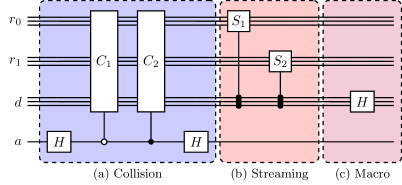
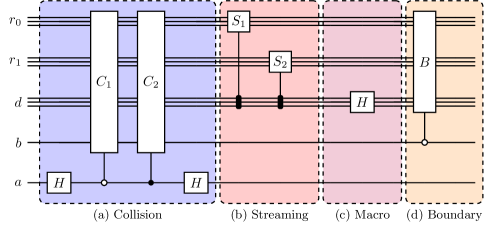
- It implements two separate quantum circuits: one for solving the vorticity transport equation and another for solving the Poisson equation to recover the stream function.
- Classical pre-computation of boundary conditions is used to reduce quantum circuit depth and CNOT gate count, improving resource efficiency.
- The two circuits are designed to be executed in parallel per time step, effectively halving the observed gate depth compared to sequential execution.
- Quantum circuits are synthesized using Qiskit’s transpiler, converting high-level operations into single-qubit and CNOT gates for hardware compatibility.
- The algorithm uses a D2Q5 lattice model with a grid size of 64×64, and quantum state preparation and measurement are performed via statevector simulation to verify correctness.
Experimental results
Research questions
- RQ1Can decoupling the stream function and vorticity components into separate quantum circuits reduce the total number of CNOT gates required for QLBM simulations of the Navier–Stokes equations?
- RQ2To what extent does concurrent execution of the two circuits reduce effective circuit depth and improve runtime efficiency on near-term quantum hardware?
- RQ3How does classical pre-computation of boundary conditions affect the quantum resource cost of the QLBM algorithm compared to full quantum encoding of boundaries?
- RQ4What is the accuracy of the two-circuit QLBM relative to classical LBM simulations for the 2D lid-driven cavity flow problem?
- RQ5Does the two-circuit approach maintain the same qubit scaling as prior single-circuit QLBM methods, enabling potential near-term implementation?
Key findings
- The two-circuit QLBM reduces the total CNOT gate count by 35% compared to the single-circuit implementation for a 64×64 grid.
- The combined circuit depth is reduced by 16% when the stream function and vorticity circuits are executed in parallel, effectively halving the observed depth.
- Classical pre-computation of boundary conditions reduces the CNOT count by at least 35%, with the vorticity circuit seeing a 75% reduction in CNOTs when boundaries are pre-computed.
- The relative error in stream function and vorticity between the quantum and classical LBM simulations is negligible, with errors below 1% in the lid-driven cavity test case.
- The method maintains qubit scaling of O(log M), where M is the grid size, which is more favorable than linear scaling and improves prospects for near-term implementation.
- The two-circuit approach simplifies algorithm design and improves fault tolerance by isolating the solution of different physical components into modular, independently executable circuits.
Read this paper
Open the full text in the Nubint reader and ask about any passage as you read.
Read this paper on NubintThis review was generated by AI from the original paper. Please check the paper before citing it.